Back
Maslow’s Hierarchy of Needs: Motivation in Psychology
Study Guide - Smart Notes
 Tailored notes based on your materials, expanded with key definitions, examples, and context.
Emotion and Motivation
Maslow’s Hierarchy of Needs
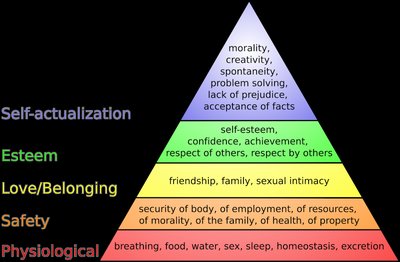
Maslow’s Hierarchy of Needs is a foundational theory in psychology that explains human motivation as a progression through a series of levels, each representing different types of needs. According to Abraham Maslow, individuals must satisfy lower-level needs before they can address higher-level needs. This model is often depicted as a pyramid, with basic needs at the bottom and more complex psychological needs at the top.
Physiological Needs: These are the most basic human requirements for survival, such as breathing, food, water, sex, sleep, homeostasis, and excretion. Without these, the body cannot function properly.
Safety Needs: Once physiological needs are met, individuals seek safety and security. This includes personal security, employment, resources, health, and property.
Love/Belonging Needs: Humans are social creatures and require relationships, friendship, family, and sexual intimacy to feel a sense of belonging.
Esteem Needs: After belongingness is fulfilled, people strive for self-esteem, confidence, achievement, and respect from others.
Self-Actualization: The highest level involves realizing one’s full potential, including morality, creativity, spontaneity, problem solving, lack of prejudice, and acceptance of facts.
Example: A student who is hungry and tired (physiological needs) will struggle to focus on schoolwork. Once these needs are met, the student may seek safety in a stable home environment, then develop friendships (love/belonging), strive for academic achievement (esteem), and finally pursue personal growth and creativity (self-actualization).
Additional info: Maslow’s theory is widely used in education, therapy, and organizational psychology to understand motivation and behavior. While the hierarchy is influential, modern research suggests that needs may not always be strictly hierarchical and can overlap.