 Back
BackMemory and Forgetting: Mechanisms, Models, and Experimental Evidence
Study Guide - Smart Notes
 Tailored notes based on your materials, expanded with key definitions, examples, and context.
Memory and Forgetting
Overview of Memory Processes
Memory is a fundamental cognitive process that involves encoding, storing, and retrieving information. Forgetting refers to the loss or alteration of information previously encoded in memory. This section explores key mechanisms, models, and experimental findings related to memory and forgetting.
Attention and Sensory Input
Bottleneck Model of Attention
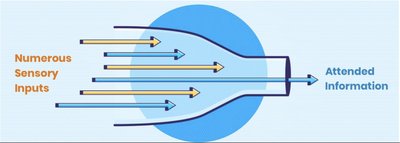
The bottleneck model of attention describes how the brain processes numerous sensory inputs but only a limited amount of information is attended to and processed further. This selective attention mechanism is crucial for efficient cognitive functioning.
Numerous Sensory Inputs: The environment provides a vast array of sensory information at any given moment.
Attended Information: Only a subset of this information passes through the attentional bottleneck to be consciously processed.
Example: In a noisy room, you may focus on one conversation while ignoring others.
Forgetting: Interference Theories
Proactive and Retroactive Interference
Interference theories explain forgetting as a result of competition between different memories. Two main types are proactive and retroactive interference.
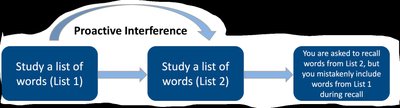
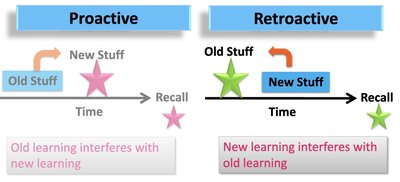
Proactive Interference: Old memories interfere with the retrieval of new information.
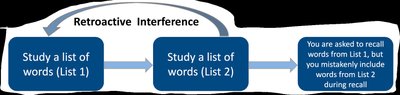
Retroactive Interference: New memories interfere with the retrieval of old information.
Example: If you learn List 1, then List 2, and mistakenly recall List 1 items when asked about List 2, this is proactive interference. If you recall List 2 items when asked about List 1, this is retroactive interference.
Short-Term Memory and Decay
Duration and Decay of Short-Term Memory
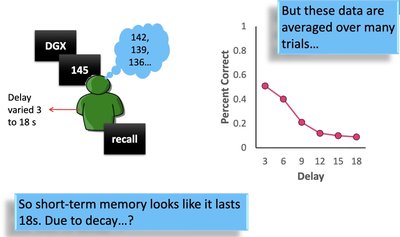
Short-term memory (STM) holds information temporarily for immediate use. Its duration is limited, and information decays rapidly unless actively maintained.
STM Duration: Typically lasts about 18 seconds without rehearsal.
Decay: The loss of information over time due to lack of rehearsal or interference.
Example: Remembering a sequence of numbers for a few seconds before recalling them.
Proactive Interference: Experimental Evidence
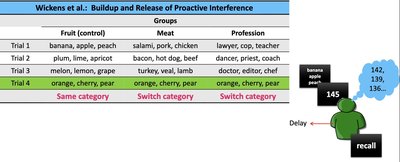
Wickens et al.: Buildup and Release of Proactive Interference
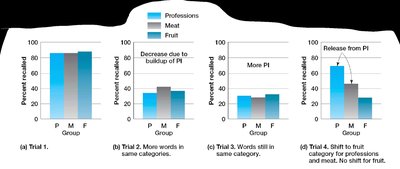
Wickens and colleagues demonstrated how proactive interference builds up with similar material and can be released by changing the category of information.
Buildup: Repeatedly recalling similar items (e.g., fruits) leads to increased interference and decreased recall.
Release: Switching to a new category (e.g., from fruits to professions) reduces interference and improves recall.
Trial | Fruit (control) | Meat | Profession |
|---|---|---|---|
1 | banana, apple, peach | salami, pork, chicken | lawyer, cop, teacher |
2 | plum, lime, apricot | bacon, hot dog, beef | dancer, priest, coach |
3 | melon, lemon, grape | turkey, veal, lamb | doctor, editor, chef |
4 | orange, cherry, pear | orange, cherry, pear | orange, cherry, pear |
Release from Proactive Interference (PI)
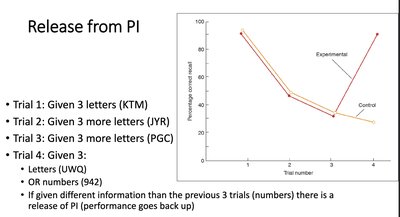
When the type of information changes after several similar trials, recall performance improves, indicating a release from proactive interference.
Experimental Design: Participants are given several trials with similar items, then a trial with different items (e.g., numbers instead of letters).
Result: Performance increases on the new category, demonstrating the release from PI.
Short-Term Memory Search: Sternberg Task
Sternberg Memory Scanning Paradigm
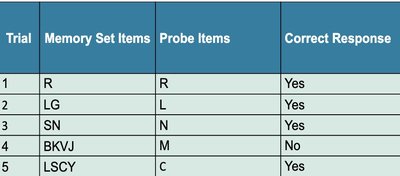
The Sternberg task investigates how people search for information in short-term memory. Participants are shown a set of items, then asked if a probe item was in the set.
Memory Set: A list of items to remember (e.g., letters or numbers).
Probe Item: A single item presented after the set; participant responds "yes" or "no" if it was in the set.
Correct Response: Indicates whether the probe was present in the memory set.
Trial | Memory Set Items | Probe Items | Correct Response |
|---|---|---|---|
1 | R | R | Yes |
2 | LG | L | Yes |
3 | SN | N | Yes |
4 | BKVJ | M | No |
5 | LSCY | C | Yes |
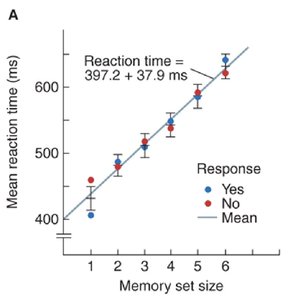
Reaction Time and Memory Set Size
Reaction time increases linearly with the number of items in the memory set, suggesting a serial search process in short-term memory.
Equation:
Interpretation: Each additional item adds a fixed amount of time to the search process.
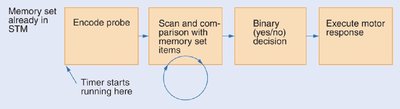
Stages of the Sternberg Task
The Sternberg task involves several cognitive stages:
Encoding the probe
Scanning and comparing with memory set items
Making a binary (yes/no) decision
Executing a motor response
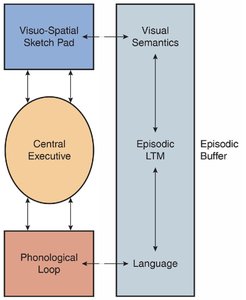
Working Memory Model
Baddeley and Hitch's Working Memory Model
Working memory is a multi-component system responsible for temporarily holding and manipulating information. Baddeley and Hitch proposed a model with three main components:
Central Executive: Directs attention and coordinates activities of the subsystems.
Phonological Loop: Handles verbal and auditory information.
Visuo-Spatial Sketchpad: Manages visual and spatial information.
Episodic Buffer: Integrates information across domains and links working memory with long-term memory.
Types of Long-Term Memory
Declarative and Nondeclarative Memory
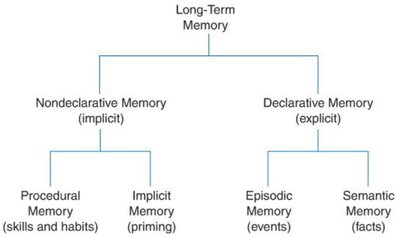
Long-term memory is divided into declarative (explicit) and nondeclarative (implicit) memory.
Declarative Memory: Conscious recall of facts and events. Includes episodic (events) and semantic (facts) memory.
Nondeclarative Memory: Unconscious memory for skills and habits (procedural) and priming effects.
Mnemonic Devices
Method of Loci
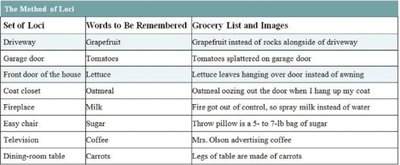
The method of loci is a mnemonic strategy that involves associating items to be remembered with specific locations in a familiar environment.
Set of Loci | Words to Be Remembered | Grocery List and Images |
|---|---|---|
Driveway | Grapefruit | Grapefruit instead of rocks alongside driveway |
Garage door | Tomatoes | Tomatoes splattered on garage door |
Front door of the house | Lettuce | Lettuce leaves hanging over door instead of awning |
Coat closet | Oatmeal | Oatmeal oozing out the door when I hang up my coat |
Fireplace | Milk | Fire got out of control, so spray milk instead of water |
Easy chair | Sugar | Throw pillow is a 5- to 7-lb bag of sugar |
Television | Coffee | Mrs. Olson advertising coffee |
Dining-room table | Carrots | Legs of table are made of carrots |
Peg Word System
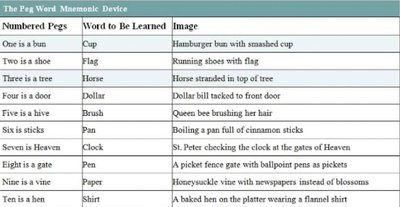
The peg word system is another mnemonic device that uses a fixed set of "peg" words associated with numbers to remember lists of items.
Numbered Pegs | Word to Be Learned | Image |
|---|---|---|
One is a bun | Cup | Hamburger bun with smashed cup |
Two is a shoe | Flag | Running shoes with flag |
Three is a tree | Horse | Horse stranded in top of tree |
Four is a door | Dollar | Dollar bill tacked to front door |
Five is a hive | Brush | Queen bee brushing her hair |
Six is sticks | Pan | Boiling a pan full of cinnamon sticks |
Seven is Heaven | Clock | St. Peter checking the clock at the gates of Heaven |
Eight is a gate | Pen | A picket fence gate with ballpoint pens as pickets |
Nine is a vine | Paper | Honeysuckle vine with newspapers instead of blossoms |
Ten is a hen | Shirt | A baked hen on the platter wearing a flannel shirt |
Other Mnemonic Devices
Other mnemonic devices include acronyms, acrostics, and visual imagery to aid memory.
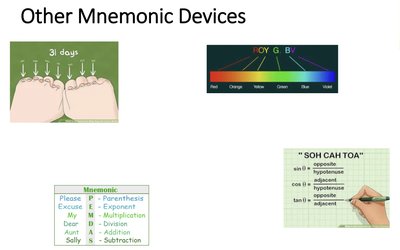
Acronyms: e.g., ROY G BIV for the colors of the rainbow.
Acrostics: e.g., "Please Excuse My Dear Aunt Sally" for the order of operations in math.
Visual Imagery: Creating vivid mental images to link information.
Forgetting Curves and Rehearsal
Ebbinghaus Forgetting Curve
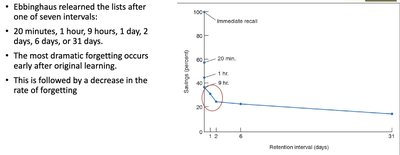
Hermann Ebbinghaus studied the rate at which information is forgotten over time. His forgetting curve shows rapid loss of information shortly after learning, followed by a slower rate of forgetting.
Intervals Tested: 20 minutes, 1 hour, 9 hours, 1 day, 2 days, 6 days, 31 days.
Key Finding: Most forgetting occurs soon after learning; the rate of forgetting decreases over time.
Effect of Rehearsal on Retention
Hellyer's (1962) research demonstrated that the more frequently an item is rehearsed, the better it is retained over time.
Probability of Recall: Increases with the number of rehearsals.
Retention Interval: Longer intervals lead to more forgetting, but rehearsal mitigates this effect.
Encoding and Retrieval
Encoding Specificity Principle
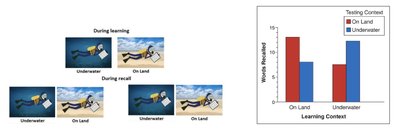
The encoding specificity principle states that memory is improved when information available at encoding is also available at retrieval. Context and cues play a significant role in successful recall.
Example: Learning words underwater and recalling them underwater leads to better performance than recalling them on land.
Summary Table: Types of Interference
Type of Interference | Definition | Example |
|---|---|---|
Proactive | Old information interferes with new learning | Recalling old phone number instead of new one |
Retroactive | New information interferes with old learning | Learning a new password makes it hard to remember the old one |
Additional info: Some explanations and examples have been expanded for clarity and completeness based on standard cognitive psychology textbooks.
