Back
BackMemory: Constructing and Reconstructing Our Pasts
Study Guide - Smart Notes
 Tailored notes based on your materials, expanded with key definitions, examples, and context.
Memory: Constructing and Reconstructing Our Pasts
Introduction to Memory
Memory is the process by which we retain information over time, allowing us to learn from experience and adapt to our environment. It is not a static record but a dynamic system that can be both remarkably accurate and surprisingly fallible.
Accuracy and Illusions in Memory
Memory Illusions: Sometimes, people recall events or details that never occurred. For example, recalling the word "sleep" from a list of sleep-related words, even though it was not present, demonstrates how memory can be influenced by associations.
Constructive Nature: Our brains often fill in gaps to make sense of incomplete information, which is generally adaptive but can lead to errors.
Memory Paradox: Memory can be both highly reliable (e.g., recalling entire books) and prone to significant errors (e.g., false memories).
Remarkable Memory Capacity
Exceptional Cases: Some individuals, such as those with hyperthymestic syndrome, can recall vast amounts of information, while others can perform extraordinary feats like memorizing thousands of digits of pi.
Reconstructive Memory: Remembering is an active process; we reconstruct memories, often adding details or perspectives that make sense but may not be accurate.
Types and Processes of Memory
Three Types of Memory
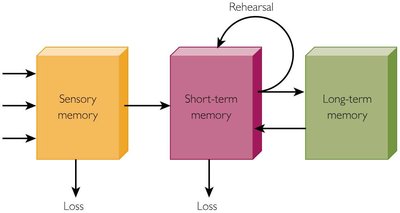
Memory is commonly divided into three systems, each with distinct functions, spans, and durations:
Sensory Memory: Briefly retains sensory information (e.g., iconic memory for visual input lasts about one second; echoic memory for auditory input lasts 5–10 seconds).
Short-Term Memory (STM): Holds information for about 5–20 seconds. Information can be lost through decay (fading over time) or interference (competition from other information).
Long-Term Memory (LTM): Stores information for extended periods, potentially for a lifetime. Errors in LTM are often semantic, while STM errors are more likely to be acoustic.
Sensory Memory
Each sense has its own sensory memory (e.g., iconic for vision, echoic for hearing).
Allows us to briefly retain impressions of sensory information.

Short-Term Memory
Capacity is about 7 ± 2 items (the "magic number").
Chunking: Grouping information into meaningful units increases STM capacity.
Rehearsal: Repeating information (maintenance rehearsal) or linking it meaningfully (elaborative rehearsal) extends STM duration.
Levels of Processing: Deeper processing (semantic) leads to better recall than shallow (visual or phonological) processing.
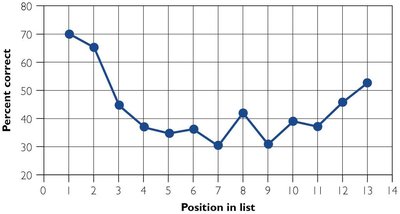
Serial Position Effects
Primacy Effect: Better recall for items at the beginning of a list.
Recency Effect: Better recall for items at the end of a list.
Distinctive items (e.g., unusual words) are also more likely to be remembered.
Subtypes of Long-Term Memory
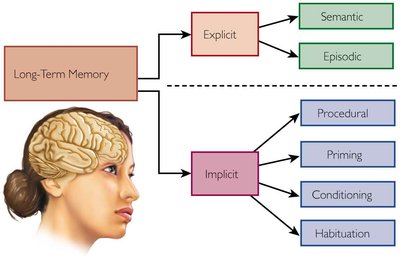
Explicit (Declarative) Memory: Memories we recall intentionally and consciously.
Semantic Memory: General knowledge and facts.
Episodic Memory: Personal experiences and events.
Implicit Memory: Memories we do not recall consciously.
Procedural Memory: How to perform tasks and skills.
Priming: Enhanced identification of stimuli after exposure to related stimuli.
Conditioning and Habituation: Learned associations and decreased response to repeated stimuli.
Encoding, Storage, and Retrieval
Encoding
Encoding is the process of getting information into memory. Attention is crucial for effective encoding, and most events are not encoded unless attended to. Mnemonics, such as rhymes, songs, and the method of loci, help link new information to existing knowledge.
Storage
Storage refers to maintaining information in memory. Schemas—organized knowledge structures—help us interpret and store information but can also lead to biases and errors by oversimplifying or "filling in gaps."
Retrieval
Retrieval is the process of reactivating or reconstructing information from memory. Failures of retrieval are common causes of forgetting. Retrieval cues (hints) can facilitate recall.
Recall: Generating information from memory.
Recognition: Identifying previously learned information among options.
Relearning: Learning information more quickly the second time.
Tip-of-the-Tongue Phenomenon
Occurs when we are confident we know information but cannot retrieve it immediately.
Often resolved with the right cue.
Distributed vs. Massed Practice
Distributed Practice: Studying information in small increments over time is more effective than cramming (massed practice).
Encoding Specificity
Memory retrieval is more effective when conditions at retrieval match those at encoding.
Context-Dependent Learning: Retrieval is better when the physical context matches.
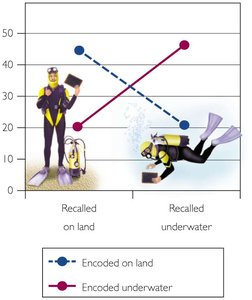
State-Dependent Learning: Retrieval is better when the internal state (mood, physiological state) matches the state during encoding.
Biological Basis of Memory
Neural Mechanisms
Memories are stored across various brain regions; there is no single "memory center."
Long-Term Potentiation (LTP): Repeated stimulation strengthens synaptic connections, facilitating learning and memory formation.
The hippocampus is crucial for forming new memories.
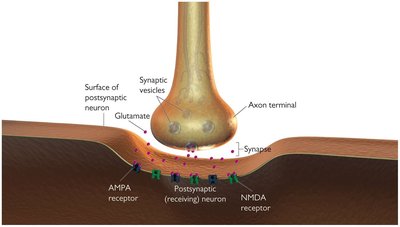
Amnesia
Retrograde Amnesia: Loss of past memories.
Anterograde Amnesia: Inability to form new memories.
Case studies (e.g., H.M., Clive Wearing) show that damage to the hippocampus impairs explicit memory but often spares implicit memory.
Emotional Memory
The amygdala and hippocampus interact to encode emotional and factual aspects of memories, respectively.
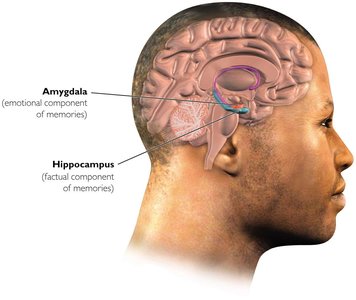
Memory Deterioration and Alzheimer’s Disease
Memory typically declines with age, especially after 65.
Alzheimer’s disease is the most common cause of dementia, characterized by memory and language loss due to cortical degeneration.
Active lifestyles and intellectual engagement are correlated with lower rates of Alzheimer’s, though causality is not established.
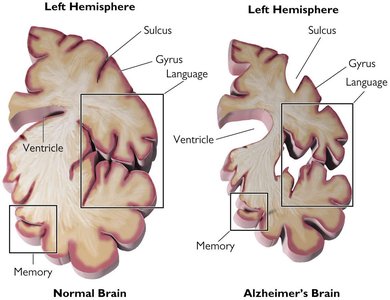
Development and Fallibility of Memory
Memory Development in Children
Children’s memory abilities become more sophisticated with age, increasing in span and conceptual understanding.
Meta-memory (awareness of one’s own memory processes) develops, allowing for better use of memory strategies.
Infantile Amnesia: Adults cannot recall memories from before ages 2–3, likely due to underdeveloped hippocampus and sense of self in infants.
False Memories and Memory Errors
Memories are susceptible to distortion and error.
Flashbulb Memories: Vivid, emotional memories that feel accurate but decline in accuracy over time.
Imagination Inflation: Imagining an event increases confidence that it occurred.
Source Monitoring Confusion: Difficulty distinguishing the origin of a memory, leading to memory illusions (e.g., cryptomnesia).
Suggestive Memory Techniques: Procedures that can implant false memories, such as the misinformation effect.
Eyewitness testimony is often unreliable; confidence does not equal accuracy.
Study Strategies Based on Memory Research
Pointer | Memory Concept |
|---|---|
Spread your study time out—review your notes and text in increments rather than cramming. | Distributed versus massed study |
Test yourself frequently on the material you’ve read. | Testing effect |
Connect new knowledge with existing knowledge rather than simply memorizing facts or names. | Elaborative rehearsal |
Work to process ideas deeply and meaningfully—avoid writing notes down word for word from instructors’ lectures or slides. Try to capture the information in your own words. | Levels of processing |
The more reminders or cues you can connect from your knowledge base to new material, the more likely you are to recall new material when tested. | Mnemonic devices |