 Back
BackMemory: Encoding, Storage, Retrieval, and Forgetting
Study Guide - Smart Notes
 Tailored notes based on your materials, expanded with key definitions, examples, and context.
Memory: An Overview
Memory is the persistence of learning over time through the processes of encoding, storage, and retrieval of information. It is fundamental to human cognition, allowing us to retain and use knowledge, skills, and experiences.
Evidence of Memory
Recall: Retrieving information learned earlier (e.g., fill-in-the-blank tests).
Recognition: Identifying previously learned items (e.g., multiple-choice tests).
Relearning: Assessing the amount of time saved when learning material again.
Measuring Retention
Retention is measured by recall, recognition, and relearning. Ebbinghaus' research demonstrated that repeated practice improves retention and that we remember more than we can recall.
Memory Models
Information-Processing Model
Compares human memory to computer operations.
Involves three processes: encoding, storage, and retrieval.
Connectionism Model
Focuses on multitrack, parallel processing.
Memories are products of interconnected neural networks.
Atkinson-Shiffrin Three-Stage Model
Sensory Memory: Immediate, brief recording of sensory information.
Short-Term Memory: Holds a few items briefly; information is encoded through rehearsal.
Long-Term Memory: Permanent and limitless storehouse for later retrieval.
Working Memory
Active processing of auditory, visual-spatial information, and information from long-term memory.
Central executive manages focused processing.
Encoding Memories
Dual-Track Memory: Effortful vs. Automatic Processing
Explicit Memory (Declarative): Facts and experiences consciously known and declared; encoded through effortful processing.
Implicit Memory (Nondeclarative): Skills and conditioned associations; encoded automatically, without conscious awareness.
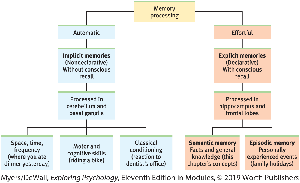
Automatic Processing and Implicit Memories
Includes procedural memory for automatic skills and classically conditioned associations.
Information about space, time, and frequency is processed automatically.
Effortful Processing and Explicit Memories
Sensory Memory: Feeds working memory with brief images (iconic) and sounds (echoic).
Iconic Memory: Visual stimuli, lasting a few tenths of a second.
Echoic Memory: Auditory stimuli, recalled within 3-4 seconds.
Short-Term Memory Capacity
Holds about 7 items (plus or minus 2) briefly.
Capacity varies by age and distractions.
Effortful Processing Strategies
Chunking: Organizing items into familiar, manageable units.
Mnemonics: Memory aids using imagery and organizational devices.
Hierarchies: Organizing information into broad categories subdivided into narrower concepts.
Distributed Practice
Spacing Effect: Encoding is more effective when spread over time.
Testing Effect: Enhanced memory after retrieving information, not just rereading it.
Levels of Processing
Shallow Processing: Encoding on a basic level (letters or sounds).
Deep Processing: Encoding semantically, based on meaning; leads to better retention.
Making Material Personally Meaningful
Information is remembered better when meaningful or related to personal experience (self-reference effect).
Memory Storage
Long-term memory storage is essentially limitless. Memories are distributed across networks in the brain, not stored in single locations.
Types of Long-Term Memory
Semantic Memory: Facts and general knowledge.
Episodic Memory: Personally experienced events.
Key Brain Structures
Hippocampus: Registers and temporarily holds explicit memories before consolidation.
Cerebellum: Forms and stores implicit memories from classical conditioning.
Basal Ganglia: Involved in procedural memories for skills.
Amygdala: Triggers emotional memories, especially during stress or excitement.
Synaptic Changes and Long-Term Potentiation (LTP)
LTP is an increase in a synapse’s firing potential after brief, rapid stimulation.
Believed to be a neural basis for learning and memory.
Research on Aplysia (sea slug) showed increased serotonin release and cell efficiency with learning.
Memory Retrieval
Retrieval Cues
Memories are stored in a web of associations; cues help retrieve them.
Priming: Activation of associations, often unconsciously.
Context-Dependent Memory: Recall improves when encoding and retrieval contexts match.
State-Dependent Memory: Emotions and moods serve as retrieval cues (mood-congruent memory).
Forgetting
Why Do We Forget?
Forgetting can occur at any memory stage due to encoding failure, storage decay, or retrieval failure.
Anterograde Amnesia: Inability to form new memories.
Retrograde Amnesia: Inability to retrieve past information.
Encoding Failure
Much of what we sense is never encoded and thus cannot be remembered.
Encoding lag is linked to age and inattention.
Storage Decay
Even well-encoded memories can fade over time.
Ebbinghaus’ forgetting curve shows rapid initial loss, then levels off.
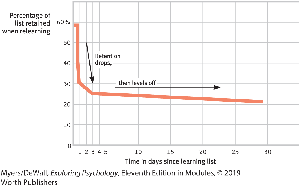
Retrieval Failure
Interference can block retrieval:
Proactive Interference: Old information disrupts new learning.
Retroactive Interference: New learning disrupts recall of old information.
Motivated Forgetting: Repression of painful memories (rarely supported by current research).
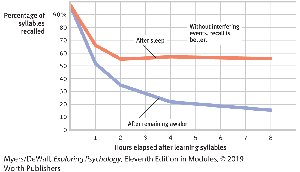
Memory Construction Errors
Memory is Not Precise
Memories are reconstructed, not replayed exactly.
Reconsolidation: Retrieved memories can be altered before being stored again.
Misinformation and Imagination Effects
Misinformation Effect: Memories can be corrupted by misleading information.
Imagination inflation: Imagining fake events can create false memories.
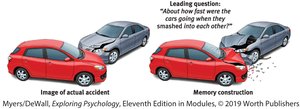
Source Amnesia and Déjà Vu
Source Amnesia: Attributing a memory to the wrong source.
Déjà Vu: The feeling of having experienced something before, possibly due to unconscious retrieval cues.
Discerning True and False Memories
False memories feel real but are usually limited to the gist of events.
Eyewitness testimony can be unreliable due to memory construction errors.
Improving Memory
Use the SQ3R method: Survey, Question, Read, Retrieve, Review.
Rehearse repeatedly and make material meaningful.
Activate retrieval cues and use mnemonic devices.
Minimize interference, sleep more, and test your knowledge regularly.
