 Back
Back8. Memory: Models, Forgetting, and Constructive Processes
Study Guide - Smart Notes
 Tailored notes based on your materials, expanded with key definitions, examples, and context.
Memory: Models, Forgetting, and Constructive Processes
Memory Techniques and the Modal Model
Memory is a complex cognitive process involving the encoding, storage, and retrieval of information. One influential framework for understanding memory is the Modal Model, which divides memory into distinct stores.
Modal Model of Memory: Proposes three main memory stores: Sensory Memory, Short-Term Memory (STM), and Long-Term Memory (LTM).
Sensory Memory: Briefly holds sensory information (e.g., visual, auditory) for a fraction of a second.
Short-Term Memory: Temporarily holds information for processing (typically 15–30 seconds).
Long-Term Memory: Stores information over extended periods, potentially for a lifetime.
Serial Position Curve: Demonstrates the primacy effect (better recall for items at the beginning of a list) and recency effect (better recall for items at the end).
Is the Modal Model too simple? Evidence suggests memory is more complex, with multiple interacting systems.


Theories of Forgetting
Forgetting is a natural part of memory, and several theories attempt to explain why it occurs.
Decay Theory: Suggests that memories fade over time if not accessed. However, research (e.g., Jenkins & Dallenbach) indicates that interference, not just time, plays a major role.
Interference Theory: Proposes that forgetting occurs because other information interferes with retrieval.
Retroactive Interference: New learning disrupts recall of previously learned information.
Proactive Interference: Previously learned information interferes with learning new information.
Encoding vs. Retrieval: Forgetting can result from failures at either the encoding or retrieval stage.
Example: If you learn a list of words before sleeping, you may remember them better than if you stay awake, due to reduced interference during sleep (Jenkins & Dallenbach experiment).
Amnesia and Types of Long-Term Memory Loss
Amnesia is a clinical condition characterized by severe memory loss. It can be classified by direction and source:
Retrograde Amnesia: Loss of memories formed before the onset of amnesia.
Anterograde Amnesia: Inability to form new long-term memories after the onset of amnesia.
Organic Amnesia: Caused by physical damage to the brain (e.g., injury, disease).
Functional Amnesia: Results from psychological factors (e.g., trauma).
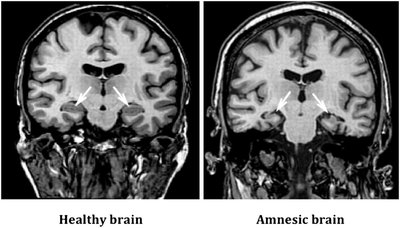
Case Study Example: Patient N.C. could remember old memories and maintain short-term memory, but could not form new long-term memories (anterograde amnesia). However, some forms of learning, such as priming and procedural memory (e.g., mirror tracing), remained intact.
Types of Long-Term Memory
Long-term memory is not a single system but consists of multiple types:
Explicit (Declarative) Memory: Conscious recollection of facts and events.
Episodic Memory: Memory for personal experiences (e.g., what you ate yesterday).
Semantic Memory: General knowledge and facts (e.g., cheese comes from cows).
Implicit Memory: Unconscious memory for skills and procedures (e.g., riding a bike, making a burrito).
Additional info: Dissociations between explicit and implicit memory in amnesic patients provide evidence for multiple memory systems.
Memory as a Constructive Process
Memory is not a perfect recording of events. Instead, it is a reconstructive process, similar to perception, where memories are built from stored information and influenced by schemas and expectations.
Constructive Memory: Memories can be altered or distorted by new information, suggestions, or expectations.
Elizabeth Loftus (1975): Demonstrated that the way questions are framed can influence what people remember (e.g., asking about a barn in a video where none appeared led some participants to falsely remember seeing one).
Example: After watching a video, participants were more likely to "remember" seeing a barn if the question implied its presence.
Summary Table: Types of Long-Term Memory
Type | Description | Example |
|---|---|---|
Explicit (Declarative) | Conscious recall of facts/events | Remembering your last birthday |
Episodic | Personal experiences | Recalling a vacation |
Semantic | General knowledge | Knowing Paris is the capital of France |
Implicit (Nondeclarative) | Unconscious skills/procedures | Riding a bicycle |
Procedural | Motor and cognitive skills | Typing on a keyboard |
Key Takeaways
Memory is not a unitary phenomenon; it consists of multiple systems and processes.
Forgetting can result from decay, interference, or retrieval failures.
Amnesia provides insight into the different types of memory and their neural bases.
Memory is inherently constructive and subject to distortion.
