 Back
Memory: Processes, Models, and Disorders in Introduction to Psychology
Study Guide - Smart Notes
 Tailored notes based on your materials, expanded with key definitions, examples, and context.
Memory: Processes, Models, and Disorders
Overview of Memory in Psychological Science
Memory is a fundamental topic in psychology, encompassing the processes by which information is encoded, stored, and retrieved. Understanding memory is essential for analyzing cognitive function, learning, and disorders.
The Atkinson-Shiffrin Model of Memory
Stages of Memory
The Atkinson-Shiffrin model describes memory as a multistage process involving sensory memory, short-term memory (STM), and long-term memory (LTM). Information flows from sensory input to STM, where rehearsal can encode it into LTM for permanent storage. Retrieval brings memories from LTM back into STM for further processing.
Sensory Memory: Briefly holds incoming sensory information.
Short-Term Memory (STM): Limited capacity and duration (about 30 seconds).
Long-Term Memory (LTM): Stores information for extended periods, potentially permanently.
Rehearsal: Repeating information to encode it into LTM.
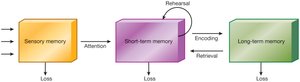
Short-Term Memory (STM)
Capacity and Chunking
STM can hold about 7 ± 2 units of information. Chunking, or organizing smaller units into larger, meaningful groups, expands STM capacity. Experience and expertise influence chunking ability.
Duration: Less than a minute.
Chunking: Organizing information into meaningful units.
Example: Grouping numbers into familiar sequences (e.g., phone numbers).
Long-Term Memory (LTM)
Organization and Retrieval
LTM has no capacity limitations. Information is organized by semantic categories, sounds, and visual features. The tip-of-the-tongue phenomenon illustrates retrieval challenges when only partial information is accessible.
Semantic Organization: Items grouped by meaning.
Tip-of-the-Tongue: Partial retrieval of similar-sounding or visually similar words.
Serial Position Effects
Primacy and recency effects describe the tendency to remember the first and last items in a list. Proactive and retroactive interference can hinder memory for items in the middle.
Primacy Effect: Better recall for early items (LTM).
Recency Effect: Better recall for recent items (STM).
Proactive Interference: Earlier information interferes with new learning.
Retroactive Interference: New information overshadows older memories.
Working Memory Model
Components of Working Memory
Working memory is an active STM system with several components: the phonological loop, visuospatial sketchpad, episodic buffer, and central executive. Each manages different types of information and tasks.
Phonological Loop: Processes speech and auditory information.
Visuospatial Sketchpad: Handles visual and spatial information.
Episodic Buffer: Integrates information across domains and links to LTM.
Central Executive: Directs attention and coordinates the other components.
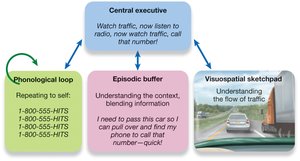
Phonological Loop
Word-Length Effect: Shorter words are easier to remember in STM.
Capacity: Information retained for 15–30 seconds.
Visuospatial Sketchpad
Stores visual features as separate or combined chunks, aiding in object recognition and spatial tasks.
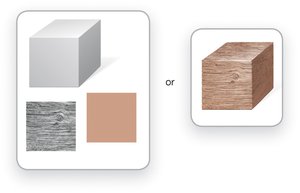
Episodic Buffer
Capacity: Holds 7–10 pieces of information.
Integration: Links meaningful episodes to LTM.
Central Executive
Function: Focuses attention and manages working memory tasks.
Location: Frontal lobes of the brain.
Types of Long-Term Memory
Declarative vs. Nondeclarative Memory
LTM is divided into declarative (explicit) and nondeclarative (implicit) memory systems.
Declarative Memory: Conscious, verbalizable memories (facts, experiences).
Nondeclarative Memory: Unconscious, automatic skills and conditioning.
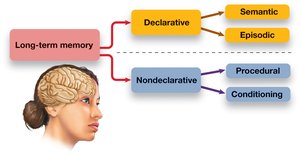
Declarative Memory
Episodic Memory: Personal experiences, organized by episodes.
Semantic Memory: Facts and general knowledge.
Nondeclarative Memory
Procedural Memory: Motor skills and learned actions.
Conditioning: Learned associations, often unconscious.
Memory Disorders
Dementia, Amnesia, Hyperthymesia
Memory disorders affect cognitive function and daily life. Dementia involves progressive decline, amnesia is profound memory loss, and hyperthymesia is the ability to recall autobiographical events in vivid detail.
Dementia: Memory loss, confusion, poor judgment.
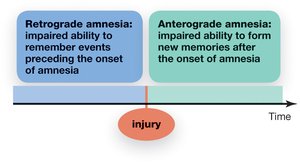
Amnesia: Loss of memory, can be retrograde (loss of past memories) or anterograde (inability to form new memories).
Hyperthymesia: Highly superior autobiographical memory.
Encoding and Retrieval
Encoding Processes
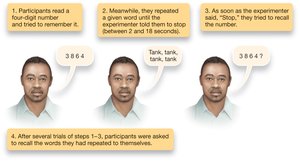
Encoding is the process of transforming information into a memory trace. Deeper processing, such as elaborating on meaning or using emotional content, improves retention.
Maintenance Rehearsal: Repeating information to prolong exposure.
Elaborative Rehearsal: Thinking about meaning to enhance encoding.
Levels of Processing (LOP): Deeper processing leads to better recall.
Self-Reference Effect: Relating information to oneself improves memory.
Encoding Specificity Principle
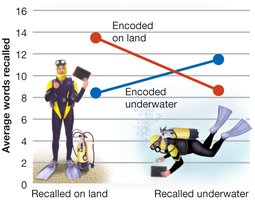
Retrieval is most effective when the context or internal state matches the conditions during encoding. This includes context-dependent, state-dependent, and mood-dependent memory.
Context-Dependent Learning: Recall improves when encoding and retrieval contexts match.
State-Dependent Memory: Internal states (e.g., arousal) match during encoding and retrieval.
Mood-Dependent Memory: Mood at retrieval matches mood during encoding.
Emotional Memories
Emotion and Memory Consolidation
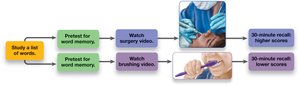
Emotion enhances memory consolidation, often involving the limbic system, especially the amygdala and hippocampus. Flashbulb memories are vivid but not necessarily accurate.
Limbic System: Includes hippocampus (encoding) and amygdala (emotion).
Flashbulb Memories: Highly vivid, detailed memories of significant events.
The Forgetting Curve
Ebbinghaus and Bahrick's Research
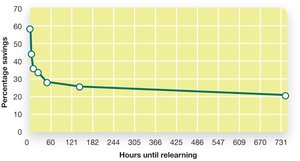
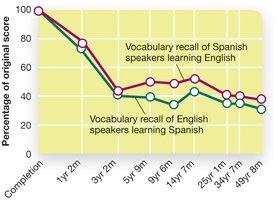
Forgetting occurs rapidly after learning, then levels off. Ebbinghaus's curve shows steep initial decline, while Bahrick's research on language retention demonstrates long-term stabilization.
Forgetting Curve: Rapid loss followed by stabilization.
Long-Term Retention: Some information remains for decades.
Mnemonics and Memory Improvement
Mnemonic Techniques
Mnemonics are strategies to enhance memory, including acronyms, first-letter techniques, dual coding, and the method of loci.
Acronym: Pronounceable word from initials (e.g., VEM J SUN).
First-Letter Technique: Uses first letters to form sentences.
Dual Coding: Storing information in multiple forms (e.g., song and visual).
Method of Loci: Linking items to locations along a familiar path.
Schemas and Memory Organization
Schemas in Memory
Schemas are organized clusters of memories that guide expectations, attention, and recall. They are influenced by culture and experience, and can lead to biases.
Schema-Consistent Information: Easier to recall, but details may be vague.
Schema-Inconsistent Information: Unusual items are more memorable.
Memory Reconstruction and False Memories
Constructive Memory and Misinformation Effect
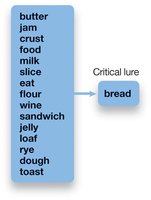
Memory is reconstructive, and can be influenced by schemas, imagination, and misinformation. False memories can arise from suggestive questioning or doctored images.
False Memory: Recalling events that did not occur.
Misinformation Effect: Memory altered by misleading information.
Imagination Inflation: Increased confidence in false memories after imagining them.
Eyewitness Testimony and Memory Reliability
Improving Eyewitness Identification
Eyewitnesses are fallible. Procedures such as double-blind lineups, appropriate instructions, and confidence statements can improve reliability.
Double-Blind Procedures: Prevents bias in identification.
Sequential Lineup: Reduces false positives.
Confidence Statements: Record witness confidence at the time of identification.
Recovered Memories and Controversy
Debate Over Validity
Recovered memories, often associated with repression, are controversial. Some clinicians attempt to recover suppressed memories, while others question their validity, citing cases of false memory with significant consequences.
Freudian Psychoanalysis: Theory of repression and recovery.
Recovered Memory Controversy: Debate over whether suppressed memories are real or false.
Example: Beth Rutherford case illustrates dangers of false memory.
