 Back
BackMemory: Processes, Models, and Mechanisms
Study Guide - Smart Notes
 Tailored notes based on your materials, expanded with key definitions, examples, and context.
Memory: Processes, Models, and Mechanisms
Module Introduction
Memory is a fundamental cognitive process that allows us to encode, store, and retrieve information. This module explores the processes of memory, the different types of memory systems, and the mechanisms of forgetting. Understanding these concepts is essential for effective learning and application in everyday life.
Three Processes of Memory
Encoding, Storage, and Retrieval
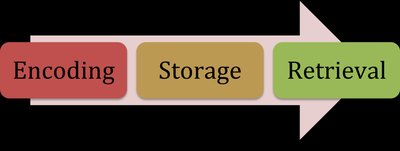
Memory operates through three core processes: encoding, storage, and retrieval. These processes are often compared to the functioning of a computer system.
Encoding: The process of transforming sensory input into a form that can be stored in memory. Encoding can be automatic (without conscious effort) or effortful (requiring deliberate attention).
Storage: The maintenance of encoded information over time. This is analogous to saving files on a computer's hard drive.
Retrieval: Accessing stored information when needed. Retrieval does not remove information from storage; it simply makes it available for use.
Models of Memory
Multi-Store Model (Atkinson & Shiffrin, 1968)
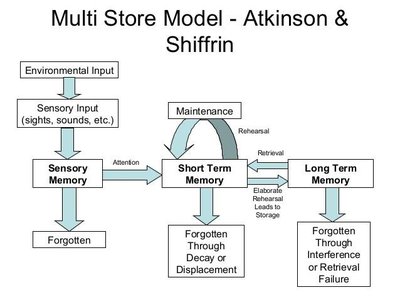
The multi-store model proposes that memory consists of three distinct stores: sensory memory, short-term (working) memory, and long-term memory. Information flows sequentially through these stores, with potential for forgetting at each stage.
Sensory Memory: Briefly holds sensory information (e.g., sights, sounds) for a fraction of a second to a few seconds.
Short-Term Memory (STM): Holds a limited amount of information for about 15–30 seconds. Maintenance rehearsal can keep information in STM; elaborate rehearsal can transfer it to long-term memory.
Long-Term Memory (LTM): Stores information for extended periods, potentially for a lifetime. Retrieval brings information from LTM back to STM for use.
Sensory Memory
Types of Sensory Memory
Sensory memory temporarily stores information from each sense, allowing us to retain impressions of sensory input after the stimulus has ended. Each sense has a specialized sensory register:
Iconic Memory: Visual sensory memory, lasting less than a second.
Echoic Memory: Auditory sensory memory, lasting 2–4 seconds.
Haptic Memory: Touch sensory memory, lasting about 2 seconds.
Gustatory Memory: Taste sensory memory, lasting 1–2 seconds.
Olfactory Memory: Smell sensory memory, lasting 2–4 seconds.
Short-Term and Working Memory
Short-Term Memory vs. Working Memory
Short-term memory (STM) refers to the temporary holding of information, while working memory involves the manipulation and processing of that information. The terms are often used interchangeably, but working memory is considered a more dynamic system.
Baddeley and Hitch's Working Memory Model
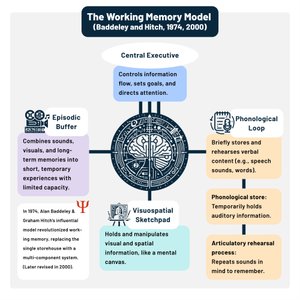
This influential model divides working memory into four components:
Phonological Loop: Stores and rehearses verbal and auditory information.
Visuospatial Sketchpad: Maintains and manipulates visual and spatial information.
Episodic Buffer: Integrates information from different sources and links working memory with long-term memory.
Central Executive: Directs attention, sets goals, and manages the activities of the other components.
Limitations of Working Memory
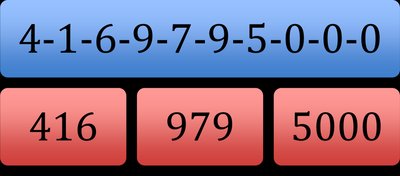
Capacity: According to Miller (1956), STM can hold 7 ± 2 items (5 to 9 items on average). Chunking is a strategy to increase capacity by grouping information into meaningful units (e.g., phone numbers).
Duration: STM lasts about 15–30 seconds unless information is actively rehearsed.
Rehearsal Strategies
Maintenance Rehearsal: Repeating information to keep it in STM.
Elaborative Rehearsal: Linking new information to existing knowledge for deeper processing and better transfer to LTM.
Long-Term Memory
Characteristics and Types
Long-term memory (LTM) is a relatively permanent and limitless storehouse of information. It is divided into two main categories:
Explicit (Declarative) Memory: Memories that require conscious recall.
Semantic Memory: Facts and general knowledge (e.g., capital cities).
Episodic Memory: Personal experiences and events (e.g., your graduation day).
Implicit (Nondeclarative) Memory: Memories retrieved unconsciously.
Procedural Memory: Skills and tasks (e.g., riding a bike).
Conditioning: Learned associations (e.g., Pavlov’s dogs salivating to a bell).
Priming: Exposure to one stimulus influences response to another (e.g., seeing "eggs" primes "bacon").
The Role of the Hippocampus
The hippocampus is essential for forming, organizing, and consolidating new long-term memories. Damage to the hippocampus can result in anterograde amnesia, where new memories cannot be formed.
Forgetting
Theories of Forgetting
Trace Decay Theory: Memories fade over time if not accessed or rehearsed.
Interference Theory: Other information interferes with memory retrieval.
Proactive Interference: Old information disrupts recall of new information.
Retroactive Interference: New information disrupts recall of old information.
Amnesia
Infantile Amnesia: Inability to recall memories from the first 3–4 years of life.
Retrograde Amnesia: Loss of memories formed before the onset of amnesia.
Anterograde Amnesia: Inability to form new memories after the onset of amnesia.
Tip-of-the-Tongue Phenomenon
The tip-of-the-tongue (TOT) state is a temporary inability to retrieve a known word or piece of information, often resolved later. It is considered a retrieval failure rather than a loss of the memory itself.
Key Takeaways
Memory involves encoding, storage, and retrieval.
The multi-store model divides memory into sensory, short-term (working), and long-term stores.
Short-term memory is limited in capacity and duration; strategies like chunking and rehearsal can improve performance.
Long-term memory is divided into explicit and implicit types, each with subcategories.
Forgetting is normal and can result from decay, interference, or amnesia.
