 Back
BackMemory: Processes, Types, and Mechanisms
Study Guide - Smart Notes
 Tailored notes based on your materials, expanded with key definitions, examples, and context.
Memory
Introduction to Memory
Memory is a fundamental cognitive process that enables us to encode, store, and retrieve information. It is essential for learning, decision-making, and daily functioning. Psychologists study memory to understand how information is processed, why we forget, and how memories can be improved.
Key Questions: How do we process and store information? Are there different types of memory? How do we retrieve memories? Why do we forget?
How Memory Functions
Stages of Memory
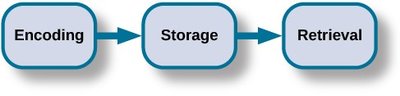
Memory operates as an information processing system, similar to a computer. It involves three main processes:
Encoding: Inputting information into the memory system.
Storage: Retaining encoded information over time.
Retrieval: Accessing stored information and bringing it into conscious awareness.
Encoding
Encoding is the process of transforming sensory input into a form that can be stored in memory. It involves labeling, organizing, and connecting new information to existing knowledge.
Automatic Processing: Unconscious encoding of details such as time, space, and frequency (e.g., remembering when you last studied).
Effortful Processing: Conscious encoding that requires attention and effort (e.g., learning new concepts).
Types of Encoding
Semantic Encoding: Encoding of words and their meanings; most effective for recall.
Visual Encoding: Encoding of images; concrete words are easier to recall than abstract words.
Acoustic Encoding: Encoding of sounds.
Self-Reference Effect: Information related to oneself is remembered better.
Storage
Storage refers to maintaining encoded information over time. Two influential models describe how information is stored:
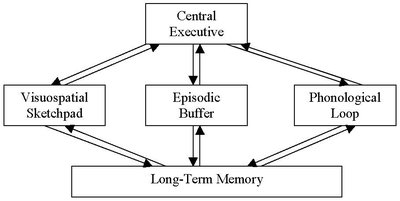
Baddeley & Hitch Model of Working Memory
This model proposes that short-term memory consists of multiple systems supervised by a central executive:
Visuospatial Sketchpad: Handles visual and spatial information.
Episodic Buffer: Integrates information across domains.
Phonological Loop: Processes auditory information.
Atkinson-Shiffrin Model (A-S Model)
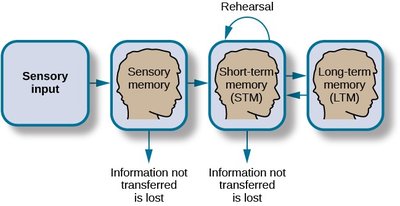
This model describes memory as a flow through three stages:
Sensory Memory: Brief storage of sensory events (up to a few seconds).
Short-Term Memory (STM): Temporary storage (about 20 seconds, 7±2 items).
Long-Term Memory (LTM): Continuous, potentially limitless storage.
Memory Consolidation: The process of transferring information from STM to LTM, often through rehearsal.
Types of Long-Term Memory
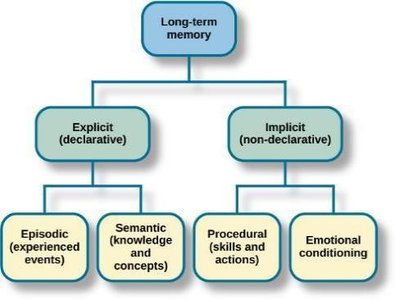
Long-term memory is divided into explicit (declarative) and implicit (non-declarative) memory:
Explicit Memory: Conscious recall of facts and events.
Semantic Memory: Knowledge about words, concepts, and language.
Episodic Memory: Personal experiences and events (autobiographical memory).
Implicit Memory: Unconscious memories, often demonstrated through behavior.
Procedural Memory: Skills and actions (e.g., riding a bike).
Emotional Conditioning: Learned emotional responses.
Retrieval
Retrieval is the process of accessing stored information. It is essential for daily functioning and learning.
Recall: Retrieving information without cues (e.g., essay tests).
Recognition: Identifying previously learned information when encountered again (e.g., multiple-choice tests).
Relearning: Learning information more quickly the second time.
Biological Basis of Memory
Brain Structures Involved in Memory
Different brain regions contribute to various aspects of memory:
Amygdala: Involved in emotional memories, especially fear.
Hippocampus: Critical for explicit memory formation and spatial memory.
Cerebellum: Important for procedural memories and classical conditioning.
Prefrontal Cortex: Involved in semantic tasks and memory retrieval.
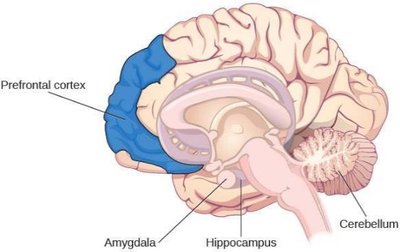
Neurotransmitters such as epinephrine, dopamine, serotonin, glutamate, and acetylcholine play key roles in memory formation and consolidation by strengthening synaptic connections.
Memory Phenomena and Disorders
Flashbulb Memory
Flashbulb memories are vivid, detailed memories of significant or emotional events (e.g., September 11, 2001). They serve as generational reference points but are not immune to distortion.
Amnesia
Amnesia is the loss of long-term memory due to disease, trauma, or psychological factors.
Anterograde Amnesia: Inability to form new memories after trauma (often involves hippocampal damage).
Retrograde Amnesia: Loss of memories formed before trauma.
Memory Construction and Reconstruction
Memory is not a perfect recording; it is reconstructed each time it is retrieved, making it susceptible to distortion and suggestibility. This is especially relevant in eyewitness testimony.
Suggestibility: External information can lead to the creation of false memories.
Forgetting and Memory Errors
Why Do We Forget?
Forgetting is the loss of information from long-term memory. It can occur due to encoding failure, where information is never stored properly.

Schacter’s Seven Sins of Memory
Psychologist Daniel Schacter identified seven ways memory can fail:
Transience: Memory fades over time (storage decay).
Absentmindedness: Lapses in attention lead to forgetting.
Blocking: Temporary inability to access information (tip-of-the-tongue).
Misattribution: Confusing the source of a memory.
Suggestibility: Incorporating misinformation into memory.
Bias: Current beliefs distort past memories.
Persistence: Inability to forget unwanted memories.
Types of Bias
Stereotypical Bias: Associating memories with stereotypes (e.g., racial or gender bias).
Egocentric Bias: Remembering events in a way that enhances one's self-image.
Hindsight Bias: Believing an outcome was predictable after it has occurred.
Persistence
Some individuals, such as military veterans, may experience persistent, involuntary recall of traumatic memories.

Interference
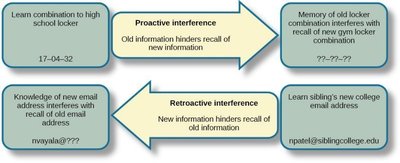
Interference occurs when information in memory competes, causing forgetting:
Proactive Interference: Old information hinders recall of new information.
Retroactive Interference: New information interferes with recall of old information.
Improving Memory
Ways to Enhance Memory
Rehearsal: Repeating information to strengthen memory.
Chunking: Grouping information into manageable units (e.g., phone numbers).
Elaborative Rehearsal: Connecting new information to existing knowledge.
Mnemonic Devices: Memory aids that organize information for encoding (e.g., acronyms, rhymes).
Expressive Writing: Writing about information to reinforce memory.
Saying Words Aloud: Verbal repetition enhances encoding.

How to Study Effectively
Use elaborative rehearsal to make information meaningful.
Apply the self-reference effect by relating material to yourself.
Be aware of the forgetting curve and review material regularly.
Minimize interference by studying in distraction-free environments.
Engage in aerobic exercise to promote neurogenesis in the hippocampus.
Get adequate sleep to support memory consolidation.
Utilize mnemonic devices for complex information.
