 Back
Memory Systems and Conceptual Knowledge: Study Guide for Introduction to Psychology
Study Guide - Smart Notes
 Tailored notes based on your materials, expanded with key definitions, examples, and context.
Memory: Interpretation and Conceptualization
Neural Regions and Memory Processing
Memory involves interpreting events through various brain regions, each associated with different types of information processing. The prefrontal region is linked to meaningful processing of verbal and visual information, while the posterior region (temporal cortex) is associated with representing conceptual information.
Prefrontal Region: Processes meaningful verbal and visual information.
Posterior Region (Temporal Cortex): Represents conceptual information.
Meaningfulness: A critical determinant of what is remembered.
Memory for Verbal Information
Left Prefrontal Region: Involved in processing verbal information.
Left Hemisphere Activation: Increased when categorical information is presented verbally.
Retention: People typically remember the meaning of messages rather than details unless cued or warned.
Memory for Visual Information
Right Prefrontal Region: Processes visual information.
Recall: Like verbal memory, recall of visual details improves when attention is cued.
Visual Memory: Generally superior to verbal memory.
Importance of Meaning
Dominant Recall: Meaning is what is most often recalled.
Significance: Significant events are remembered in more detail.
Mnemonics: Techniques that associate items with meaningful concepts improve memory.
Example: Using knuckles and spaces to remember the number of days in each month.
Propositional Representations
Memory is enhanced when information is encoded as propositions—abstract units of meaning that can be judged as true or false.
Proposition: Smallest unit of knowledge, often expressed as simple sentences.
Relations: Organizational elements (verbs, adjectives).
Arguments: Elements corresponding to times, places, people, or things (nouns).
Propositional Analysis: Complex sentences are remembered as sets of abstract meaningful units.
Amodal vs. Perceptual Symbol Systems
Amodal Symbol System: Abstract, nonperceptual representations (e.g., propositional representations).
Perceptual Symbol System: Information is represented in perceptual modalities (vision, auditory, etc.), extending Paivio’s dual code theory.
Dual Code Theory: Information is encoded in both verbal and visual codes.
Embodied Cognition
Embodied cognition emphasizes the role of the body and environment in shaping cognitive processes.
Definition: Cognition is shaped by bodily interactions with the environment.
Example: Mirror neurons activate when observing or performing actions.
Multi-modal vs. Amodal Representations
Multi-modal: Meaning is tied to different perceptual or motor systems; information can be converted between modalities.
Amodal: Meaning is represented in an abstract system, with conversion between perceptual/motor and abstract representations.
Conceptual Knowledge and Memory
Categories and Concepts
People experience the world through categories and concepts, which influence memory.
Categorical Information: More likely to be remembered than details.
Semantic Networks: Hierarchical structures for representing categorical information.
Schemas: Slot-value representations specifying category attributes and typical values.
Schemas and Inferences
Slot Structure: Attributes (slots) that members of a category possess (e.g., house: isa, parts, materials).
Default Values: People infer default values unless they notice otherwise.
Variation: Schemas allow variation in category membership; typical members are processed more efficiently.
Event Concepts and Scripts
Scripts: Event schemas for stereotypical events (e.g., going to a movie).
Sequence: Go to theater, buy ticket, buy drinks/food, see movie, leave theater.
Prototype vs. Exemplar Theories
Prototype Theory: Categories are represented by a single prototype (average member).
Exemplar Theory: Categories are represented by specific instances rather than a central prototype.
Rule-based and Theory-based Structures
Rule-based: Categories organized by rules influenced by general knowledge and theories.
Brain Patterns: Different categories produce distinct patterns across the brain; damage to specific regions affects category knowledge.
Memory and the Brain
Neural Plasticity
Neural plasticity is the brain’s ability to change and reorganize in response to experience, learning, injury, or aging. It underlies memory formation and recovery.
Definition: Formation of new connections and strengthening/weakening of neural pathways.
Role: Enables memory, skill acquisition, and recovery from damage.
Anatomy Involved in Memory
Temporal Cortex: Permanent storage of memories.
Hippocampus: Storage of new memories; filters and encodes meaningful experiences.
Prefrontal Cortex: Encoding new memories and retrieving old ones; left for verbal, right for visual.
Sensory Memories
Visual Sensory Store (Iconic Memory)
Definition: Brief storage of visual information.
Whole Report Procedure: Recall some information briefly before it fades.
Partial Report Procedure: Cued recall improves memory for specific areas.
Auditory Sensory Store (Echoic Memory)
Definition: Brief storage of auditory information, lasting up to 10 seconds.
Transient Stores: Both visual and auditory sensory stores are short-lived.
Short-Term and Working Memory
Theory of Short-Term Memory
Sensory Store: Perceptual information briefly held; attended information moves to short-term memory.
Rehearsal: Deep rehearsal (assigning meaning) is necessary for transfer to long-term memory.
Depth of Processing: More important than duration of rehearsal.
Working Memory Model (Baddeley)
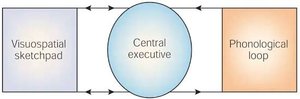
Baddeley’s model replaced the concept of short-term memory with working memory, consisting of multiple components.
Visuospatial Sketchpad: Maintains visual information.
Phonological Loop: Maintains verbal information; includes articulatory process (inner voice) and phonological store (inner ear).
Central Executive: Controls the slave systems and coordinates information.
Anatomy: Prefrontal and parietal cortex maintain different types of information.
Activation and Long-Term Memory
Activation Calculations and Spreading Activation
Activation: Probability and speed of retrieval depend on a concept’s activation level.
Spreading Activation: Activation spreads through networks, making related memories more available.
Practice and Memory Strength
Power Law of Learning
Repeated Practice: Strengthens memory according to a power function.
Long-Term Potentiation (LTP): Neural pathways become more sensitive with repeated stimulation.
Power Law Equation:
Where S is strength, T is practice time, a and b are constants.
Factors Influencing Memory
Spacing Effects: Distributed practice improves memory more than cramming.
Incidental vs. Intentional Learning: Depth of processing is more important than intention.
Flashbulb Memory: Highly significant events are remembered in detail due to their meaning.
Long-Term Memory: Models and Types
Multi-Store Model (Atkinson & Shiffrin, 1968)
Components: Sensory store, short-term store (working memory), long-term store.
Stages of Long-Term Memory Formation
Encoding: Receiving and processing information; meaningful encoding leads to stronger memory.
Consolidation: Solidifying connections; includes synaptic (hours) and system (weeks to years) consolidation.
Storage: Building distributed networks across cortical areas.
Retrieval: Accessing and potentially updating memories.
Key Factors Enhancing Memory Formation
Sleep: Deep sleep aids consolidation.
Emotion: Amygdala tags critical experiences for memory.
Spaced Repetition: Revisiting information strengthens pathways.
Active Recall: Testing improves retention.
Elaborative Interrogation: Connecting new ideas to existing knowledge enhances retrieval.
Types of Long-Term Memory
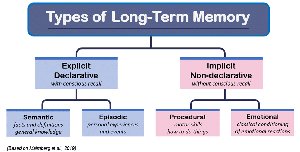
Explicit (Declarative) Memory: Requires conscious thought; includes semantic and episodic memory.
Implicit (Non-declarative) Memory: Retrieved unconsciously; includes procedural and emotional memory.
Explicit Memory
Semantic Memory: General knowledge, facts, vocabulary.
Episodic Memory: Personal experiences and events.
Implicit Memory
Procedural Memory: Skills and habits learned through repetition.
Emotional Memory: Conditioned emotional responses.
Key Characteristics of Long-Term Memory
Unlimited Capacity and Duration: Potential to remember everything studied.
Information Decay: Unused information weakens and disappears.
Interference: Retroactive (new replaces old) and proactive (old interferes with new) interference.
Patient H.M. and Memory Research
Case Study: Patient H.M. provided insights into memory organization.
Findings: Procedural memory remained intact despite impaired declarative memory.
Principle: Memory is a distinct cerebral function, separable from other abilities.
Conclusion
Long-term memory encompasses various types and subtypes, including memory for facts, experiences, skills, and emotional responses. It is essential for daily functioning, exam preparation, and understanding the world.
