 Back
BackMemory Systems and Processes: A Comprehensive Study Guide
Study Guide - Smart Notes
 Tailored notes based on your materials, expanded with key definitions, examples, and context.
Memory Systems
Overview of Memory Models
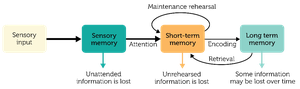
Memory is the process by which information is encoded, stored, and retrieved. The Atkinson-Shiffrin Model (1968) is a foundational framework that describes memory as a flow of information through a series of stages: sensory memory, short-term memory (STM), and long-term memory (LTM).
Encoding: The process of transforming sensory input into a form that can be stored in memory.
Storage/Maintenance: The retention of encoded information over time.
Retrieval: The process of accessing stored information when it is needed.
Sensory Memory
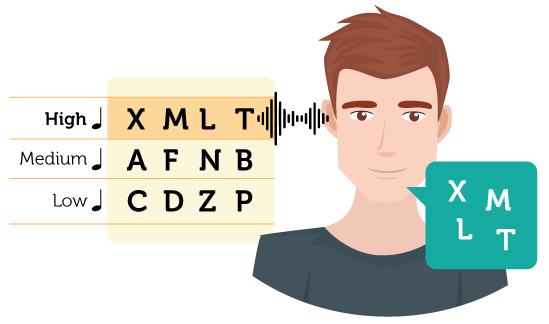
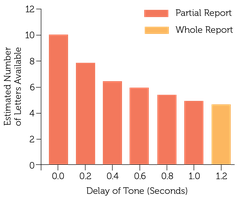
Sensory memory holds incoming sensory information for a very brief period (300-500 ms). It includes iconic (visual) and echoic (auditory) memory. Sperling's (1960) experiments distinguished between whole report and partial report methods, demonstrating the large but fleeting capacity of sensory memory.
Iconic Memory: Visual sensory memory, lasting less than a second.
Echoic Memory: Auditory sensory memory, lasting a few seconds.
Short-Term Memory (STM)
Short-term memory temporarily holds a limited amount of information for about 15-30 seconds. Its capacity is typically 7±2 items for auditory information or 3-4 items for visual information. STM can be improved through strategies such as chunking.
Capacity: 7±2 items (auditory), 3-4 items (visual).
Chunking: Grouping information into meaningful units to enhance STM capacity.

Chunking in STM
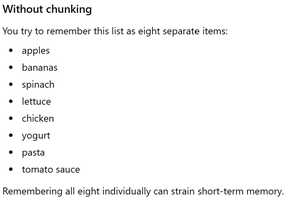
Chunking allows individuals to increase the amount of information held in STM by grouping items into larger, meaningful units.

Expertise and STM
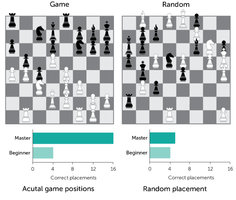
Expertise in a domain (e.g., chess) allows for more efficient chunking and memory performance, as shown in studies comparing chess masters and beginners.
STM Duration and Forgetting
Without rehearsal, information in STM decays rapidly, typically within 15-30 seconds. The Brown-Peterson task demonstrates this limitation by preventing rehearsal and measuring recall over time.

Memory Decay and Spaced Practice
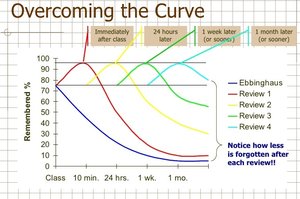
Forgetting can be mitigated by spaced practice, which is more effective for long-term retention than massed practice (cramming). The Ebbinghaus forgetting curve illustrates how information is lost over time without review, but repeated reviews slow the rate of forgetting.
Working Memory Model (Baddeley & Hitch)
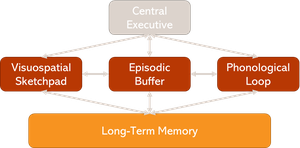
The working memory model expands on STM by including multiple components: the central executive, visuospatial sketchpad, phonological loop, and episodic buffer. This model explains how we temporarily store and manipulate information for complex cognitive tasks.
Central Executive: Directs attention and coordinates activities of the subsystems.
Visuospatial Sketchpad: Maintains visual and spatial information ("inner eye").
Phonological Loop: Maintains verbal and auditory information ("inner voice").
Episodic Buffer: Integrates information across domains and links working memory with LTM.
Long-Term Memory (LTM)
Types of Long-Term Memory
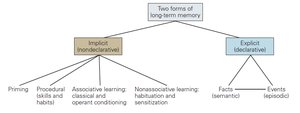
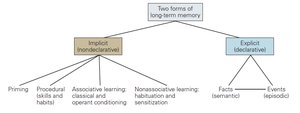
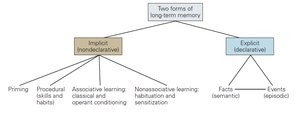
LTM is the system responsible for storing information over extended periods. It is divided into explicit (declarative) and implicit (nondeclarative) memory.
Explicit Memory: Conscious recollection of facts (semantic) and events (episodic).
Implicit Memory: Unconscious memory for skills, priming, and conditioning.
Implicit Memory
Associative Learning: Classical and operant conditioning.
Non-associative Learning: Habituation and sensitization.
Priming: Change in response to a stimulus due to prior exposure.
Procedural Memory: Skills and habits (e.g., riding a bike).
Explicit Memory
Episodic Memory: Memory for personal events, including context and sensory details ("mental time travel").
Semantic Memory: Memory for facts and general knowledge, independent of context.
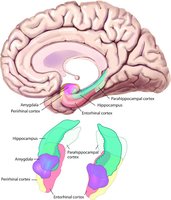
Explicit memory relies heavily on the medial temporal lobes (MTL), especially the hippocampus, and the cerebral cortex.
Neural Basis of Memory
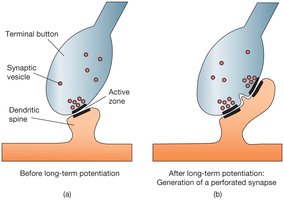
Long-term potentiation (LTP) is a process where repeated activation of synapses strengthens the connection between neurons, encapsulated by Hebb's Law: "neurons that fire together, wire together." This process is fundamental to learning and memory formation.
Amnesia
Types and Causes of Amnesia
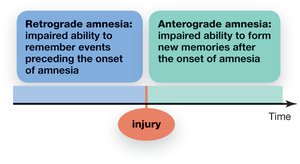
Amnesia refers to deficits in memory function due to brain damage, trauma, or disease. The modal model distinguishes between short-term and long-term memory systems, which can be selectively impaired.
Anterograde Amnesia: Inability to form new long-term memories after the onset of amnesia.
Retrograde Amnesia: Inability to recall memories formed before the onset of amnesia.
Case Study: Patient HM
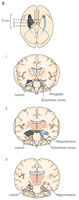
Patient HM underwent bilateral removal of the hippocampus, amygdala, and surrounding areas to treat seizures, resulting in profound anterograde amnesia but preserved working memory and pre-surgery long-term memory. This case provided critical evidence for the role of the hippocampus in memory formation.
Encoding and Retrieval
Serial Position Effect
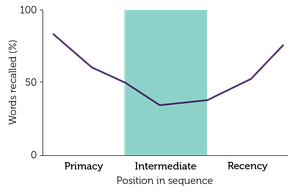
The serial position effect describes the tendency to recall the first (primacy effect) and last (recency effect) items in a list better than those in the middle. Maintenance rehearsal (rote repetition) supports the primacy effect, while recent items remain in STM.

Levels of Processing (LOP)
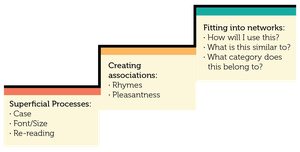
The depth of processing theory (Craik & Tulving, 1975) posits that information processed at a deeper, more meaningful level is more likely to be remembered than information processed superficially. Elaborative rehearsal, which involves attaching meaning to information, enhances memory performance.

Context-Dependent Memory
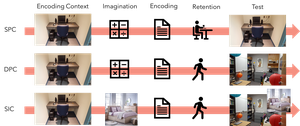
According to the encoding specificity principle, memory retrieval is most effective when the context at retrieval matches the context at encoding. This includes:
State-Dependent Memory: Matching physiological states (e.g., mood, intoxication).
Mood-Dependent Memory: Matching emotional states.
Context-Dependent Memory: Matching environmental or external contexts (e.g., studying and testing in the same location).

Experimental Evidence for Context Effects
Studies such as Godden & Baddeley (1975) demonstrated that recall is better when study and test contexts match (e.g., learning underwater and recalling underwater). Context reinstatement and the self-relevance effect further illustrate the importance of context in memory retrieval.


References
Atkinson, R. C., & Shiffrin, R. M. (1968). Human memory: A proposed system and its control processes.
Craik, F. I. M., & Tulving, E. (1975). Depth of processing and the retention of words in episodic memory.
Godden, D. R., & Baddeley, A. D. (1975). Context-dependent memory in two natural environments: On land and underwater.
Scoville, W. B., & Milner, B. (1957). Loss of recent memory after bilateral hippocampal lesions.
Sperling, G. (1960). The information available in brief visual presentations.
