 Back
BackMiddle Childhood: Development, Parenting, Intelligence, and Disorders
Study Guide - Smart Notes
 Tailored notes based on your materials, expanded with key definitions, examples, and context.
Middle Childhood Development
Emerging Independence and Social Relationships
During middle childhood, children begin to assert greater independence and actively seek friendships. While parents remain central figures, peer relationships, including the formation of 'best friends,' become increasingly significant. Participation in organized sports is common, but parental overemphasis on competition can lead to negative outcomes such as discouragement and burnout.
Peer Relationships: Development of friendships and social skills is a hallmark of this stage.
Organized Sports: Physical development supports participation, but enjoyment should be prioritized over competition.
Self-Concept: Children form a sense of self, influenced by family, peers, and media.
Moral Development
Kohlberg's Theory of Moral Development
Lawrence Kohlberg expanded on Piaget's work to propose a stage theory of moral reasoning, assessed through responses to moral dilemmas such as the Heinz dilemma. Kohlberg identified three levels, each with two stages, reflecting increasingly sophisticated moral reasoning.
Pre-conventional Morality: Morality based on consequences (punishment/reward).
Conventional Morality: Morality based on social approval and law/order.
Post-conventional Morality: Morality based on abstract principles and individual rights.
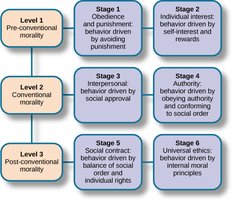
Example: The Heinz dilemma asks whether a man should steal a drug to save his dying wife, prompting consideration of law versus human need.
Parenting Styles
Dimensions and Types of Parenting
Parenting styles are classified along two dimensions: warmth–coldness and restrictiveness–permissiveness. Four major styles are recognized:
Authoritative: High expectations, structure, open communication, supportive discipline. Most effective for healthy development.
Neglectful: Low responsiveness and involvement; associated with negative outcomes.
Permissive: High responsiveness, low demands; nurturing but may lead to poor self-discipline.
Authoritarian: High demands, low responsiveness; strict rules, little dialogue, punitive discipline.
Additional info: Research shows that children of lesbian and gay parents are as well-adjusted as those of heterosexual parents, with no differences in key developmental outcomes.
Aggression and Media Influences
Gender Differences and Media Effects
Aggression can be physical or indirect (social/relational). Boys are more likely to display physical aggression, while girls often engage in indirect aggression such as exclusion or rumor-spreading. Media, including television and video games, can increase aggressive behavior in children.
Physical Aggression: More common in boys; persists across cultures and ages.
Indirect Aggression: More common in girls; includes social exclusion and rumor-spreading.
Media Influence: Exposure to violent media increases aggression and desensitization to violence.
Cyberbullying: Bullying via electronic means; associated with negative academic and health outcomes.
Child Management and Discipline
Corporal Punishment and Alternatives
Research overwhelmingly shows that physical punishment, such as spanking, is associated with increased aggression, antisocial behavior, and mental health problems. Positive reinforcement and non-physical discipline strategies are recommended by experts.
Physical Punishment: Ineffective and harmful; associated with negative outcomes.
Positive Reinforcement: Rewarding desired behaviors increases their frequency.
Shaping: Gradually reinforcing successive approximations toward a desired behavior.
Time-Out: Removing a child from a reinforcing situation to decrease undesirable behavior.
Ignoring: Withholding attention from minor misbehaviors to reduce their occurrence.


Example: Teaching a dog to skateboard or a child to use good manners both rely on shaping and positive reinforcement, not punishment.
Childhood Intelligence
Nature, Measurement, and Controversies
Intelligence is a complex, multifaceted construct influenced by both genetics and environment. Early attempts to measure intelligence, such as craniometry, were flawed. Modern intelligence testing began with Binet and Simon, and was further developed by Terman (Stanford-Binet) and Wechsler (WAIS).
General Intelligence Factor (g): Spearman proposed a single underlying factor for cognitive abilities.
Heritability: Intelligence is highly heritable (70-80%), but environment also plays a crucial role.
IQ Tests: Standardized tests (e.g., WAIS, Stanford-Binet) measure a range of cognitive abilities; scores are distributed normally (bell curve).
Gender Differences: No overall IQ difference, but girls excel in verbal skills, boys in spatial tasks.
Limitations: IQ tests do not measure creativity, emotional intelligence, or practical skills.
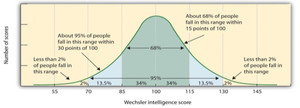
Example: The normal distribution of IQ means most people score near the average (IQ=100), with fewer at the extremes.
Intellectual Disabilities
Definition, Causes, and Diagnosis
Intellectual disability (ID) is defined by below-average intellectual functioning (IQ < 70) and deficits in adaptive behavior, diagnosed before age 18. Causes include genetic conditions (e.g., Down syndrome, Fragile X), prenatal toxins, and environmental factors.
Genetic Causes: Fragile X syndrome, Down syndrome, PKU.
Environmental Causes: Prenatal exposure to alcohol (FAS), drugs, infections.
Diagnosis: Based on standardized assessment and evaluation of adaptive functioning.
Autism Spectrum Disorder (ASD) and ADHD
Characteristics, Diagnosis, and Prevalence
ASD is characterized by deficits in social interaction, communication, and repetitive behaviors. ADHD involves inattention, hyperactivity, and impulsivity. Both are highly heritable and diagnosed through behavioral assessment, not medical tests.
ASD: Wide range of symptoms and severity; more common in boys; no link to vaccines.
ADHD: Three types (inattentive, hyperactive-impulsive, combined); more common in boys; treated with behavioral interventions and sometimes medication.
Comorbidity: Both conditions can co-occur with other developmental or learning disorders.
Child Behavior and Tantrums
Understanding and Managing Tantrums
Tantrums are a normal part of child development, often resulting from frustration or unmet desires. Effective management involves staying calm, ignoring attention-seeking misbehavior, and reinforcing positive behaviors.
Causes: Frustration, desire for independence, seeking attention.
Management: Ignore tantrums, avoid rewarding misbehavior, reinforce calm behavior after the tantrum ends.


Example: A child may have a tantrum in a grocery store when denied candy; giving in reinforces the behavior, so it is important to remain consistent and not reward tantrums.
