 Back
BackMotivation and Emotion: Biological, Cognitive, and Social Foundations
Study Guide - Smart Notes
 Tailored notes based on your materials, expanded with key definitions, examples, and context.
Motivation
Definition and Importance
Motivation refers to the physiological and psychological processes underlying the initiation of behaviors that direct organisms toward specific goals. It is essential for survival as it contributes to homeostasis, the body's tendency to maintain a balanced internal state.
Drive: A biological trigger that signals deprivation and prompts goal-directed behavior (e.g., thirst from water deprivation).
Incentives: External stimuli that we seek to reduce drives (e.g., water, food, social interaction).
Motives can be biological (e.g., hunger, thirst) or psychological (e.g., need for belonging).
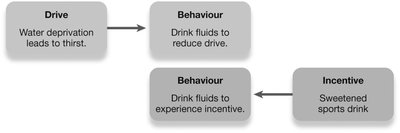
Drive Reduction and Incentive Theories
Motivation can be explained by two main theories:
Drive Reduction Theory: Behaviors are initiated to reduce internal drives (e.g., drinking fluids to reduce thirst).
Incentive Theory: Behaviors are also motivated by the pursuit of external rewards (e.g., drinking a sweetened sports drink for pleasure).
Biological Bases of Hunger
The Hypothalamus and Hunger Regulation
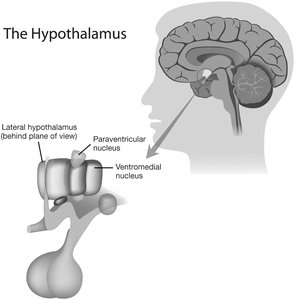
The hypothalamus is a critical brain structure for detecting changes in glucose and regulating hunger:
Lateral hypothalamus: Initiates hunger ("go" signal).
Ventromedial hypothalamus: Inhibits hunger ("stop" signal).
Damage to these areas can cause radical changes in eating behavior.
Hormonal Regulation of Hunger
Ghrelin: Increases appetite; levels drop after gastric bypass surgery.
Leptin: Produced by fat cells; signals satiety and reduces hunger.
Insulin: Secreted by the pancreas; regulates satiety and food intake.
GLP-1 (Ozempic): Mimics a hormone that reduces hunger and slows gastric emptying, making eating less rewarding.
Food and Reward
The brain's reward system is activated by highly palatable foods, especially those high in fat and sugar. The cingulate cortex is involved in linking food taste and texture with emotional reward, reinforcing eating behaviors through dopamine release.
Cognitive and Social Influences on Eating
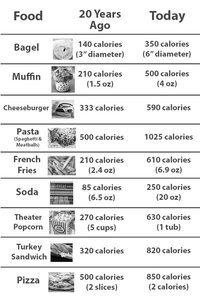
Portion Size and Unit Bias
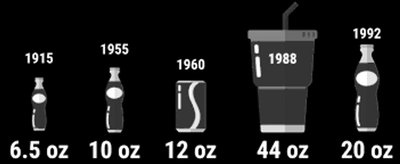
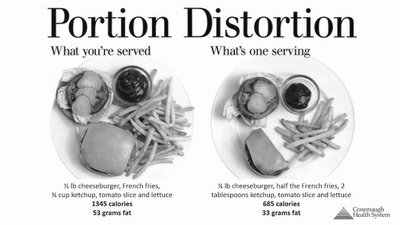
People often use portion sizes as cues for how much to eat, a phenomenon known as unit bias—the assumption that the portion provided is the appropriate amount to consume.
Social and Environmental Factors
Social facilitation: Eating more in the presence of others.
Impression management: Eating less to manage others' perceptions.
Modeling: Matching eating behavior to others.
Cultural norms: Influence what, when, and how much we eat (e.g., meal structure in Italy, portion sizes in the US vs. France).
Food-related cues: Appearance, smell, and effort required to obtain food can impact eating behavior.
Stress: Heightened arousal or negative emotions can lead to overeating ("stress-eating").
Obesity: Societal and Environmental Contributors
Increased availability of high-calorie, low-cost foods.
Changes in portion sizes and eating habits (e.g., eating on the run).
Reduced physical activity due to technology and lifestyle changes.
Role of food industry and government in shaping eating environments.
Psychological Needs: Belongingness and Love
The Need to Belong
Belongingness is a basic human need, essential for physical and mental health. Motivation to maintain warm, affectionate, and mutually caring relationships is fundamental for well-being.
Permanence of relationships is more important than frequency of interactions.
Social connectedness predicts better health outcomes; loneliness is a major risk factor for physical and mental illness.

Technology and Belongingness
Technology can both foster and challenge belongingness by creating global communities but potentially isolating individuals from local social ties.
Types of Love
Passionate love: Characterized by physical and emotional longing, desire for sexual interaction, and intense cravings ("honeymoon stage").
Compassionate love: Involves tenderness, affection, commitment, and enduring partnership.
Emotions: Nature, Function, and Expression
Understanding Emotions
Emotions are mental states or feelings associated with our evaluation of experiences. They involve arousal (bodily changes), brain activation, cognitive appraisals, subjective feelings, and behavioral expressions, all shaped by cultural rules.
Cognitive component: Subjective conscious experience.
Physiological component: Bodily arousal.
Behavioral component: Overt expressions (e.g., facial expressions).
Functions of Emotions
Prepare us for action (linking events to responses).
Shape future behavior (reinforcement or punishment).
Facilitate social interaction (signal to others, predict behavior).
Basic and Universal Emotions
Most researchers agree on basic emotions: happiness, anger, fear, sadness, and disgust.
Emotional expression is largely innate and universal (Darwin, Ekman).
Cross-cultural similarities in emotional development and expression.
Microexpressions and Deception
Microexpressions: Brief, involuntary facial expressions that reveal true emotions, even when concealed.
Research suggests faked emotional expressions are often asymmetrical.
"Liar's stereotype" includes cues like gaze aversion and raised eyebrows, but these are not always reliable indicators of deception.
Cultural Influences on Emotion
Cultures differ in what emotions are felt and how they are expressed (cultural display rules).
For example, Japanese culture often suppresses negative emotions in public, while American culture may encourage more open expression.
Theories of Emotion
James-Lange Theory
Emotions result from the perception of bodily reactions to stimuli. The body reacts first, and the brain interprets these reactions as emotions.
Example: "My heart is pounding, so I must be afraid." Physical sensations can influence subjective feelings.
Cannon-Bard Theory
Emotions and physiological reactions occur simultaneously but independently. The thalamus sends signals to both the amygdala (emotion) and the autonomic nervous system (bodily response).
Example: "I feel afraid and my heart is pounding at the same time."
Schachter-Singer Two-Factor Theory
Emotions arise from a combination of physiological arousal and cognitive interpretation (labeling) of that arousal.
General arousal leads to assessment, which leads to subjective feelings.
Example: The Capilano bridge study showed that people misattributed arousal from fear as attraction.
Facial Feedback Hypothesis
Facial muscle activity can influence emotional experience. For example, holding a pencil between the teeth (simulating a smile) can make cartoons seem funnier. However, replication studies have questioned the robustness of this effect.
Theory of Constructed Emotion
Lisa Feldman Barrett's theory posits that emotions are constructed by the brain, interpreting bodily sensations based on past experiences and cultural context. The same physiological response can be labeled differently depending on the situation and cultural background.
Summary Table: Theories of Emotion
Theory | Key Idea | Example |
|---|---|---|
James-Lange | Body reacts first, emotion follows | "My heart races, so I feel afraid." |
Cannon-Bard | Body and emotion occur together | "I feel afraid and my heart races at the same time." |
Schachter-Singer | Body reacts, then cognitive label determines emotion | "My heart races; I must be excited (or afraid, depending on context)." |
Constructed Emotion | Emotions are constructed from bodily sensations and context | "Tears at a wedding may mean joy or sadness, depending on culture." |
