 Back
BackMotivation: Theories, Needs, and Biological Factors
Study Guide - Smart Notes
 Tailored notes based on your materials, expanded with key definitions, examples, and context.
Approaches to Understanding Motivation
Defining Motivation
Motivation is the process by which activities are started, directed, and continued so that physical or psychological needs or wants are met. It is what "moves" people to act, whether to fulfill basic needs or pursue goals.
Intrinsic Motivation: Performing an action because it is inherently rewarding, satisfying, or enjoyable.
Extrinsic Motivation: Performing an action to achieve an external outcome, such as a reward or avoiding punishment.
Example: A child who enjoys drawing for fun is intrinsically motivated, while a child who draws to earn a reward is extrinsically motivated.

Additional info: Research shows intrinsic motivation enhances creativity, while extrinsic rewards may reduce it.
Early Approaches: Instinct and Drive-Reduction Theories
Early theories sought to explain motivation through biological and learned factors.
Instincts: Biologically determined, innate patterns of behavior present in both humans and animals (e.g., migration, mating).
Drive-Reduction Theory: Behavior arises from physiological needs that create internal drives, pushing the organism to satisfy the need and reduce tension.
Primary Drives: Related to survival needs (e.g., hunger, thirst).
Acquired (Secondary) Drives: Learned through experience (e.g., need for money, social approval).
Homeostasis: The body's tendency to maintain a steady internal state.
Example: Hunger motivates eating, which restores homeostasis by balancing glucose levels.


Psychological Needs and Motivation
McClelland’s Theory: Affiliation, Power, and Achievement
David McClelland identified three key psychological needs that influence motivation:
Need for Affiliation (nAff): Desire for friendly social interactions and relationships.
Need for Power (nPow): Desire to control or influence others, often expressed through status and possessions.
Need for Achievement (nAch): Strong desire to succeed in attaining goals, both realistic and challenging.
Example: High-achievement individuals seek feedback and challenging tasks, while high-affiliation individuals excel in teamwork.


Personality and Achievement: Dweck’s Self-Theory
Carol Dweck’s research links achievement motivation to personality and beliefs about intelligence:
Fixed Mindset: Belief that intelligence is unchangeable; leads to external locus of control and learned helplessness.
Growth Mindset: Belief that intelligence can be developed; leads to internal locus of control and persistence.
Constructive Criticism: Praise for effort and strategies fosters motivation more than praise for ability.
Additional info: Encouraging a growth mindset increases resilience and achievement motivation.
Arousal and Incentive Approaches
Arousal Theory
Arousal theory posits that people seek an optimal level of tension or stimulation. Task performance is best at moderate arousal, as described by the Yerkes-Dodson law:
Yerkes-Dodson Law: Easy tasks require higher arousal for optimal performance; difficult tasks require lower arousal.
Sensation Seekers: Individuals who need more complex and varied sensory experiences.
Example: Bungee-jumping and rock climbing are activities that increase arousal for sensation seekers.


Incentive Approaches
Incentive theory explains motivation as a response to external stimuli and their rewarding properties, independent of internal needs or arousal.
Incentives: Things that attract or lure people into action due to their rewarding properties.
Example: Eating dessert for its taste, even when not hungry.
Additional info: Motivation often results from both internal drives and external incentives.
Humanistic Approaches
Maslow’s Hierarchy of Needs
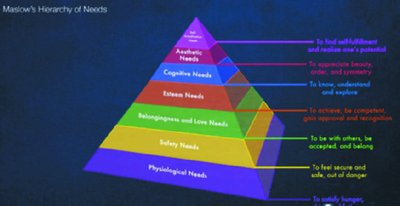
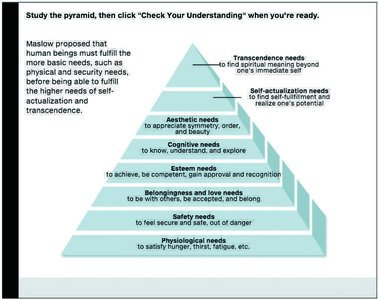
Abraham Maslow proposed a hierarchy of needs, suggesting that basic needs must be met before higher levels of growth and self-actualization can be achieved.
Deficiency Needs: Physiological and safety needs (food, water, security).
Growth Needs: Belongingness, esteem, cognitive, aesthetic, self-actualization, and transcendence.
Self-Actualization: Achieving one's full potential; seldom reached but experienced as "peak experiences."
Transcendence: Seeking spiritual meaning beyond oneself.

Additional info: Cross-cultural research shows the order of needs may differ across societies; some cultures prioritize security or social needs over self-actualization.
Self-Determination Theory (SDT)
SDT, developed by Ryan and Deci, identifies three universal needs for psychological growth and well-being:
Autonomy: Control over one's own behavior and goals.
Competence: Mastery of challenging tasks.
Relatedness: Sense of belonging and intimacy in relationships.
Example: Supportive environments foster intrinsic motivation and healthy development.

Additional info: Intrinsic motivation is enhanced by autonomy and competence; external rewards may reduce intrinsic motivation unless the task is inherently interesting.
Biological and Social Components of Hunger
Physiological Factors
Hunger is influenced by multiple physiological mechanisms:
Insulin: Hormone that reduces blood glucose, increasing hunger.
Glucagon: Hormone that increases blood glucose.
Leptin: Hormone signaling satiety to the hypothalamus.
Hypothalamus: VMH stops eating when glucose is high; LH initiates eating when insulin is high.
Weight Set Point: The level of weight the body tries to maintain.
Basal Metabolic Rate (BMR): Rate at which the body burns energy at rest.

Social and Cultural Factors
Eating behaviors are shaped by social cues, culture, and gender:
Social Cues: Eating at set times, responding to food presentation.
Classical Conditioning: Hunger reflex conditioned to certain times or sensory cues.
Emotional Eating: Some individuals eat for emotional reasons, such as stress or depression.
Cultural Differences: Japanese women eat due to hunger or social demands; American women may eat for emotional reasons.


Additional info: Gender and culture influence eating habits and responses to food cues.
Obesity and Maladaptive Eating
Factors Contributing to Obesity
Obesity is defined as body weight 20% or more over the ideal weight for height. It is influenced by:
Genetics: Family history increases risk.
Hormones: Leptin and other hormones affect appetite and weight regulation.
Overeating: Increased food variety and availability lead to higher consumption.
Exercise and Metabolism: Lower activity and slower metabolism contribute to weight gain.
Stress and Sleep: Both are linked to increased risk of obesity.
Cultural Trends: Industrialized societies show higher rates of obesity due to lifestyle changes.

Additional info: Obesity rates are rising globally, especially in countries adopting Western lifestyles.
Summary Table: Types of Motivation and Needs
Type | Description | Example |
|---|---|---|
Intrinsic Motivation | Action is rewarding in itself | Drawing for fun |
Extrinsic Motivation | Action leads to external outcome | Drawing for a reward |
Primary Drive | Survival needs | Eating when hungry |
Acquired Drive | Learned needs | Working for money |
Need for Achievement | Desire to succeed | Striving for high grades |
Need for Affiliation | Desire for relationships | Teamwork |
Need for Power | Desire to influence | Seeking leadership |
