 Back
BackNegative Reinforcement: Principles, Contingencies, and Applications in Psychology
Study Guide - Smart Notes
 Tailored notes based on your materials, expanded with key definitions, examples, and context.
Negative Reinforcement
Definition and Principle
Negative reinforcement is a fundamental principle of behavior in psychology. It occurs when a response leads to the termination, reduction, postponement, or avoidance of an aversive stimulus, thereby increasing the likelihood of similar responses in the future.
Key Point 1: Negative reinforcement strengthens behavior by removing or reducing an unpleasant stimulus after the behavior occurs.
Key Point 2: It is important to note that behaviors—not people—are reinforced.
Example: Turning off a loud alarm clock (removal of aversive stimulus) increases the likelihood of getting up when the alarm rings in the future.

Three-Term Escape Contingency
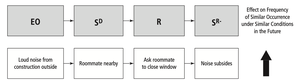
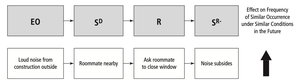
The three-term contingency describes the basic structure of escape behavior under negative reinforcement.
EO (Establishing Operation): An aversive stimulus is present (e.g., loud noise).
SD (Discriminative Stimulus): A cue signals the availability of escape (e.g., roommate nearby).
R (Response): The behavior performed to escape (e.g., asking roommate to close window).
SR- (Negative Reinforcer): The aversive stimulus is removed (e.g., noise subsides).
Four-Term (Avoidance) Contingency
The four-term contingency expands on escape by including avoidance, where the behavior prevents the aversive stimulus from occurring.
Key Point: Avoidance behaviors are reinforced by preventing the onset of an aversive event.
Example: Completing homework before a deadline to avoid teacher reprimand.
Negative Reinforcement Versus Punishment
Negative reinforcement and punishment are often confused, but they differ in their effects and the nature of stimulus change.
Negative Reinforcement: Increases behavior by removing an aversive stimulus.
Punishment: Decreases behavior by introducing or removing a stimulus.
Contextual Flexibility: The same stimulus may serve as a negative reinforcer or a punisher depending on context.
Three-Term Punishment Contingency
The three-term punishment contingency involves the presentation or removal of a stimulus following a behavior, resulting in decreased future occurrences of that behavior.
Example: A student receives a reprimand after talking out of turn, decreasing the likelihood of future interruptions.
EOs in Escape Contingencies
Establishing operations (EOs) play a critical role in escape contingencies.
Key Point: Escape from task demands is a common source of negative reinforcement for behaviors such as property destruction, aggression, and self-injury.
Comparing Escape and Avoidance Contingencies
Escape and avoidance contingencies are both forms of negative reinforcement but differ in timing and function.
Escape: Behavior terminates an ongoing aversive stimulus.
Avoidance: Behavior prevents the aversive stimulus from occurring.
Example: Escape: Leaving a noisy room; Avoidance: Wearing earplugs before entering a noisy environment.
Characteristics of Negative Reinforcement
Several factors influence the effectiveness of negative reinforcement contingencies:
The stimulus change must immediately follow the target response.
The magnitude of reinforcement should be large.
The target response must consistently produce escape or postponement of the EO.
Reinforcement should not be available for competing (nontarget) responses.

Contextual Factors in Negative Reinforcement
Contextual factors can mediate the aversiveness of demand situations and influence negative reinforcement.
Providing choices among tasks can reduce aversiveness.
Allowing individuals to choose the order of tasks increases engagement.
Presenting demands in a pleasant context can decrease resistance.
Behavioral Replacement Strategies
Behavioral replacement strategies are used to reduce problem behaviors maintained by negative reinforcement.
Key Point: Teaching alternative behaviors that achieve the same function (e.g., requesting a break instead of engaging in aggression).
Teacher and Caregiver Responding
Negative reinforcement can also affect teacher and caregiver behavior.
Key Point: The occurrence of problem behavior may serve as an EO for caregiver escape and avoidance, influencing their responses.
Ethical Considerations in Using Negative Reinforcement
Ethical concerns arise primarily from the severity of the antecedent event (EO) that occasions the target behavior.
The presence of aversive stimuli can generate competing behaviors, interfering with desired behavior acquisition.
Undesirable side effects associated with punishment may also occur when using negative reinforcement-based interventions.
Summary Table: Negative Reinforcement vs. Punishment
Aspect | Negative Reinforcement | Punishment |
|---|---|---|
Effect on Behavior | Increases | Decreases |
Stimulus Change | Removal of aversive stimulus | Presentation/removal of stimulus |
Example | Turning off alarm | Reprimand for misbehavior |
