 Back
BackObservational Learning (Modeling) in Psychology
Study Guide - Smart Notes
 Tailored notes based on your materials, expanded with key definitions, examples, and context.
Observational Learning (Modeling)
Definition and Overview
Observational learning, also known as modeling, is a form of learning that occurs by watching others and then imitating their actions. Unlike classical and operant conditioning, which rely on direct experience and reinforcement, observational learning allows individuals to acquire new behaviors simply by observing models. This process is supported by mirror neurons, which activate both when an individual performs an action and when they observe the same action performed by another.
Model: The person or animal whose behavior is observed and imitated.
Imitation: The act of copying the behavior of a model.
Examples of Observational Learning in Animals
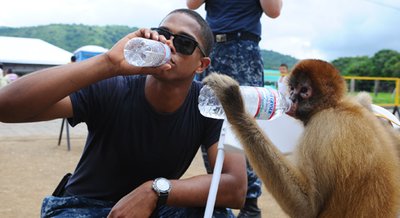
Observational learning is not limited to humans; many animals also learn by watching others. For example, chimpanzees can learn more efficient ways to obtain food by observing the techniques used by their peers.
Example: In a study, chimpanzees who observed others sucking juice through a straw (rather than dipping it) quickly adopted the more effective method themselves.
Human Examples and Implications
Humans frequently learn behaviors through observation, both positive and negative. For instance, children may imitate both constructive and destructive behaviors modeled by adults.
Example: A child who observes a parent using physical punishment may imitate this behavior with toys or peers.
Social Learning Theory
Psychologist Albert Bandura expanded on behaviorist theories by introducing social learning theory, which emphasizes the role of cognitive processes in learning. Bandura argued that learning can occur without direct reinforcement and that internal mental states are important.
Imitation vs. Observational Learning: Imitation is direct copying, while observational learning involves understanding and applying observed behaviors, sometimes in new contexts.
Types of Models
Bandura identified three main types of models:
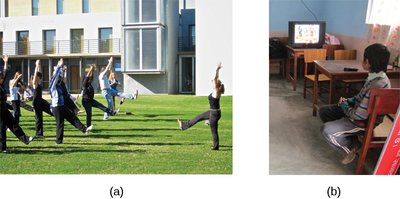
Live Model: A person demonstrating a behavior in person (e.g., a coach showing a skill).
Verbal Instructional Model: A person explaining or describing a behavior (e.g., a teacher giving instructions).
Symbolic Model: Behaviors demonstrated by characters in books, movies, television, or online media.
Steps in the Modeling Process
Bandura outlined four essential steps for successful observational learning:
Attention: Focusing on the model's behavior.
Retention: Remembering what was observed.
Reproduction: Having the ability to replicate the behavior.
Motivation: Wanting to perform the behavior, often influenced by observed consequences (reinforcement or punishment).
Vicarious Reinforcement: Increased motivation to imitate a behavior if the model is rewarded.
Vicarious Punishment: Decreased motivation if the model is punished.
Bandura’s Bobo Doll Experiment
Bandura’s famous experiment demonstrated that children who observed adults behaving aggressively toward a Bobo doll were more likely to imitate that aggression, especially if the adult was not punished. This experiment highlighted the power of observational learning in transmitting both prosocial and antisocial behaviors.
Prosocial and Antisocial Effects of Observational Learning
Observational learning can have both positive (prosocial) and negative (antisocial) effects:
Prosocial Modeling: Observing positive behaviors (e.g., kindness, honesty) encourages similar actions in observers.
Antisocial Modeling: Observing negative behaviors (e.g., aggression, dishonesty) can lead to the imitation of those behaviors.
Parents and public figures serve as important models, and their actions often speak louder than their words.
Media Influence and Aggression
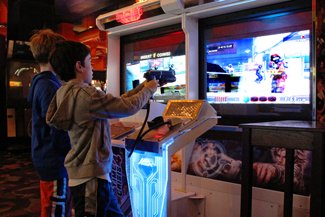
Research suggests that exposure to violent media (television, movies, video games) may increase aggressive thoughts and behaviors, especially in children. However, some researchers argue that other factors, such as family environment and mental health, also play significant roles in aggression.
Summary Table: Steps in the Modeling Process
Step | Description |
|---|---|
Attention | Focusing on the model's behavior |
Retention | Remembering what was observed |
Reproduction | Ability to replicate the behavior |
Motivation | Desire to perform the behavior, influenced by observed consequences |
Glossary
Model: Person who performs a behavior that serves as an example in observational learning.
Observational Learning: Type of learning that occurs by watching others.
Key Takeaways
Observational learning is a powerful mechanism for acquiring new behaviors without direct experience.
Bandura’s social learning theory emphasizes the importance of cognitive processes and the influence of models.
Both positive and negative behaviors can be learned through observation, highlighting the responsibility of role models in society.
