 Back
BackOperant Conditioning and Behaviorism: Key Concepts in Learning Psychology
Study Guide - Smart Notes
 Tailored notes based on your materials, expanded with key definitions, examples, and context.
Behaviorism and Classical Conditioning
Foundations of Behaviorism
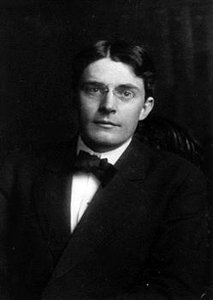
Behaviorism is a school of psychology that emphasizes the study of observable behavior, rejecting the importance of internal mental processes. Founded by John B. Watson, behaviorism incorporates elements of Pavlov’s classical conditioning and asserts that all behavior can be understood as a stimulus-response reaction.
Behaviorism: Focuses on observable, measurable behaviors.
Classical Conditioning: Learning process where a neutral stimulus becomes associated with a reflexive response.
Contrast with Freud: Freud emphasized unconscious motives, while behaviorists focus on observable actions.
Watson’s Little Albert Experiment
Watson and Rayner’s experiment with Little Albert demonstrated how emotional responses, such as fear, can be conditioned in humans. By pairing a neutral stimulus (white rat) with an aversive stimulus (loud noise), they conditioned a fear response.
Unconditioned Stimulus (UCS): Loud noise
Conditioned Stimulus (CS): White rat
Unconditioned Response (UCR): Fear/crying to loud noise
Conditioned Response (CR): Fear/crying to white rat
Stimulus Generalization: Little Albert began to fear other furry objects.
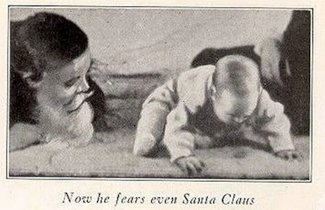
Additional info: This experiment is now considered unethical due to lack of informed consent and potential harm.
Operant Conditioning
Definition and Principles
Operant conditioning is a form of associative learning where behavior is influenced by its consequences. Developed by B. F. Skinner, it focuses on reinforcement and punishment to increase or decrease behaviors.
Operant Conditioning: Learning through consequences (reinforcement or punishment).
Law of Effect: Behaviors followed by satisfying consequences are more likely to be repeated; those followed by unpleasant consequences are less likely.
Skinner Box and Experimental Methods
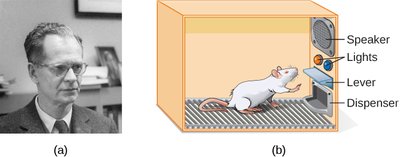
Skinner used the operant conditioning chamber (Skinner box) to systematically study how animals learn behaviors through reinforcement.
Skinner Box: Contains a lever or disk for animals to press/peck for food rewards.
Measurement: Responses are counted to analyze learning patterns.
Reinforcement and Punishment
Operant conditioning uses four main mechanisms to modify behavior:
Positive Reinforcement: Adding a desirable stimulus to increase behavior (e.g., giving a toy for cleaning a room).
Negative Reinforcement: Removing an undesirable stimulus to increase behavior (e.g., seatbelt alarm stops when buckled).
Positive Punishment: Adding an undesirable stimulus to decrease behavior (e.g., scolding for texting in class).
Negative Punishment: Removing a pleasant stimulus to decrease behavior (e.g., taking away a toy for misbehavior).
Reinforcement | Punishment | |
|---|---|---|
Positive | Something added to increase behavior | Something added to decrease behavior |
Negative | Something removed to increase behavior | Something removed to decrease behavior |
Shaping
Shaping is a technique used to teach complex behaviors by reinforcing successive approximations toward a target behavior.
Breaks behavior into small steps.
Reinforces each step closer to the desired behavior.
Used in animal training and human learning (e.g., teaching a child to clean a room step by step).
Primary and Secondary Reinforcers
Reinforcers can be classified as primary or secondary:
Primary Reinforcers: Innate, satisfy basic needs (e.g., food, water, shelter).
Secondary Reinforcers: Learned, have value when linked to primary reinforcers (e.g., money, praise, tokens).
Token Economies: Systems using tokens as secondary reinforcers, effective in schools and institutions.
Reinforcement Schedules
Reinforcement can be delivered on different schedules, affecting the rate and persistence of behavior:
Continuous Reinforcement: Every response is reinforced; best for initial learning.
Partial (Intermittent) Reinforcement: Only some responses are reinforced; more resistant to extinction.
Schedule | Description | Result | Example |
|---|---|---|---|
Fixed Interval | Reinforcement at predictable time intervals | Moderate response rate, pauses after reinforcement | Hospital patient uses timed pain relief |
Variable Interval | Reinforcement at unpredictable time intervals | Moderate, steady response rate | Checking social media |
Fixed Ratio | Reinforcement after predictable number of responses | High response rate, pauses after reinforcement | Factory worker paid per item |
Variable Ratio | Reinforcement after unpredictable number of responses | High, steady response rate | Gambling |
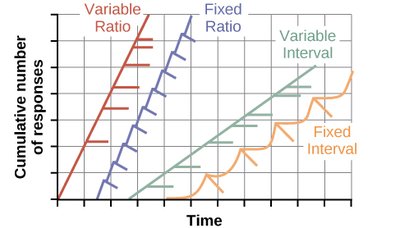
Additional info: Variable ratio schedules are most resistant to extinction; fixed interval schedules are easiest to extinguish.
Cognition and Latent Learning
Latent Learning and Cognitive Maps
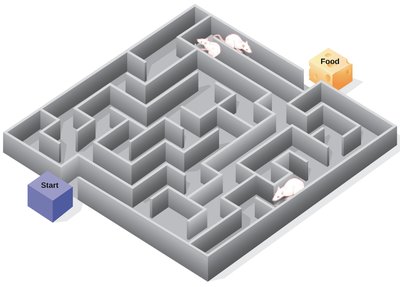
Edward C. Tolman’s research showed that learning can occur without immediate reinforcement, suggesting a cognitive component. Rats developed a mental map of a maze and demonstrated latent learning when a reward was introduced.
Latent Learning: Learning that is not immediately demonstrated in behavior.
Cognitive Map: Mental representation of spatial layout.
Human Example: Children learn routes by observation and demonstrate knowledge when needed.
Glossary of Key Terms
Cognitive map: Mental picture of the layout of the environment.
Fixed interval reinforcement schedule: Behavior is rewarded after a set amount of time.
Fixed ratio reinforcement schedule: Set number of responses must occur before a behavior is rewarded.
Law of effect: Behaviors followed by satisfying consequences are repeated; unpleasant consequences discourage behavior.
Negative punishment: Taking away a pleasant stimulus to decrease or stop a behavior.
Negative reinforcement: Taking away an undesirable stimulus to increase a behavior.
Operant conditioning: Learning in which the stimulus/experience happens after the behavior is demonstrated.
Partial reinforcement: Rewarding behavior only some of the time.
Positive punishment: Adding an undesirable stimulus to stop or decrease a behavior.
Positive reinforcement: Adding a desirable stimulus to increase a behavior.
Primary reinforcer: Has innate reinforcing qualities (e.g., food, water, shelter, sex).
Punishment: Implementation of a consequence to decrease a behavior.
Radical behaviorism: Skinner’s form of behaviorism, focusing solely on stimulus-outcome associations.
Reinforcement: Implementation of a consequence to increase a behavior.
Secondary reinforcer: Has no inherent value; only reinforcing when linked with something else (e.g., money, gold stars).
Shaping: Rewarding successive approximations toward a target behavior.
Variable interval reinforcement schedule: Behavior is rewarded after unpredictable amounts of time.
Variable ratio reinforcement schedule: Number of responses differ before a behavior is rewarded.
Vicarious punishment: Observer sees model punished, making observer less likely to imitate behavior.
Vicarious reinforcement: Observer sees model rewarded, making observer more likely to imitate behavior.
