Back
BackOrganizational Behavior: Syllabus Overview and Key Topics
Study Guide - Smart Notes
 Tailored notes based on your materials, expanded with key definitions, examples, and context.
Organizational Behavior: Syllabus Overview
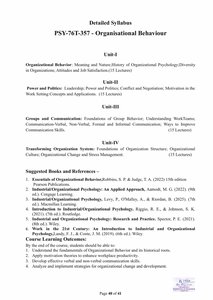
Unit I: Organizational Behavior
Organizational Behavior is the study of how individuals and groups act within organizations. This unit introduces the meaning and nature of organizational psychology, focusing on diversity in organizations, attitudes, and job satisfaction.
Diversity in Organizations: Examines the variety of differences among people in an organization, including race, gender, age, and cultural background.
Attitudes and Job Satisfaction: Explores how employees' attitudes affect their job satisfaction and organizational outcomes.
Example: A diverse workforce can enhance creativity and problem-solving but may also present challenges in communication and integration.
Unit II: Power and Politics
This unit covers the dynamics of leadership, power, and politics within organizations, as well as conflict and negotiation. It also addresses motivation in the work setting and its impact on organizational effectiveness.
Leadership: The process of influencing others to achieve organizational goals.
Power and Politics: Power refers to the capacity to influence others, while politics involves the use of power in organizational settings.
Conflict and Negotiation: Conflict arises from differences in interests or values, and negotiation is the process of resolving these conflicts.
Motivation: The internal and external factors that drive individuals to take action.
Example: A manager uses negotiation skills to resolve a dispute between team members, ensuring continued productivity.
Unit III: Groups and Communication
This unit explores the foundations of group behavior, communication, and work teams. It also discusses communication models, non-verbal communication, and the impact of technology on communication.
Group Behavior: How individuals behave in group settings, including roles, norms, and group dynamics.
Communication: The process of sharing information, including verbal and non-verbal methods.
Work Teams: Groups of people with complementary skills working toward a common goal.
Communication Models: Frameworks for understanding how information is transmitted and received.
Example: Effective communication within a team leads to better collaboration and project outcomes.
Unit IV: Organizational Systems
This unit examines the structure and dynamics of organizations, including organizational structures, organizational culture, and organizational change and development.
Organizational Structure: The formal arrangement of jobs and reporting relationships within an organization.
Organizational Culture: The shared values, beliefs, and norms that influence how employees think and act.
Organizational Change and Development: Processes aimed at improving organizational effectiveness and adapting to environmental changes.
Example: A company undergoing restructuring may need to address changes in culture and employee roles to ensure a smooth transition.
Suggested Books and References
Essentials of Organizational Behavior – Robbins, S. P. & Judge, T. A. (2017)
Organizational Behavior – Luthans, F. (2017)
Organizational Behavior – McShane, S. L. & Von Glinow, M. A. (2018)
Handbook of Industrial, Work & Organizational Psychology – Anderson, N., Ones, D. S., Sinangil, H. K., & Viswesvaran, C. (2001)
Industrial and Organizational Psychology – Muchinsky, P. M. (2006)
Course Learning Outcomes
Understand the meaning, nature, and scope of organizational behavior and industrial/organizational psychology.
Explain the role of power, politics, and leadership in organizations.
Describe the foundations of group behavior and communication in work teams.
Analyze organizational structure, culture, and processes of change and development.