 Back
BackParenting Styles and Their Effects on Child Development
Study Guide - Smart Notes
 Tailored notes based on your materials, expanded with key definitions, examples, and context.
Parenting and Child Development
Introduction to Parenting
Parenting plays a crucial role in shaping a child's psychological, emotional, and social development. Researchers have identified several key questions regarding the impact of parenting on children, including the effects of parental employment, single-parent households, adoption, separation, divorce, and disciplinary strategies.
Effects of Dual Working Parents: Investigates how children are influenced when both parents work outside the home, considering factors such as supervision, emotional support, and role modeling.
Single-Parent Households: Explores the challenges faced by children raised by one parent, including economic stress, reduced parental attention, and social stigma.
Adopted and Fostered Children: Examines whether children raised by non-biological parents experience differences in adjustment, attachment, and well-being compared to those raised by biological parents.
Impact of Separation and Divorce: Considers the potential negative effects on a child's emotional and social development, such as increased risk of behavioral problems and academic difficulties.
Guidance and Discipline: Discusses effective strategies for guiding and disciplining children to promote healthy development.
Parenting Styles
Overview of Parenting Styles
Parenting styles are categorized based on levels of warmth (emotional support and affection) and control (discipline and expectations). The four primary styles are Permissive, Uninvolved, Authoritarian, and Authoritative. Each style has distinct characteristics and is associated with different child outcomes.
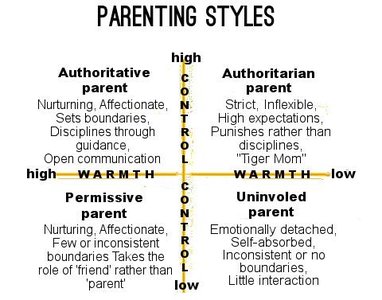
Permissive Parenting
The permissive parent demonstrates high warmth but low control. This style is characterized by a nurturing and affectionate approach, with few rules, minimal expectations, and little guidance or direction. Permissive parents often act more like friends than authority figures, allowing children significant autonomy in decision-making.
Key Features: High emotional support, low discipline, few boundaries, and limited parental involvement in problem-solving.
Child Outcomes: Children may become bossy, dependent, impulsive, and exhibit low self-control and achievement. They may struggle with persistence and emotional regulation.
Example: A parent who rarely enforces bedtime or chores, allowing the child to decide their own routines.
Uninvolved Parenting
The uninvolved parent exhibits both low warmth and low control. This style is marked by emotional detachment, minimal communication, and a lack of consistent boundaries or discipline. Uninvolved parents may show little interest in their child's activities or needs.
Key Features: Low responsiveness, low demands, excessive freedom for the child, and limited parental guidance.
Child Outcomes: Associated with behavioral problems, depression, externalizing behaviors (e.g., aggression, delinquency), and attention issues. Effects may persist into adolescence and adulthood.
Example: A parent who is frequently absent or disengaged, providing little supervision or support.
Authoritarian Parenting
The authoritarian parent combines low warmth with high control. This style is characterized by strict discipline, high expectations, limited flexibility, and one-way communication from parent to child. Authoritarian parents often use punishment rather than guidance and rarely negotiate rules.
Key Features: High demands, low emotional support, rigid rules, and frequent use of punishment.
Child Outcomes: Children may develop hostility, delinquency, rebelliousness, anxiety, and depression. They may also struggle with autonomy and moral reasoning.
Example: A parent who enforces strict curfews and punishes any deviation without discussion.
Authoritative Parenting
The authoritative parent demonstrates both high warmth and high control. This style is considered the most effective, as it balances nurturing support with clear expectations and consistent discipline. Authoritative parents communicate openly, explain rules, and encourage independence while maintaining appropriate boundaries.
Key Features: High responsiveness, high demands, clear communication, and use of reasoning in discipline.
Child Outcomes: Associated with greater competence, maturity, assertiveness, self-control, moral reasoning, and prosocial behavior.
Example: A parent who sets clear rules for homework but listens to the child's perspective and adjusts expectations as needed.
Comparison of Parenting Styles
The following table summarizes the main characteristics of each parenting style:
Parenting Style | Warmth | Control | Typical Child Outcomes |
|---|---|---|---|
Permissive | High | Low | Impulsivity, low self-control, dependency |
Uninvolved | Low | Low | Behavioral problems, depression, aggression |
Authoritarian | Low | High | Hostility, anxiety, low autonomy |
Authoritative | High | High | Competence, self-control, maturity |
Conclusion
Understanding parenting styles is essential for recognizing their impact on child development. Authoritative parenting is generally associated with the most positive outcomes, while permissive, uninvolved, and authoritarian styles can contribute to various behavioral and emotional challenges in children.
