 Back
BackParts of the Brain & Memory: Structure and Function
Study Guide - Smart Notes
 Tailored notes based on your materials, expanded with key definitions, examples, and context.
Parts of the Brain & Memory
Overview of Brain Functions in Memory
Memory is a complex process involving multiple regions of the brain. Early research by Karl Lashley sought to identify the physical location of memory, known as the engram. Lashley's experiments led to the equipotentiality hypothesis, suggesting that if one part of the brain involved in memory is damaged, another part can compensate. Modern neuroscience has identified specific brain regions crucial for different types of memory.
Main Brain Regions Involved in Memory
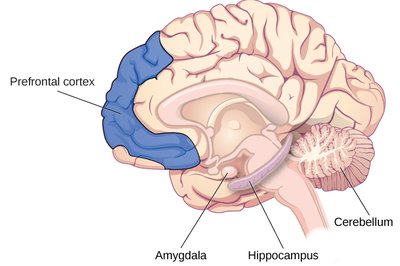
Amygdala: Regulates emotions such as fear and aggression; involved in emotional memory formation and memory consolidation.
Hippocampus: Essential for declarative, episodic, and spatial memory; projects information to cortical regions for meaning and connection; critical for memory consolidation.
Cerebellum: Processes procedural memories, motor learning, and classical conditioning.
Prefrontal Cortex: Involved in semantic tasks and retrieval of information; activation varies with task type.
The Amygdala
The amygdala is central to emotional memory formation. It regulates emotions and influences how memories are stored, especially under stress. Emotional arousal enhances memory encoding and consolidation. Experiments with rats show that damage to the amygdala can erase fear memories, demonstrating its role in emotional learning.
Memory consolidation: The process of transferring new learning into long-term memory, facilitated by emotional arousal.
Example: Pavlovian conditioning in rats, where a tone paired with a shock creates a fear memory, which can be extinguished by damaging the amygdala.
The Hippocampus
The hippocampus is vital for forming new declarative memories and spatial navigation. Lesions in the hippocampus impair recognition and spatial memory. It also connects memories with meaning and other memories. Damage to the hippocampus, as seen in patient H.M., results in an inability to form new declarative memories but preserves older memories.
Declarative memory: Memory of facts and events.
Spatial memory: Memory for locations and spatial relationships.
Example: Rats with hippocampal lesions show impaired maze navigation and object recognition.
The Cerebellum and Prefrontal Cortex
The cerebellum is involved in implicit memory, such as procedural learning and classical conditioning. Damage to the cerebellum impairs conditioned responses, like the eye-blink reflex. The prefrontal cortex is active during semantic tasks and retrieval, as shown by PET scans. Different regions are activated during encoding and retrieval.
Implicit memory: Unconscious memory for skills and procedures.
Semantic tasks: Tasks involving meaning, such as categorizing nouns.
Example: PET scans show left frontal activity during encoding and right frontal activity during retrieval.
Neurotransmitters and Memory
Neurotransmitters are chemical messengers critical for memory formation. Key neurotransmitters include epinephrine, dopamine, serotonin, glutamate, and acetylcholine. Repeated neural activity increases neurotransmitter release and strengthens synaptic connections, supporting memory consolidation.
Arousal theory: Strong emotions trigger strong memories; weaker emotions result in weaker memories.
Example: Stress increases glutamate release, enhancing memory for stressful events.
Flashbulb Memories
A flashbulb memory is an exceptionally clear recollection of an important event, often associated with strong emotional arousal. These memories are vivid and long-lasting, but not always accurate. The 9/11 terrorist attacks are a classic example, with most people recalling where they were when they heard the news.
Example: Survey data shows 97% of Americans aged 8 or older at the time of 9/11 remember the moment they learned of the event.

Inaccurate and False Memories
Even flashbulb memories can lose accuracy over time. Memory is not a perfect recording; it is reconstructed from components stored in different brain regions. This reconstruction process can introduce errors, leading to false memories, where individuals recall events or details that did not occur.
Memory reconstruction: The process of assembling a memory from its stored components.
False memory: Remembering something that did not happen.
Example: Research participants recall hearing a word that was never presented.
Glossary
Arousal theory: Strong emotions trigger the formation of strong memories; weaker emotions form weaker memories.
Engram: Physical trace of memory.
Equipotentiality hypothesis: Some parts of the brain can take over for damaged parts in forming and storing memories.
Flashbulb memory: Exceptionally clear recollection of an important event.
