 Back
BackPersonality Theories and Trait Models: Study Notes
Study Guide - Smart Notes
 Tailored notes based on your materials, expanded with key definitions, examples, and context.
Personality Theories and Trait Models
Trait Theory of Personality
Trait theory focuses on identifying and describing specific psychological characteristics that make up a person's personality. Traits are stable over time and can be used to predict behavior in various situations.
Trait: A consistent characteristic that influences behavior.
Example: An extraverted person is likely to be sociable at a party.
Gordon Allport's Trait Typology
Gordon Allport identified over 4,500 words in the English language to describe personality traits and organized them into three categories:
Cardinal Traits: Dominant traits that direct most of a person's activities.
Central Traits: Major characteristics that form the foundation of personality.
Secondary Traits: Traits that influence behavior in fewer situations and have less impact.
Example: Eddie Munson's personality can be analyzed using Allport's categories.
The Five Factor Model (Big Five/OCEAN)
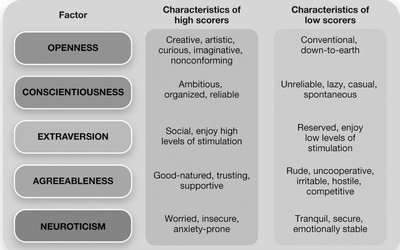
The Five Factor Model is the dominant trait theory in psychology, describing personality using five broad dimensions. It is universal across cultures and is used to predict behavior and understand personality development.
Openness: Creativity, curiosity, and imagination.
Conscientiousness: Organization, reliability, and ambition.
Extraversion: Sociability and high stimulation preference.
Agreeableness: Trust, supportiveness, and good-naturedness.
Neuroticism: Anxiety, insecurity, and emotional instability.
Maturity Principle: Agreeableness and conscientiousness tend to increase with age.
Cultural Variations: The Big Five are observed across different cultures, though expression may vary.
HEXACO Model
The HEXACO model expands the Five Factor Model by adding a sixth factor: honesty/humility. This factor includes sincerity, modesty, and altruism.
Honesty/Humility: Sincere, honest, modest, and altruistic traits.
Stability of Personality Traits
Personality traits are generally stable over time, especially after adolescence. The maturity principle suggests that traits such as agreeableness and conscientiousness become more dominant with age, often during university years.
Undercontrolled children: More likely to engage in externalizing behaviors.
Inhibited children: Tend to internalize behaviors.
Early behavior: Predicts personality at age 40.
Behaviourist Approach
The behaviourist perspective, championed by B.F. Skinner, views personality as a collection of learned behaviors shaped by patterns of reinforcement. Personality can change through learning new behavior patterns.
Observable behavior: Only behaviors that can be seen are considered.
Reinforcement: Social behaviors (e.g., being sociable at parties) are reinforced by attention.
Social Cognitive Approach
This approach emphasizes the interaction between individuals and their environment, including observational learning and modeling. Reciprocal determinism describes how environment and individual influence each other.
Self-efficacy: Belief in one's ability to succeed in specific situations.
High self-efficacy: Leads to motivation, confidence, and seeking opportunities.
Developing self-efficacy: Involves attention to prior successes/failures and reinforcement from others.
Cultural Influences on Personality
Culture shapes personality traits and values. Individualist cultures (e.g., Western nations) emphasize independence and personal achievement, while collectivist cultures (e.g., Asia, Africa, South America) prioritize social harmony and group needs.
Individualist traits: More personally oriented.
Collectivist traits: More socially oriented.
Regional Differences
Personality clusters: Friendly/conventional, relaxed/creative, temperamental/uninhibited.
Selective migration: People relocate to regions that fit their personality.
Climate: May influence personality (e.g., heat increases irritability).
Biological Approach
The biological perspective examines the influence of genetics and temperament on personality. Twin studies show that even when raised apart, twins often have similar personalities, suggesting a strong genetic component.
Temperament: Affects parental treatment and later personality development.
Psychoanalytic Theory (Freud)
Freud's psychoanalytic theory posits that unconscious forces, memories, and urges shape personality. Personality is structured into three components:
ID: Operates on the pleasure principle, seeking immediate gratification.
Ego: Operates on the reality principle, mediating between ID and external reality.
Superego: Acts as the moral guardian, striving for perfection.
Psychosexual Development
Freud proposed five stages of psychosexual development, each associated with conflicts and potential fixations:
Oral Stage: Oral fixation may result from unresolved conflicts.
Anal Stage: Anal fixation may result from strict or lenient toilet training.
Phallic Stage: Oedipus complex emerges.
Latency Stage: Sexual urges are dormant.
Genital Stage: Mature sexual interests develop.
Defense Mechanisms
Defense mechanisms are tools used to mediate between the ID, superego, and external reality:
Repression: Blocking thoughts/feelings from consciousness.
Denial: Refusing to acknowledge repressed feelings/thoughts.
Regression: Retreating to earlier developmental stages under stress.
Projection: Attributing threatening impulses to others.
Displacement: Redirecting impulses toward more acceptable objects.
Neo-Freudian Theories
Neo-Freudians expanded on Freud's ideas:
Carl Jung: Introduced the concept of the collective unconscious and distinguished between introversion and extraversion.
Karen Horney: Challenged Freud's gender assumptions, arguing that women's inferiority was due to social status, not anatomy (introduced "womb envy").
Birth Order and Personality
Intelligence: Slightly affected by birth order.
Personality: Not significantly impacted by birth order.
More siblings: May promote cooperative personality, agreeableness, and honesty/humility.
Humanistic Approaches
Humanistic theories emphasize the unique and positive qualities of human experience and potential. Exceptional individuals share traits such as creativity, realistic thinking, and concern for others.
Maslow: Described self-actualized individuals as having few friends, well-developed sense of humor, and peak experiences.
Carl Rogers: Proposed that self-actualization and positive regard are central to personality development.
Self-concept: Congruence (alignment between real self and self-perception) leads to satisfaction; incongruence leads to anxiety.
Unconditional positive regard: Acceptance without judgment fosters self-actualization.
Projective Tests
Projective tests are personality assessments that ask individuals to interpret ambiguous images or situations, with the idea that they project their true feelings and thoughts onto them.
The Dark Triad and Related Traits
The Dark Triad refers to three non-clinical personality traits associated with manipulative and antisocial behavior:
Psychopathy: Low empathy, impulsivity, thrill-seeking, coldness; linked to amygdala dysfunction.
Narcissism: Entitlement, superiority, excessive self-love, desire for attention, fragile self-esteem.
Machiavellianism: Manipulative, dishonest, focused on personal gain, cynical, unprincipled, lack of empathy.
Sadism: Pleasure from hurting, humiliating, or controlling others; associated with cruelty, manipulativeness, and low emotional regulation.
Example: Individuals with high levels of these traits may struggle in collaborative or empathy-driven environments.
