 Back
BackPersonality: Theories, Traits, and Assessment
Study Guide - Smart Notes
 Tailored notes based on your materials, expanded with key definitions, examples, and context.
Personality: Theories, Traits, and Assessment
Introduction to Personality
Personality refers to the unique and enduring patterns of thoughts, feelings, and behaviors that characterize an individual. Psychologists study personality to understand individual differences and predict behavior across various situations.
Trait Theories of Personality
Early Trait Research
Trait theories focus on identifying and measuring individual personality characteristics. Gordon Allport identified thousands of words describing traits and organized them into three categories:
Cardinal Traits: Dominant traits that influence most aspects of a person's behavior.
Central Traits: General characteristics found to some degree in every person (e.g., honesty, sociability).
Secondary Traits: Traits that appear only in certain situations and are less influential.
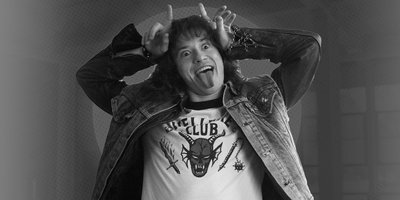
Example: A person might be described as a nonconformist (cardinal), creative and loyal (central), and a "metalhead" (secondary).
The Big Five (Five Factor Model)
The Big Five model is the most widely accepted trait theory, proposing five broad dimensions of personality:
Openness to Experience: Imagination, creativity, curiosity.
Conscientiousness: Organization, dependability, discipline.
Extraversion: Sociability, assertiveness, enthusiasm.
Agreeableness: Trustworthiness, altruism, kindness.
Neuroticism: Emotional instability, anxiety, moodiness.
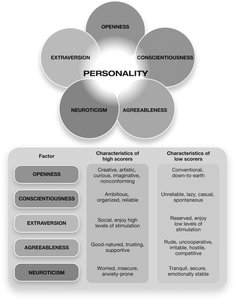
Applications: The Big Five traits predict real-world outcomes such as academic/job success (conscientiousness), leadership (extraversion), and relationship quality (agreeableness, low neuroticism).
HEXACO Model
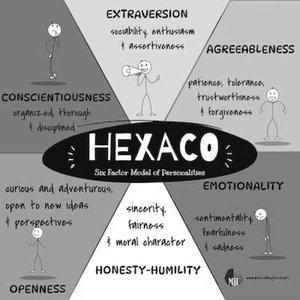
The HEXACO model extends the Big Five by adding a sixth factor: Honesty-Humility. High scorers are sincere and modest, while low scorers are manipulative and self-important.
Stability and Development of Traits
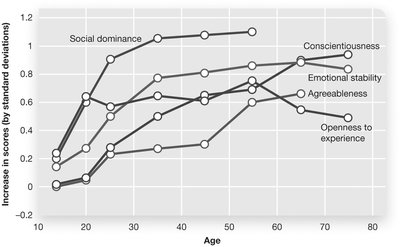
Personality traits are relatively stable over time, but some (like agreeableness and conscientiousness) tend to increase with age—a phenomenon known as the maturity principle. Early temperament can predict adult personality, and certain childhood behaviors (e.g., impulsivity) are linked to later outcomes.
Learning and Social-Cognitive Perspectives
Behaviorist Perspective
Behaviorists argue that personality is a collection of learned behavior patterns shaped by reinforcement. People can change their personalities by learning new behaviors.
Social Cognitive Approach
This approach emphasizes the interaction between individuals and their environments (Bandura). Key concepts include:
Observational Learning: Learning behaviors by watching others.
Reciprocal Determinism: Personality is shaped by the interaction of behavior, cognition, and environment.

Self-Efficacy
Self-efficacy is the belief in one's ability to succeed in specific situations. High self-efficacy leads to confidence and persistence, while low self-efficacy can result in anxiety and avoidance.
Cultural and Biological Influences
Individualist vs. Collectivist Cultures
Culture shapes personality expression. Individualist cultures (e.g., U.S., England) value independence and assertiveness, while collectivist cultures (e.g., Asia, Africa) value social harmony and group needs.
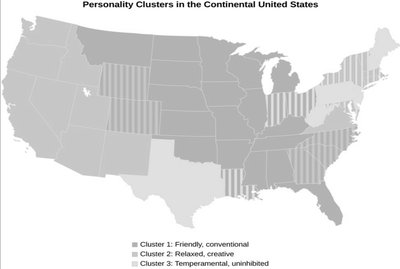
Regional Differences in the USA
Personality traits can cluster regionally, with some areas being more friendly/conventional, others more creative/relaxed, and others more uninhibited.
Biological Approach
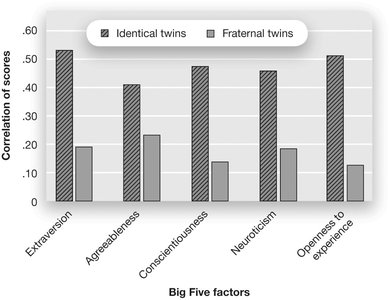
Genetic studies, such as twin studies, show that personality traits are partly inherited. Identical twins raised apart are as similar as those raised together, indicating a strong genetic component.

Psychoanalytic Theory
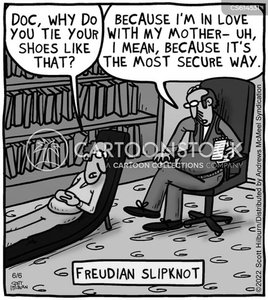
Freud's Structure of Personality
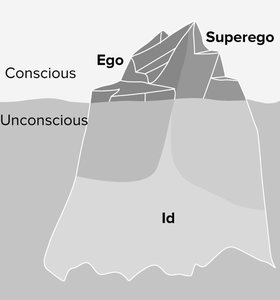
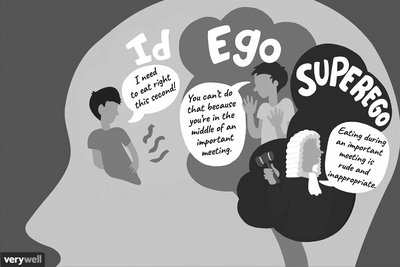
Freud proposed that personality consists of three interacting systems:
Id: Operates on the pleasure principle; seeks immediate gratification.
Ego: Operates on the reality principle; mediates between id and superego.
Superego: Moral conscience; strives for perfection.
Psychosexual Stages of Development
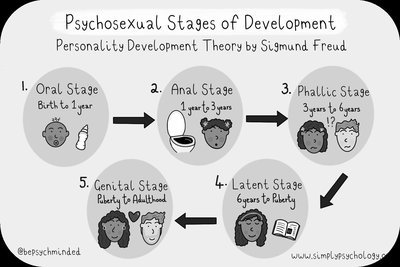
Freud theorized that personality develops through stages focused on different erogenous zones. Fixations can occur if conflicts are not resolved at each stage.
Oral Stage (0-1 yr): Pleasure from sucking/eating; fixation leads to oral behaviors.
Anal Stage (2-4 yrs): Toilet training; fixation can result in messiness or excessive orderliness.
Phallic Stage (4-6 yrs): Focus on genitals; Oedipus/Elektra complex.
Latency Stage (6-12 yrs): Sexual feelings dormant; focus on skills and hobbies.
Genital Stage (12+ yrs): Mature sexual intimacy; successful resolution leads to well-balanced personality.
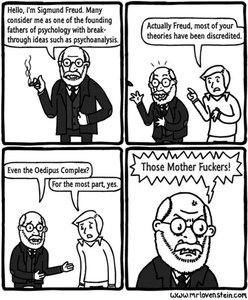
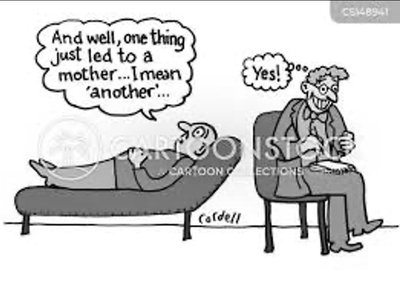
Defense Mechanisms
Defense mechanisms are unconscious strategies the ego uses to reduce anxiety by distorting reality. Examples include repression, denial, regression, projection, and displacement.

Neo-Freudian Theories
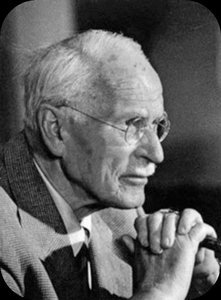
Neo-Freudians expanded on Freud's ideas. Carl Jung introduced the collective unconscious and archetypes, and Karen Horney challenged Freud's views on gender, proposing that social factors, not anatomy, explain women's experiences.
Humanistic Approaches
Maslow and Rogers
Humanistic theories emphasize free will, self-actualization, and the inherent goodness of people. Maslow identified traits of self-actualized individuals, while Rogers focused on the importance of self-concept and unconditional positive regard for healthy personality development.
Personality Assessment
Self-Report Measures
Self-report inventories, such as the MMPI-2, ask individuals to answer questions about their behaviors and feelings. These tests are widely used in clinical settings to assess personality and psychological disorders.
Projective Tests
Projective tests, like the Rorschach Inkblot Test and Thematic Apperception Test (TAT), present ambiguous stimuli and ask individuals to interpret them. These tests aim to uncover unconscious aspects of personality but are criticized for subjectivity.
Dark Triad and Tetrad Traits
The Dark Triad
The Dark Triad refers to three socially aversive personality traits: narcissism, psychopathy, and Machiavellianism. These traits are associated with aggression, low empathy, and manipulative behaviors.
Dark Tetrad: Sadism
Some researchers add sadism to the triad, forming the "Dark Tetrad." Sadism involves deriving pleasure from inflicting pain or humiliation on others.
Dating and the Dark Triad
Individuals high in Dark Triad traits often pursue short-term mating strategies, use manipulation, and may struggle with long-term relationships.
Birth Order and Personality
Research suggests that birth order has little lasting effect on major personality traits, though firstborns may score slightly higher on intelligence tests. Larger sibship size is associated with higher honesty-humility and agreeableness.
Summary Table: Big Five Traits
Factor | High Scorers | Low Scorers |
|---|---|---|
Openness | Creative, curious, imaginative | Conventional, narrow interests |
Conscientiousness | Organized, reliable, disciplined | Unreliable, lazy, careless |
Extraversion | Sociable, energetic, assertive | Reserved, solitary, quiet |
Agreeableness | Trusting, kind, cooperative | Rude, uncooperative, suspicious |
Neuroticism | Worried, insecure, emotional | Calm, secure, emotionally stable |
