 Back
BackPersonality: Theories, Traits, and Biological Foundations
Study Guide - Smart Notes
 Tailored notes based on your materials, expanded with key definitions, examples, and context.
Personality
Introduction to Personality
Personality refers to the characteristic patterns of thinking, feeling, and behaving that are unique to an individual and remain relatively consistent over time and across situations. Psychologists study personality to understand individual differences and predict behavior.
Idiographic approach: Focuses on detailed descriptions of unique personality traits in individuals.
Nomothetic approach: Examines large groups to make generalizations about personality structure.
Personality tests: Tools used to assess personality traits, such as the use of descriptive words and the Barnum effect (the tendency to accept vague, general personality descriptions as uniquely applicable to oneself).
Personality Traits and Models
Personality traits are enduring characteristics that describe an individual's behavior. The most widely accepted model is the Five Factor Model (OCEAN):
Openness: Associated with cognitive functioning, achievement, and engagement. High openness correlates with higher IQ and adaptability to stress.
Conscientiousness: Linked to better health, longevity, goal accomplishment, and lower risk behaviors.
Extraversion: Related to relationship satisfaction, well-being, and sometimes risky behaviors.
Agreeableness: Involves teamwork, social harmony, and self-transcendence.
Neuroticism (Emotional Stability): High neuroticism is linked to stress, poor sleep, and lower well-being.
Personality Across the Lifespan
Personality traits can change over the lifespan, influenced by both genetic and environmental factors. Temperament in childhood often predicts later personality.
Well-adjusted: Self-controlled, confident, adaptable.
Under-controlled: Impulsive, restless, emotionally volatile.
Inhibited: Socially uncomfortable, fearful, easily upset by new situations.
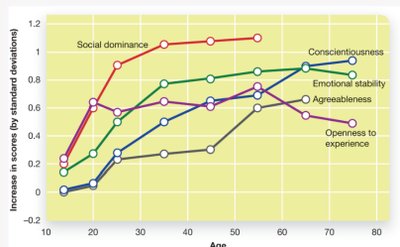
Alternative Models and Dark Traits
HEXACO Model: Expands OCEAN by adding Honesty-Humility (HH). High HH indicates sincerity and modesty; low HH is linked to deceit and greed.
The Dark Triad: Consists of Machiavellianism, psychopathy, and narcissism—traits associated with manipulative and antisocial behavior.
Authoritarian Personality: Characterized by rigidity, dogmatism, and "us vs. them" thinking; related to low openness.
Biological Approaches to Personality
Genetic Influences
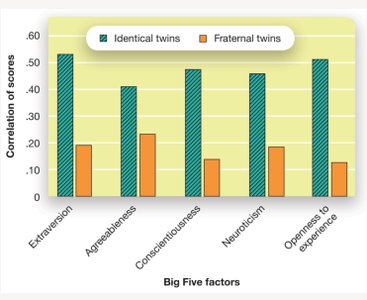
Genetic studies, including twin and adoption studies, show that personality traits are heritable. Identical twins show higher correlations in personality traits than fraternal twins, indicating a genetic component.
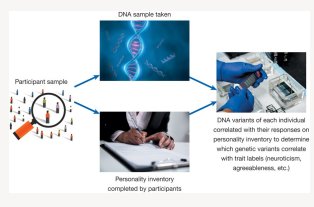
Modern research uses genome-wide association studies (GWAS) to identify specific genes linked to personality traits, such as the 5-HTT gene related to neuroticism.
Evolution and the Brain
Evolutionary psychology explores why personality traits evolved. For example, animal studies (e.g., in Parus major, the great tit) show individual differences in exploration and risk-taking, suggesting evolutionary roots for personality.

The arousal theory of extraversion posits that extraversion is determined by an individual's threshold for arousal, regulated by the Ascending Reticular Activating System (ARAS) in the brain.
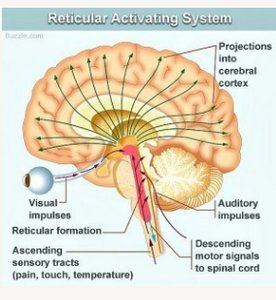
Behavioral Activation System (BAS): Regulates approach behavior and sensitivity to rewards.
Behavioral Inhibition System (BIS): Regulates avoidance behavior and sensitivity to punishment.
Psychodynamic Approach (Freud)
Freud's Theory of Personality
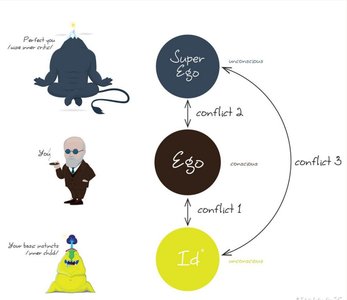
Freud proposed that personality is shaped by unconscious conflicts among three structures of the psyche:
Id: Operates on the pleasure principle, seeking immediate gratification.
Superego: Represents morality and conscience.
Ego: Operates on the reality principle, mediating between the id and superego.
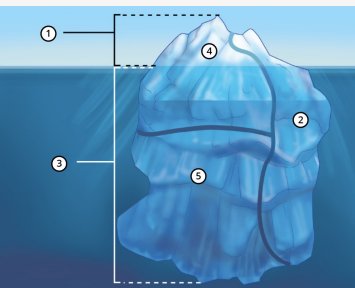
Freud likened the mind to an iceberg, with the conscious mind above water and the much larger unconscious mind below.
Defence Mechanisms
Defence mechanisms are unconscious strategies used by the ego to reduce anxiety from internal conflicts:
Denial: Refusing to acknowledge unpleasant realities.
Displacement: Redirecting impulses to a safer target.
Identification: Adopting characteristics of a more powerful person.
Projection: Attributing one's own unacceptable qualities to others.
Rationalization: Justifying behaviors with plausible but false reasons.
Reaction formation: Transforming unacceptable impulses into their opposites.
Repression: Burying distressing thoughts in the unconscious.
Sublimation: Channeling unacceptable impulses into socially acceptable activities.
Psychosexual Stages of Development
Freud theorized that personality develops through a series of stages, each focused on a different erogenous zone:
Oral stage (0-18 months): Focus on security and empowerment; fixation can lead to oral behaviors in adulthood.
Anal stage (18 months-3 years): Focus on control and competence; fixation can result in rigidity or messiness.
Phallic stage (3-6 years): Focus on relationships with parents; includes Oedipus complex and castration anxiety.
Latency stage (6-13 years): Period of relative calm and freedom from sexual concerns.
Genital stage (puberty onward): Mature adult sexuality develops.
