 Back
BackPiaget’s Preoperational Stage and Cognitive Development in Early Childhood
Study Guide - Smart Notes
 Tailored notes based on your materials, expanded with key definitions, examples, and context.
Piaget’s Preoperational Stage of Cognitive Development
Progression of Activities in Early Childhood
During the preoperational stage, children engage in increasingly complex play activities that reflect their cognitive growth. Constructive and pretend play are common among 2-year-olds, while 5- and 6-year-olds participate in sophisticated role-play and debate rules.
Constructive Play: Building and manipulating objects, fostering problem-solving skills.
Pretend Play: Using imagination to create scenarios, demonstrating symbolic thinking.
Role-Play: Assigning roles and negotiating rules, indicating social and cognitive development.
Piaget’s View of Early Childhood Thinking
Piaget characterized children’s thought during the preoperational stage as dominated by the acquisition of the semiotic function, which is the ability to use symbols for communication and thinking. This stage is marked by a strong capacity for symbol use but limited logical reasoning.
Semiotic Function: The ability to represent objects and events with symbols, such as words, images, or gestures.
Symbol Use: Children begin to understand and use models, maps, and graphic symbols (letters).
Logical Thinking: Children in this stage struggle with logical operations and often rely on intuition.
Interventions: Targeted support can help children with disabilities develop social and symbolic skills.
Egocentrism
Egocentrism is a hallmark of preoperational thinking, where children view the world solely from their own perspective. They assume others see, think, and feel as they do.
Definition: The inability to differentiate between one’s own viewpoint and that of others.
Example: Children may not understand that someone else can see a different view of an object.

Piaget’s Three Mountains Task is used to assess egocentrism. Children are asked to describe what another person sees from a different perspective. Preoperational children often fail this task, demonstrating egocentric reasoning.
Centration and Animism
Centration refers to the tendency to focus on one aspect of a situation while ignoring others. Animism is the belief that inanimate objects are alive.
Centration: Children may believe any moving object is alive, or focus on one variable at a time.
Animism: Attributing life and emotions to dolls and stuffed animals.
Observation-Based Reasoning: Conclusions are often based on immediate perceptions.
Conservation
Conservation is the understanding that quantity remains the same despite changes in appearance. Preoperational children typically fail conservation tasks due to centration.
Conservation Task: Children are shown two identical arrays, then one is transformed. If they recognize the quantity is unchanged, they demonstrate conservation.
Logical Reasoning: Rarely seen before age 5.
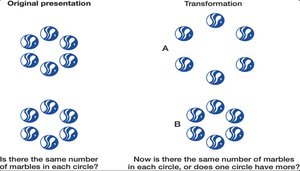
A Conservation Problem illustrates how children may incorrectly judge quantity based on appearance rather than logic.
Themes of the Preoperational Stage
Two major themes characterize early childhood cognition: increased symbolic ability and limited logical independence.
Symbol Use: Language development and pretend play are key indicators.
Limited Logical Thinking: Children require adult guidance and protection.
Challenges to Piaget’s View
Recent Research Findings
While studies confirm many of Piaget’s observations, evidence suggests preschoolers are more cognitively sophisticated than he proposed.
Egocentrism: Research shows children as young as 2 or 3 can understand differences in perception and adapt their behavior accordingly.
Perspective-Taking: John Flavell identified two levels: Level 1 (basic awareness of different experiences) and Level 2 (complex rules for understanding others’ perspectives).
Understanding Emotions: Preschoolers can recognize emotions in others, challenging Piaget’s view of egocentrism.
Other Cognitive Changes in Early Childhood
Theories of Mind
Theory of mind refers to the ability to understand that others have thoughts, beliefs, and perspectives different from one’s own. It develops gradually in early childhood and is linked to brain maturation and language development.
Emergence: By age 3, children understand that people act with goals and intentions.
False-Belief Principle: Children learn that others can hold beliefs different from reality, tested with tasks like the "crayon box" experiment.
Influences: Cognitive and language development, pretend play, and working memory are crucial.
Cross-Cultural Findings: Theory of mind development is observed universally, though cultural variations exist.
Alternative Theories of Early Childhood Thinking
Neo-Piagetian Theories
Neo-Piagetian theorists explain children’s performance on cognitive tasks in terms of working-memory limitations. Robbie Case introduced the concept of short-term storage space (STSS) and operational efficiency.
Short-Term Storage Space (STSS): The maximum number of cognitive schemes a child can attend to at once.
Operational Efficiency: Improves with practice and brain maturation.
Matrix Classification
Matrix classification tasks require children to categorize stimuli based on two dimensions. Young children often fail these tasks due to limited operational efficiency, but can learn with instruction.
Task Example: Placing objects in categories based on color and shape.
Training: Instruction can help children succeed in matrix classification.
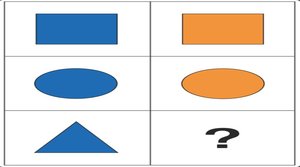
Matrix Classification Task demonstrates how children categorize objects based on multiple attributes, highlighting cognitive development and limitations.
Summary Table: Key Features of Preoperational Stage
Feature | Description | Example |
|---|---|---|
Semiotic Function | Ability to use symbols | Pretend play, drawing |
Egocentrism | Difficulty seeing others’ perspectives | Three Mountains Task |
Centration | Focus on one aspect | Conservation task |
Animism | Belief objects are alive | Talking to dolls |
Conservation | Understanding quantity remains constant | Marble arrangement task |
Theory of Mind | Understanding others’ beliefs | False-belief test |
Additional info: Academic context was added to clarify definitions, provide examples, and expand on theoretical concepts for completeness and exam preparation.
