 Back
BackProblems with Memory: Amnesia, Forgetting, and Memory Errors
Study Guide - Smart Notes
 Tailored notes based on your materials, expanded with key definitions, examples, and context.
Problems with Memory
Introduction
Memory is a complex cognitive process that is essential for learning, daily functioning, and personal identity. However, memory is not infallible; it is subject to various errors and failures. This section explores the different types of amnesia, the unreliability of eyewitness testimony, encoding failure, memory errors, and the mechanisms of interference.
Amnesia
Types of Amnesia
Amnesia refers to the loss of long-term memory due to disease, physical trauma, or psychological trauma. The two main types are anterograde amnesia and retrograde amnesia.
Anterograde Amnesia: Inability to form new memories after the event that caused the amnesia. The hippocampus is often affected, resulting in the inability to transfer information from short-term to long-term memory. Procedural memory may remain intact.
Retrograde Amnesia: Loss of memory for events that occurred before the trauma. Individuals cannot recall some or all of their past episodic memories.

Example: The case of K.C., who could not remember any events from his life except those from the last minute or two, illustrates severe episodic amnesia. H.M., another famous case, could not form new memories after surgery but could learn new motor skills.
Memory Construction and Reconstruction
Suggestibility and Eyewitness Testimony
Memory is not a perfect recording of events. The processes of construction (forming new memories) and reconstruction (retrieving and potentially altering old memories) can introduce inaccuracies. Suggestibility refers to the creation of false memories due to misinformation from external sources.
Eyewitness testimony is highly susceptible to suggestion and can lead to wrongful convictions.
Leading questions and confirmation by authorities can reinforce false memories.
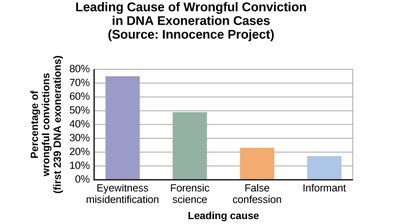
Example: The case of Ronald Cotton, who was wrongfully convicted based on eyewitness misidentification, demonstrates the dangers of suggestibility in legal contexts.
The Misinformation Effect
The misinformation effect paradigm shows that exposure to incorrect information after an event can alter a person's memory of the event. Loftus and Palmer's (1974) study demonstrated that the wording of questions can influence eyewitness recollections.
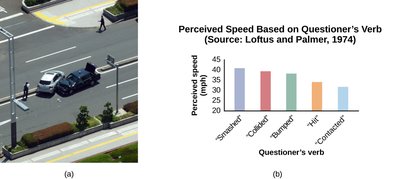
Example: Participants estimated higher speeds and falsely remembered seeing broken glass when asked how fast cars were going when they 'smashed' versus 'contacted' each other.
Repressed and Recovered Memories
There is ongoing debate about the accuracy of recovered memories, especially those of traumatic events. Some researchers argue that traumatic memories can be repressed and later recovered, while others, like Elizabeth Loftus, caution that therapeutic techniques can create false memories through suggestion.
Forgetting
Encoding Failure
Encoding failure occurs when information is never stored in long-term memory, often due to lack of attention or effortful processing. Without encoding, retrieval is impossible.

Example: Most people cannot accurately recall the details of a common coin because they never encoded those details in the first place.
Memory Errors: Schacter’s Seven Sins of Memory
Daniel Schacter identified seven ways memory can fail, grouped into forgetting, distortion, and intrusion. These are summarized in the table below:
Sin | Type | Description | Example |
|---|---|---|---|
Transience | Forgetting | Accessibility of memory decreases over time | Forgetting events from long ago |
Absentmindedness | Forgetting | Lapses in attention | Forgetting where your phone is |
Blocking | Forgetting | Temporary inaccessibility of information | Tip-of-the-tongue phenomenon |
Misattribution | Distortion | Confusing the source of information | Recalling a dream as a real event |
Suggestibility | Distortion | False memories from leading questions | Misidentifying a suspect |
Bias | Distortion | Memories distorted by current beliefs | Aligning memories to current beliefs |
Persistence | Intrusion | Inability to forget unwanted memories | Traumatic events |
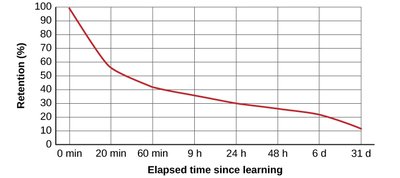
Example: Transience is illustrated by the rapid decay of memory over time, as shown by Ebbinghaus's forgetting curve.
Absentmindedness and Blocking
Absentmindedness: Memory lapses due to breaks in attention.
Blocking: Temporary inability to access information, often experienced as the tip-of-the-tongue phenomenon.

Distortion Errors: Misattribution, Suggestibility, and Bias
Misattribution: Confusing the source of a memory (e.g., blaming a crime on someone seen on TV).
Suggestibility: False memories created by external suggestions.
Bias: Memory distortion due to current beliefs or feelings (e.g., stereotypical, egocentric, and hindsight bias).
Persistence
Persistence is the involuntary recall of unwanted memories, often traumatic, which can interfere with daily functioning.
Interference
Types of Interference
Interference occurs when information in memory competes, making retrieval difficult. There are two main types:
Proactive Interference: Old information hinders the recall of newly learned information.
Retroactive Interference: New information hinders the recall of older information.
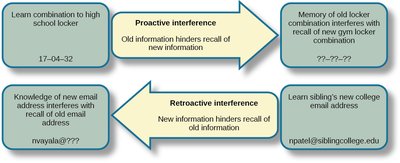
Example: Accidentally giving out your old phone number after getting a new one is proactive interference; forgetting old concepts after learning new ones is retroactive interference.
Summary
Memory is a dynamic and reconstructive process, susceptible to various errors and failures. Amnesia, encoding failure, memory errors, and interference all contribute to forgetting and the unreliability of memory, especially in legal contexts. Understanding these processes is crucial for both psychological science and practical applications such as eyewitness testimony.
