 Back
Back9. Reasoning, Decision Making, and Problem Solving: Key Concepts in Cognitive Psychology
Study Guide - Smart Notes
 Tailored notes based on your materials, expanded with key definitions, examples, and context.
Reasoning, Decision Making, and Problem Solving
Normative and Descriptive Approaches
Understanding how humans think and make decisions involves two main approaches: the normative approach and the descriptive approach. These frameworks help psychologists and economists analyze rationality and actual behavior.
Normative Approach: Theories about how people should behave if they were perfectly rational (e.g., maximizing outcomes, as in economics).
Descriptive Approach: Theories about how people actually behave, including the reasons for deviations from rationality (e.g., psychological biases, memory construction).
Deviation from the normative model is often seen as a failure of rationality, but descriptive models seek to understand why these deviations occur.
Reasoning
Reasoning is the process of drawing conclusions from evidence or principles. It can be divided into two main types: inductive reasoning and deductive reasoning.
Deductive Reasoning: Starts with general principles and applies them to specific cases to reach logically certain conclusions.
Inductive Reasoning: Begins with specific observations or facts and formulates general principles or theories based on patterns found in the data.
Science often uses both: collecting facts (induction) and testing predictions (deduction).
Examples: Forensics uses induction to reconstruct events from evidence and deduction to test hypotheses about suspects.
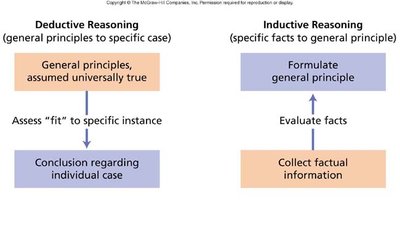
Key Differences Between Deductive and Inductive Reasoning
Deductive Reasoning | Inductive Reasoning |
|---|---|
General principles to specific case | Specific facts to general principle |
Conclusion is logically certain if premises are true | Conclusion is probable, not certain |
Example: All humans are mortal; Socrates is human; therefore, Socrates is mortal. | Example: Observing that the sun rises every day and concluding it will rise tomorrow. |
Confirmation Bias
Confirmation bias is the tendency to seek out information that confirms our existing beliefs and to ignore or undervalue evidence that could disconfirm them.
People often fail to use disconfirming evidence and may even avoid it.
This bias can persist even when individuals are aware of it.
Example: Political polarization, where individuals only consider evidence supporting their views.
Minimizing confirmation bias involves actively seeking out information that challenges one's beliefs.
Decision Making
Decision making involves choosing between alternatives and is influenced by how information is presented and processed.
Framing Effect: The way a question or problem is worded can significantly affect decisions.
People tend to be risk-seeking when facing potential losses and risk-averse when facing potential gains.
Emotions and subjective perceptions often lead to deviations from rational decision-making models.
Heuristics and Biases
Heuristics are mental shortcuts or rules of thumb that simplify decision making but can lead to systematic errors or biases.
Availability Heuristic: Judging the frequency or likelihood of an event based on how easily examples come to mind.
Availability in memory does not always reflect actual frequency in the world (e.g., overestimating rare but dramatic events like terrorist attacks compared to common ones like bathtub accidents).
Heuristics can reinforce confirmation bias by making certain information more accessible.
Problem Solving
Problem solving is the process of finding solutions to difficult or complex issues. It often requires both bottom-up (objective) and top-down (subjective) processing.
Individuals bring their own perspectives and prior knowledge to problem solving.
Classic problems, such as the "matchstick problem," illustrate the need for creative and flexible thinking.
Summary and Thought Questions
Reasoning and decision making are influenced by both objective data and subjective biases.
Heuristics and imperfect memory are not always detrimental; they can be adaptive but sometimes lead to errors.
Key questions: Is imperfect memory always bad? Are heuristics always problematic?
Recommended reading: "Thinking, Fast and Slow" by Daniel Kahneman.
