 Back
BackResearch Methods and Scientific Thinking in Psychology
Study Guide - Smart Notes
 Tailored notes based on your materials, expanded with key definitions, examples, and context.
Research Design in Psychology
The Importance of Good Research Design
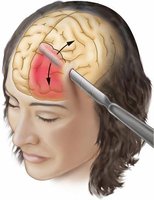
Effective research design is essential for drawing valid conclusions in psychology. Poorly designed studies can lead to false beliefs and ineffective treatments, as illustrated by historical examples such as facilitated communication for autism and the prefrontal lobotomy procedure.
Facilitated Communication: Initially believed to help children with autism communicate, later research revealed that facilitators, not the children, were the source of the messages.
Prefrontal Lobotomy: Once considered a treatment for mental illness, later controlled studies showed it was ineffective and often harmful.

Why We Need Research Designs
Even intelligent individuals can be misled by intuitive thinking. Common cognitive errors include:
Naive Realism: The belief that we see the world precisely as it is.
Confirmation Bias: The tendency to seek out evidence that supports our beliefs and ignore evidence that contradicts them.
Scientific Methodology in Psychology
Heuristics and Modes of Thinking
Heuristics are mental shortcuts that simplify decision-making but can lead to oversimplification and errors. For example, people may incorrectly judge which city is farther north based on familiarity rather than geographic knowledge.
Principles of Scientific Method
Random Selection: Ensures that study results can be generalized to the broader population.
Reliability: The consistency of a measurement.
Interrater Reliability: The degree to which different observers agree on what they are measuring.
Validity: The extent to which a test measures what it claims to measure.
Replicability: The ability to duplicate research findings in new studies.
Types of Research Designs
Naturalistic Observation
Researchers observe behavior in real-world settings without intervention.
Advantage: High external validity (generalizability to real-life situations).
Disadvantage: Low internal validity (difficulty in establishing cause-and-effect relationships).
Laboratory Observation
Observation occurs in a controlled laboratory environment, allowing for more control but potentially less generalizability.
Case Study Designs
In-depth study of one or a few individuals, often used for rare or unusual phenomena. While informative, case studies may not allow for generalization or hypothesis testing.
Self-Report Measures and Surveys
These tools assess characteristics such as personality or mental health through questionnaires.
Advantages: Easy to administer and collect data from large groups.
Disadvantages: Relies on participants' self-awareness and honesty; subject to response biases such as social desirability and malingering.
Psychological Tests
Standardized tests used to assess psychological functioning or symptoms.
Correlational Designs
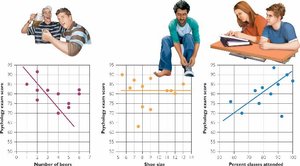
Correlational studies examine the relationship between two variables. Correlations can be positive, negative, or zero, and are quantified by the correlation coefficient (r), which ranges from -1.0 to 1.0.
Illusory Correlation: Perceiving a relationship where none exists (e.g., full moon and crime rates).
Directionality Problem: Correlation does not imply causation; A may cause B, B may cause A, or a third variable (C) may cause both.
Experimental Designs
Experiments allow for cause-and-effect conclusions by manipulating an independent variable and observing its effect on a dependent variable. Key features include random assignment and control groups.
Confounds: Variables other than the independent variable that may affect the outcome.
Ethical Issues in Research Design
Human Research Ethics
All research involving humans must be reviewed for ethical considerations, including:
Institutional Review Board (IRB) approval
Informed consent
Justification for deception
Debriefing after participation

Animal Research Ethics
Animal research is used to generate knowledge about the brain and behavior, primarily with rodents and birds. Ethical debates focus on animal welfare and the generalizability of findings to humans.
Statistics in Psychological Research
Descriptive Statistics
Descriptive statistics summarize and describe data sets.
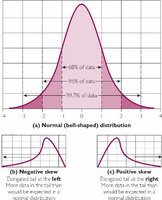
Central Tendency: Indicates where most data points cluster (mean, median, mode).
Variability: Describes how spread out the data are (range, standard deviation).

Inferential Statistics
Inferential statistics help determine whether findings from a sample can be generalized to a population.
Statistical Significance: The likelihood that a result is not due to chance (commonly, p < .05).
Meta-Analysis: Combines results from multiple studies to assess overall trends.
Practical Significance: The real-world importance of a finding.
Misuse of Statistics
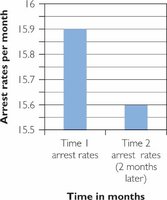
Statistics can be manipulated to mislead, such as by reporting unrepresentative measures or truncating graph axes.
Evaluating Psychological Research
Peer Review
The peer review process helps ensure research quality by identifying flaws and suggesting improvements before publication.
Interpreting Research in the Media
Media reports may misrepresent scientific findings due to lack of expertise, sensationalism, or misunderstanding. Students should critically evaluate sources and be wary of "balanced coverage" that creates false controversy.
