 Back
BackResearch Methods in Psychology: Principles, Measurement, and Ethics
Study Guide - Smart Notes
 Tailored notes based on your materials, expanded with key definitions, examples, and context.
Research Methods in Psychology
Introduction to Scientific Research in Psychology
Scientific research in psychology aims to increase our understanding of behavior, mental processes, and the world around us. Psychologists use systematic methods to investigate cause-and-effect relationships and answer questions about topics such as memory, brain function, and emotional expression.
Basic Research: Focuses on theoretical questions and building foundational knowledge without immediate practical application.
Applied Research: Uses psychological principles to solve real-world problems and improve human life.
The Scientific Method
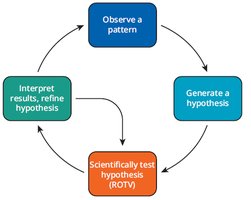
The scientific method is a structured process for empirically testing ideas and hypotheses. It involves several key steps that ensure objectivity and reliability in research.
Step 1: Observe a pattern or phenomenon.
Step 2: Generate a hypothesis to explain the pattern.
Step 3: Scientifically test the hypothesis using appropriate methods.
Step 4: Interpret results and refine the hypothesis as needed.
Objectivity vs. Subjectivity in Research
Objectivity is essential in scientific research, ensuring that measurements are consistent across observers and instruments. Subjectivity, on the other hand, occurs when personal beliefs, expectations, or experiences influence interpretation.
Objectivity: Achieved through standardized procedures and unbiased measurement tools.
Subjectivity: Can introduce bias and affect the validity of research findings.
Variables and Operational Definitions
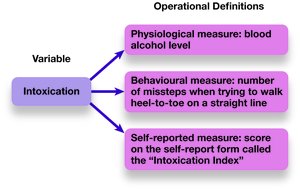
In psychological research, variables are the objects, concepts, or events being measured. To ensure clarity, researchers use operational definitions to specify how variables are observed and measured.
Variable: Any factor that can be measured or manipulated in a study.
Operational Definition: A clear statement explaining how a variable will be measured or identified in the research context.
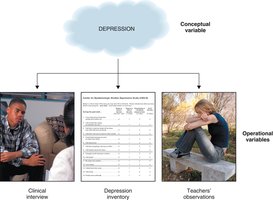
Example: Operationalizing Depression
The conceptual variable 'depression' can be operationalized in multiple ways, such as through clinical interviews, standardized inventories, or behavioral observations.
Clinical Interview: Structured conversation to assess symptoms.
Depression Inventory: Standardized questionnaire measuring severity.
Teacher's Observations: Behavioral indicators noted by educators.
Reliability and Validity in Measurement
Reliable and valid measurements are crucial for scientific research. Reliability refers to the consistency of a measure, while validity indicates whether the measure assesses what it claims to measure.
Reliability:
Test-retest Reliability: Consistency of scores over time.
Interrater Reliability: Agreement between different observers or raters.
Validity: The extent to which a test measures the intended construct.
Important: A test must be reliable to be valid, but a reliable test can still be invalid if it does not measure the intended concept.
Causation and Correlation
Research often investigates relationships between variables, such as whether debt stress causes health problems. It is important to distinguish between correlation (association) and causation (one variable directly affecting another).
Correlation: Two variables change together, but one does not necessarily cause the other.
Causation: One variable directly influences another.
Confounding Variables: Other factors that may influence both variables under study.


Generalizability of Results
Generalizability refers to the extent to which research findings can be applied to broader populations outside the study sample. Researchers use sampling techniques to ensure that study participants accurately represent the population of interest.
Random Sampling: Every member of the population has an equal chance of being selected, reducing bias and increasing generalizability.
Representative Sample: The sample closely matches the characteristics of the population.
Bias in Psychological Research
Bias can be introduced by both researchers and participants, affecting the integrity and trustworthiness of research findings. Minimizing bias is essential for sound scientific conclusions.
Researcher Bias: Unintentional influence by the researcher.
Participant Bias: Changes in behavior due to awareness of being observed.
Techniques to Reduce Bias: Anonymity, confidentiality, and careful study design.
Types of Bias
Demand Characteristics: Cues that inform participants about expected behavior.
Hawthorne Effect: Behavior changes due to being observed.
Social Desirability: Responding in ways that are viewed favorably by others.
Characteristics of Poor Research
Lack of Falsifiable Hypotheses: Hypotheses must be testable and capable of being disproven.
Anecdotal Evidence: Personal stories used as evidence, which differ from systematic qualitative research.
Biased Selection of Data: Only presenting data that supports a particular view.
Appeal to Authority: Accepting claims without supporting evidence.
Appeal to Common Sense: Claims that seem reasonable but lack scientific support.
Scientific Research Designs
Research design refers to the methods used to test hypotheses. Good research begins with a well-formulated question and uses appropriate methods to gather evidence.
Quantitative Methods: Focus on numerical data and statistical analysis.
Qualitative Methods: Focus on participant experiences and interviews.
Mixed Methods: Combine quantitative and qualitative approaches.
Types of Research Methods
Descriptive Research: Includes case studies, naturalistic observation, and self-reporting.
Correlational Research: Examines relationships between variables.
Experimental Research: Tests hypotheses through controlled experiments.
Quasi-experimental Research: Similar to experimental but lacks random assignment.
Surveys and Biological Research: Collect data from participants or biological measures.
Ethical Considerations in Psychological Research
Ethics guide responsible and moral research practices. Psychologists must adhere to strict ethical guidelines to protect participants and ensure integrity.
Informed Consent: Participants must be fully informed about the study and consent voluntarily.
Voluntary Participation: Participation must be free from coercion.
Debriefing: Participants are informed about the study's purpose after participation.
Confidentiality: Personal information must be protected.
Use of Students as Subjects: Special considerations for student participants.
Canadian Tri-Council Research Ethics Code
Respect for Human Dignity
Respect for Free & Informed Consent
Respect for Vulnerable Persons
Respect for Privacy & Confidentiality
Respect for Justice & Inclusiveness
Balancing Harms/Benefits
Minimizing Harm & Maximizing Benefits
Descriptive Statistics in Psychology
Descriptive statistics summarize and describe the main features of a dataset. Key terms include:
Frequency: Number of occurrences of a value.
Normal Distribution: Symmetrical, bell-shaped distribution of data.
Skewed Distribution: Asymmetrical distribution with a tail on one side.
Central Tendency: Measures include mean, median, and mode.
Variability: Spread of data, measured by standard deviation.
Standard Deviation: Quantifies the amount of variation in a dataset.
Hypothesis Testing: Statistical methods to determine if results support a hypothesis.
Formulas
Mean:
Standard Deviation:
Summary Table: Types of Reliability and Validity
Type | Description |
|---|---|
Test-retest Reliability | Consistency of scores over time |
Interrater Reliability | Agreement between different raters |
Validity | Extent to which a test measures what it claims to measure |
Summary Table: Types of Research Methods
Method | Description |
|---|---|
Descriptive | Case studies, observation, self-report |
Correlational | Examines relationships between variables |
Experimental | Tests hypotheses with controlled variables |
Quasi-experimental | Lacks random assignment |
