 Back
BackSchizophrenia Spectrum, Psychotic Disorders, and Substance-Related/Addictive Disorders
Study Guide - Smart Notes
 Tailored notes based on your materials, expanded with key definitions, examples, and context.
Schizophrenia Spectrum and Other Psychotic Disorders
Overview of Schizophrenia
Schizophrenia is a chronic psychotic disorder marked by episodes of a break with reality, including delusions, hallucinations, disorganized thinking, incoherent speech, and bizarre behavior. It is a major mental health condition with significant personal and societal impacts.
Delusions: False beliefs not based in reality (e.g., persecution, grandeur, reference, being controlled).
Hallucinations: Sensory perceptions without external stimuli (most commonly auditory).
Disorganized Speech: Includes neologisms, perseveration, clanging, and blocking.
Grossly Disorganized or Catatonic Behavior: Includes catatonia, odd gestures, waxy flexibility, and stupor.
Positive Symptoms: Excesses such as hallucinations, delusions, and disorganized behavior.
Negative Symptoms: Deficits such as social withdrawal, flattened affect, alogia, anhedonia, and avolition.
Historical Conceptions and Clinical Features
Emil Kraepelin: Described 'dementia praecox' as an early form of schizophrenia.
Eugen Bleuler: Coined the term 'schizophrenia' and identified the 'Four As': abnormal associations, autistic behavior/thinking, abnormal affect, and ambivalence.
Kurt Schneider: Distinguished between first-rank (core) and second-rank (non-specific) symptoms.
Prevalence and Impact
About 1% of adults are affected at some point.
High rates of unemployment, substance abuse, and suicide attempts.
Stigma and misconceptions about violence are common.
Onset typically in late teens or early 20s; men are at slightly higher risk.
Phases of Schizophrenia
Prodromal Phase: Early signs and decline in functioning before the first acute episode.
Acute (Active) Phase: Full psychotic symptoms emerge.
Residual Phase: Symptoms subside but some impairment remains.
Theoretical Perspectives
Multiple perspectives attempt to explain the development and maintenance of schizophrenia.
Psychodynamic: Overwhelming of the ego by primitive impulses; regression to early developmental stages.
Learning: Lack of social reinforcement and increased attention to inner fantasy world; modeling of bizarre behavior.
Biological: Genetic predisposition, dopamine hypothesis, brain abnormalities, prenatal factors (e.g., vitamin D deficiency).
Family Theories: Schizophrenogenic mother, double-bind communication, communication deviance, and expressed emotion.
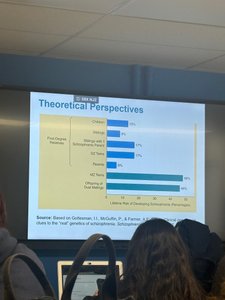
Image 1: Bar graph showing the relative support for different theoretical perspectives on schizophrenia, including genetic, family, and environmental factors.
Diathesis-Stress Model
The diathesis-stress model posits that schizophrenia results from the interaction of genetic vulnerability (diathesis) and environmental stressors.
Diathesis: Genetic or biological predisposition.
Stress: Environmental factors such as family conflict, trauma, or substance use.
Protective Factors: Supportive family, coping skills, and early intervention can reduce risk.
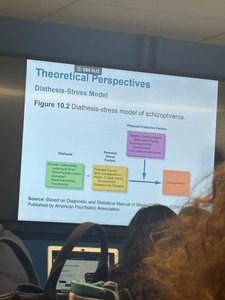
Image 2: Diagram illustrating how genetic vulnerability and environmental stressors interact to produce schizophrenia.
Other Psychotic Disorders
Delusional Disorder: Persistent non-bizarre delusions without other major symptoms.
Schizoaffective Disorder: Features of both schizophrenia and mood disorders.
Schizophreniform Disorder: Schizophrenia-like symptoms lasting 1-6 months.
Brief Psychotic Disorder: Sudden onset of psychosis lasting more than one day but less than one month, often after trauma.
Treatment Approaches
Biological: Antipsychotic drugs (typical and atypical), with risks of extrapyramidal symptoms (e.g., tardive dyskinesia, parkinsonism).
Psychosocial: Learning-based therapies (reinforcement, token economy), social skills training, cognitive-behavioral therapy (CBT), family intervention, and community support.
Comprehensive Care: Canadian guidelines recommend a combination of medication, psychoeducation, crisis intervention, and housing support.
Substance-Related and Addictive Disorders
Overview and Classification
Substance-related and addictive disorders involve maladaptive patterns of substance use leading to significant impairment or distress. These include both substance use disorders and behavioral addictions.
Polydrug Use: Use of multiple substances simultaneously.
Psychoactive Substances: Chemicals that alter mood, perception, or brain function.
Intoxication: State of behavioral or psychological change due to recent substance use.
Withdrawal Syndrome: Symptoms following reduction or cessation of substance use after dependence has developed.
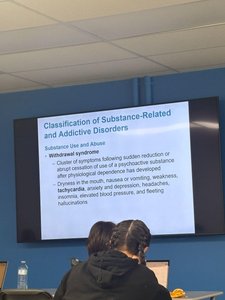
Image 3: Slide summarizing withdrawal syndromes, including symptoms such as dryness in the mouth, nausea, vomiting, weakness, tachycardia, anxiety, depression, hallucinations, and more.
Key Concepts
Addiction: Impaired control over substance use, often with physiological dependence.
Physiological Dependence: Body adapts to the substance, leading to tolerance and withdrawal symptoms.
Psychological Dependence: Emotional or mental reliance on a substance, even without physical dependence.
Pathways to Substance Use Disorder
Experimentation → Routine Use → Addiction/Dependence
Types of Substances
Depressants: Lower CNS activity (e.g., alcohol, opiates). Risks include overdose, addiction, and health complications.
Opiates: Strongly addictive, provide euphoria and pain relief (e.g., morphine, heroin, codeine, fentanyl).
Stimulants: Increase CNS activity (e.g., amphetamines, cocaine). Can cause euphoria, increased heart rate, and risk of addiction.
Hallucinogens: Cause sensory distortions (e.g., LSD, psilocybin, mescaline, marijuana).
Psychological and Sociocultural Perspectives
Learning: Operant conditioning, negative reinforcement, and observational learning contribute to substance use.
Cognitive: Beliefs and expectations about drug effects influence use (e.g., placebo effects, alcohol myopia).
Psychodynamic: Substance abuse as a sign of oral fixation or unresolved conflicts.
Sociocultural: Cultural norms, peer pressure, and social environment play a role.
Treatment Approaches
Biological: Detoxification under medical supervision, medication-assisted treatment.
Support Groups: Alcoholics Anonymous (AA), Al-Anon, and other peer support networks.
Residential Programs: Hospital or therapeutic residence for severe cases.
Cognitive-Behavioral: Self-control strategies, social skills training, cue-exposure, and relapse-prevention training.
Table: Major Types of Substances and Their Effects
Substance Type | Main Effects | Examples |
|---|---|---|
Depressants | Reduce CNS activity, induce relaxation, impair cognition | Alcohol, benzodiazepines, opiates |
Stimulants | Increase CNS activity, elevate mood, increase alertness | Amphetamines, cocaine, caffeine |
Hallucinogens | Distort perception, induce hallucinations | LSD, psilocybin, marijuana |
