 Back
BackScience and Pseudoscience in Psychology: Foundations, Critical Thinking, and Theoretical Perspectives
Study Guide - Smart Notes
 Tailored notes based on your materials, expanded with key definitions, examples, and context.
Introduction to Psychology
What Is Psychology?
Psychology is defined as the scientific study of the mind, brain, and behavior. It is a broad discipline that spans multiple levels of analysis, from biological to social influences. Understanding psychology requires integrating knowledge across these levels to fully explain complex human behavior.
Mind: Refers to mental processes such as thoughts, feelings, and motives.
Brain: The biological substrate that enables mental processes.
Behavior: Observable actions of humans and animals.
Levels of analysis range from molecular and neurochemical to social and cultural.
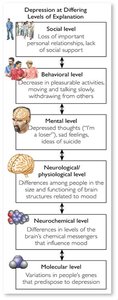
Example: Depression can be explained at multiple levels, including social (loss of relationships), behavioral (withdrawal), mental (thoughts of worthlessness), neurological (brain structure differences), neurochemical (chemical messengers), and molecular (genetic predispositions).
The Importance of Prediction and Understanding Behavior
Applications of Psychological Science
Predicting and understanding behavior is crucial for preventing harm and improving well-being. Psychological constructs and theories help us anticipate risks, such as criminal behavior or mental health crises, and inform interventions.
Understanding risk factors for harmful behaviors (e.g., substance abuse, violence).
Applying psychological knowledge to shape and improve behavior.

Example: Predicting the behavior of individuals at risk (such as those with eating disorders) can be life-saving.
Common Sense and Its Limitations
Why We Can’t Always Trust Our Common Sense
While common sense can be useful, it often leads to contradictory or inaccurate beliefs. Naïve realism—the belief that we see the world exactly as it is—can mislead us, as our perceptions are not always reliable.
Common sayings often contradict each other (e.g., "birds of a feather flock together" vs. "opposites attract").
Naïve realism can be fooled by illusions and cognitive biases.
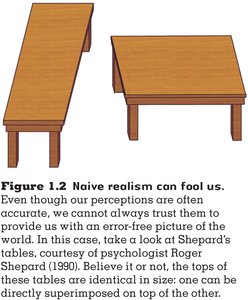
Example: Shepard's tables illusion shows that our perception of size and shape can be distorted, even when the objects are identical.

Example: Upside-down faces appear normal until rotated, illustrating how our brains process visual information in context-dependent ways.
Science vs. Pseudoscience
Defining Science and Pseudoscience
Science is a systematic approach to evidence that safeguards against biases and errors. Pseudoscience consists of claims that appear scientific but lack these safeguards and are not supported by reliable evidence.
Science: Relies on empirical evidence, testability, peer review, and self-correction.
Pseudoscience: Lacks rigorous testing, is not open to revision, and often relies on anecdotal evidence.
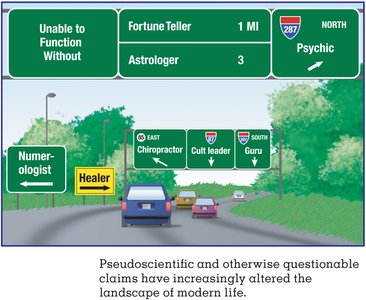
Example: Pseudoscientific claims (e.g., astrology, psychic readings) are prevalent in society and can mislead the public.
Warning Signs of Pseudoscience
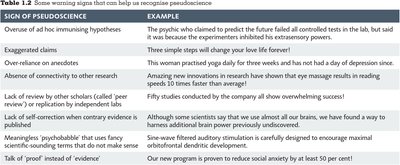
Recognizing pseudoscience is essential for critical thinking. Common warning signs include exaggerated claims, reliance on anecdotes, lack of peer review, and the use of scientific-sounding but meaningless terms.
Sign of Pseudoscience | Example |
|---|---|
Overuse of ad hoc immunizing hypotheses | The psychic who blames failed predictions on negative energy in the lab |
Exaggerated claims | "Three simple steps will change your life forever!" |
Over-reliance on anecdotes | "This woman practiced yoga daily and never felt depressed again." |
Lack of peer review or replication | "Fifty studies funded by the company all show overwhelming success." |
Lack of self-correction | "Although some scientists say we use all our brains, we found a new area." |
Meaningless psychobabble | "Sonic brainwave enhancement technology." |
Talk of 'proof' instead of 'evidence' | "Our program is proven to reduce anxiety by at least 50%." |
Popular Psychology and Its Pitfalls
Many self-help books and websites offer psychological advice, but only a small fraction are scientifically tested. Misinformation can be misleading or harmful, emphasizing the need for critical evaluation of sources.
Only about 5% of self-help books are scientifically evaluated.
Erroneous advice can lead to poor decisions and even harm.
Why Should We Care About Pseudoscience?
Pseudoscience can have serious consequences, including opportunity costs (wasting time and resources), direct harm, and undermining scientific thinking. Scientific thinking is our best defense against error and deception.
Opportunity cost: Pursuing ineffective treatments instead of evidence-based ones.
Direct harm: Dangerous interventions can cause injury or death.
Inability to think scientifically: Reduces critical thinking skills needed for informed decision-making.

Example: Tragic outcomes, such as the death of Candace Newmaker from a pseudoscientific therapy, highlight the dangers of untested interventions.
Critical Thinking in Psychology
Common Fallacies
Critical thinking involves evaluating claims with an open mind and using evidence rather than emotion or popularity as a guide. Common fallacies include:
Emotional reasoning fallacy: Letting feelings, rather than facts, guide beliefs.
Bandwagon fallacy: Assuming a claim is true because many people believe it.
"Not me" fallacy: Believing oneself immune to biases that affect others.
Great Theoretical Frameworks in Psychology
Major Perspectives
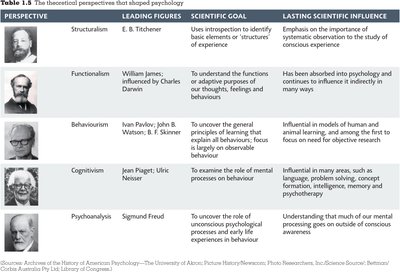
Modern psychology has been shaped by several major theoretical perspectives, each offering unique insights into human behavior and mental processes.
Perspective | Leading Figures | Scientific Goal | Lasting Scientific Influence |
|---|---|---|---|
Structuralism | E.B. Titchener | Identify basic elements of experience through introspection | Emphasis on systematic observation |
Functionalism | William James, influenced by Charles Darwin | Understand adaptive purposes of psychological characteristics | Influence on applied psychology and evolutionary theory |
Behaviourism | Ivan Pavlov, John B. Watson, B.F. Skinner | Uncover general principles of learning through observable behavior | Influence on models of learning and animal research |
Cognitivism | Jean Piaget, Ulric Neisser | Examine mental processes underlying behavior | Influence on language, memory, and problem-solving research |
Psychoanalysis | Sigmund Freud | Uncover the role of unconscious psychological processes | Emphasis on unconscious influences and early experiences |
Conclusions
Learning to think scientifically is essential for making informed decisions in psychology and everyday life. When evaluating claims from popular psychology or culture, always insist on evidence and apply critical thinking skills.
