Back
BackSensation and Perception: Foundations and Principles
Study Guide - Smart Notes
 Tailored notes based on your materials, expanded with key definitions, examples, and context.
Sensation and Perception
Introduction to Sensation and Perception
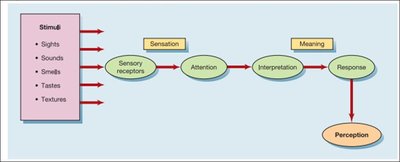
Sensation and perception are fundamental processes in psychology that allow us to detect and interpret information from our environment. Sensation refers to the detection of physical energy by sense organs, while perception involves the organization and interpretation of sensory information by the brain.
Sensation: The process by which our sensory organs detect visual, auditory, and other sensory stimuli and transmit them to the brain.
Perception: The active process of organizing and interpreting sensory information to form meaningful experiences.
Illusion: A perception that does not match reality, highlighting the difference between sensation and perception.

Psychophysics: Weber and Fechner
Understanding Sensory Thresholds
Psychophysics is the study of how physical stimuli interact with mental processes, focusing on subjective sensations. Weber and Fechner pioneered this field, introducing key concepts such as absolute thresholds, difference thresholds, and the just noticeable difference (JND).
Absolute Threshold: The smallest detectable amount of stimulation, marking the boundary between not perceiving and just perceiving a stimulus.
Difference Threshold (JND): The smallest increase or decrease in a stimulus required to produce a noticeable difference, detected 50% of the time.
Weber's Law: The JND depends on the percentage change in stimulus intensity, not the absolute amount. Stronger stimuli require larger changes for detection.
Example: Adding 500g to a 2kg weight is noticeable, but adding 500g to a 50kg weight is not. 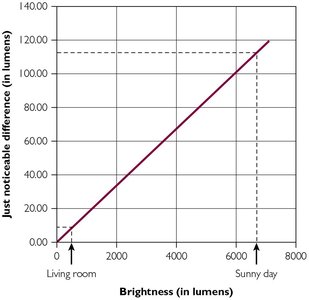
Signal Detection Theory
Detecting Stimuli in Noisy Environments
Signal detection theory explains how we detect stimuli under varying conditions, recognizing that detection involves distinguishing signals from background noise. This theory is especially relevant in occupations requiring high vigilance, such as air traffic control and medical diagnostics.
Key Point: Detection is influenced by both the presence of the stimulus and the observer's decision-making process.
Transduction and Sensory Receptors
Converting Stimuli to Neural Signals
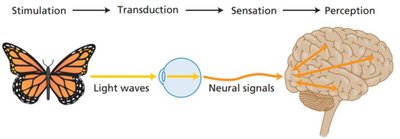
Sensory receptors are specialized cells that detect and respond to specific types of stimuli. Transduction is the process by which external sensory stimuli are converted into neural impulses that the brain can interpret.
Transduction: The transformation of physical energy (e.g., light waves) into neural signals by sensory receptors.
Sensory Adaptation
Adjusting to Unchanging Stimuli
Sensory adaptation refers to the decrease in sensitivity to a constant stimulus over time. Activation is highest when a stimulus is first detected, but gradually diminishes as adaptation occurs.
Example: Immersing yourself in cold water feels intense at first, but you adapt to the temperature over time.

Perceptual Organization and Misperception
How We Make Sense of Our Surroundings
The brain organizes sensory data into meaningful concepts, integrating current sensory input, recent experiences, and memories. Misperceptions, such as visual illusions, provide insight into how perception can differ from reality.
Example: The Moon Illusion, where the moon appears larger near the horizon than when higher in the sky.

Subliminal Information Processing
Processing Below Conscious Awareness
Subliminal information processing occurs when sensory inputs are processed without conscious awareness. These inputs can briefly influence behavior and attitudes, but effects are short-lived and diminish when individuals become aware of the influence.
Example: The Amazon logo contains a subliminal arrow from A to Z, suggesting a wide range of products.

Gestalt Principles of Perceptual Organization
Perceiving Wholes from Parts
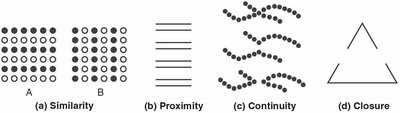
Gestalt psychology emphasizes that perception is greater than the sum of its parts. Key principles include figure-ground, similarity, proximity, continuity, and closure.
Figure-Ground Principle: Distinguishing an object (figure) from its background (ground).
Similarity: Grouping stimuli with similar characteristics.
Proximity: Grouping objects that are close together.
Continuity: Perceiving continuous patterns.
Closure: Filling in missing parts to perceive a whole figure.

Perceptual Constancy
Maintaining Stability in Perception
Perceptual constancy allows us to perceive objects as stable despite changes in angle, distance, or lighting.
Size Constancy: Perceiving the same size regardless of changes in retinal image.
Shape Constancy: Perceiving stable shape despite viewing angle changes.
Brightness Constancy: Perceiving consistent brightness under varying lighting.
Colour Constancy: Perceiving the same color under different illumination conditions.
Parallel Processing: Bottom-Up and Top-Down
Constructing and Modifying Perceptions
Parallel processing enables us to attend to multiple senses simultaneously.
Bottom-Up Processing: Building perceptions from individual sensory components detected by receptors.
Top-Down Processing: Modifying perceptions based on experiences, expectations, and context.
Example: Deciphering a doctor's handwriting (bottom-up) versus a pharmacist using experience to interpret it (top-down). 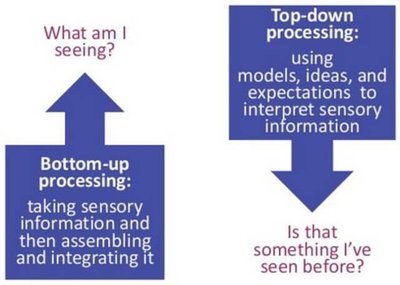
Influences on Perception: Attention
Sorting and Selecting Sensory Information
Attention is the process of focusing on specific stimuli for further processing.
Inattentional Blindness: Failure to notice changes when not directly paying attention.
Selective Attention: Focusing on one stimulus while ignoring others.
Divided Attention: Attending to multiple stimuli simultaneously.
The Binding Problem
Integrating Sensory Information
The binding problem refers to how the brain combines different sensory inputs (e.g., sight, sound, taste) into a unified perceptual experience. Rapid, coordinated activity between brain areas is thought to enable this integration.
Conclusion
Next Steps in Sensation and Perception
This overview sets the foundation for understanding sensation and perception, preparing students for deeper exploration of the visual system and other sensory modalities.