 Back
BackSensation and Perception: How We Sense and Conceptualize the World
Study Guide - Smart Notes
 Tailored notes based on your materials, expanded with key definitions, examples, and context.
Chapter 4: Sensation and Perception
Introduction
This chapter explores how humans detect, process, and interpret sensory information from the environment. It covers the principles underlying all senses, the mechanisms of vision, hearing, taste, smell, and body senses, as well as the psychological processes that shape perception and the illusions that can result.
Basic Principles of Sensation
Definitions and Key Concepts
Sensation: The detection of physical energy by sense organs, which then send information to the brain.
Perception: The brain’s interpretation of raw sensory data, resulting in meaningful experiences.
Illusion: A perception that does not match physical reality.
Transduction and Sensory Adaptation
Transduction: The process by which sense receptors convert external stimuli into neural signals.
Sensory Adaptation: Activation is highest when a stimulus is first detected, then decreases over time as adaptation occurs.
Psychophysics
Psychophysics: The study of how we perceive sensory stimuli based on their physical characteristics.
Absolute Threshold: The minimum stimulus intensity that can be detected 50% of the time (e.g., a single candle 50 km away).
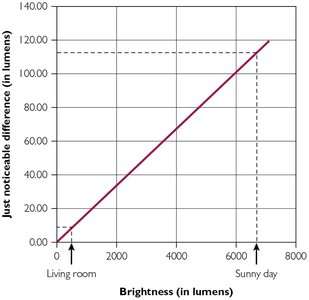
Just Noticeable Difference (JND): The smallest change in stimulus intensity that we can detect.
Weber’s Law: The JND is proportional to the intensity of the original stimulus; stronger stimuli require larger changes to be noticed.
Signal Detection Theory
Explains how we detect signals under conditions of uncertainty, accounting for both correct and incorrect responses (hits, misses, false alarms, correct rejections).
Cross-Talk Between Senses
Synesthesia: A condition in which people experience cross-modal sensations (e.g., seeing colors when hearing sounds).
Examples include the McGurk effect and the Rubber Hand Illusion.
Attention and the Binding Problem
The Role of Attention
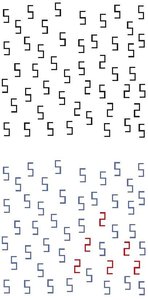
Selective Attention: Focusing on one sensory channel while ignoring others (e.g., the cocktail party effect).
Other unattended channels are still processed at some level and may reach awareness.

Inattentional Blindness: Failure to notice visible objects when attention is directed elsewhere (e.g., the Monkey illusion).
Change Blindness: Failure to detect changes in the environment, relevant in contexts like traffic safety.
The Binding Problem
Refers to how the brain integrates information from different sensory modalities into a unified perceptual experience (e.g., the look, feel, and taste of an apple).
Likely involves rapid, coordinated activity between different brain regions.
The Visual System
Light and the Eye
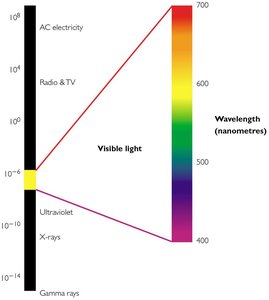
Humans perceive a narrow band of the electromagnetic spectrum as visible light (about 400–700 nm).
Other animals may see different ranges, including ultraviolet.
Properties of Light
Brightness: Amount of light reflected to the eye.
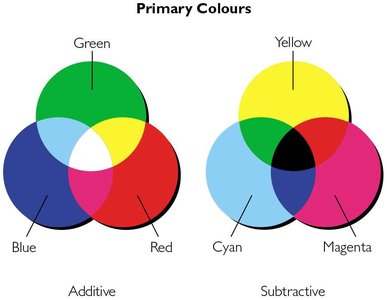
Hue: Color of light, determined by wavelength; humans are most sensitive to blue, green, and red.
Mixing lights (additive) produces white; mixing pigments (subtractive) produces black.
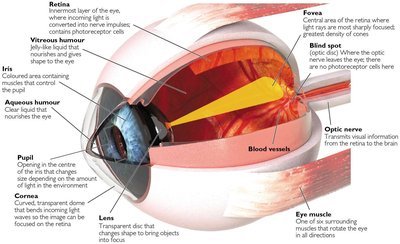
Structure of the Eye
Sclera: White part of the eye.
Iris: Colored part, controls light entry.
Pupil: Opening for light entry.
Cornea: Transparent layer focusing light.
Lens: Changes shape (accommodation) to focus light on the retina.
Retina: Membrane at the back of the eye containing photoreceptors (rods and cones).
Fovea: Central area of retina, responsible for sharp vision.
Optic Nerve: Transmits visual information to the brain; creates a blind spot.
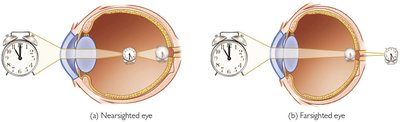
Glasses correct for myopia (nearsightedness) or hyperopia (farsightedness) by altering how light enters the eye.
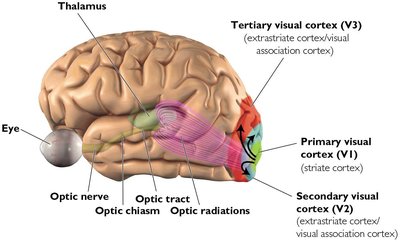
Most optic nerve fibers go to the thalamus and then the visual cortex; some go to the midbrain.
Visual Perception
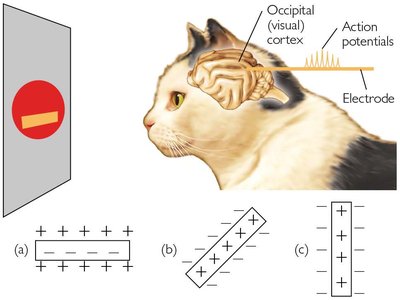
Feature detector cells in the cortex respond to specific visual stimuli (e.g., lines, edges).
Simple cells respond to orientation-specific slits of light in a particular location; complex cells are less location-dependent.
Colour Perception
Trichromatic Theory: Color vision is based on sensitivity to three primary colors (blue, green, red), consistent with three types of cones.
Explains color blindness (e.g., red-green color blindness).
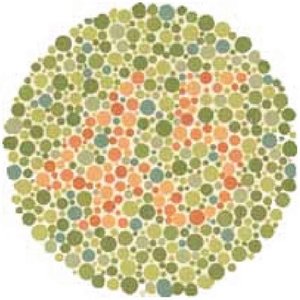
Opponent Process Theory: Color vision is based on opposing colors (red vs. green, blue vs. yellow). Afterimages support this theory.

Visual Disorders
Blindness: Can lead to reorganization of other sensory cortices (e.g., improved echolocation).
Visual Agnosia: Object recognition deficit due to cortical damage.
Blindsight: Above-chance visual performance in cortically blind individuals (damage to V1).
The Auditory System
Properties of Sound
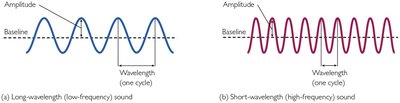
Pitch: Determined by frequency (Hz).
Loudness: Determined by amplitude (dB).
Timbre: Complexity or quality of sound.
Structure of the Ear
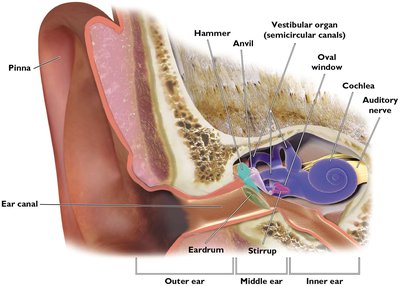
Outer Ear: Pinna and ear canal funnel sound to the eardrum.
Middle Ear: Ossicles (hammer, anvil, stirrup) transmit vibrations to the inner ear.
Inner Ear: Cochlea converts vibrations into neural activity; contains the organ of Corti and basilar membrane.
Pitch Perception
Place Theory: Different areas of the basilar membrane respond to different frequencies (high tones).
Frequency Theory: The rate of action potentials matches the frequency of the sound wave (low tones).
Smell and Taste (Chemical Senses)
Olfaction and Gustation
Both senses rely on chemical receptors stimulated by airborne or dissolved molecules.
Five basic tastes: sweet, salty, sour, bitter, umami; possible evidence for a "fatty" taste.
Odours are detected by olfactory neurons, each with a specific receptor (lock-and-key model).
Taste buds are located on papillae of the tongue; the "tongue map" is a myth.
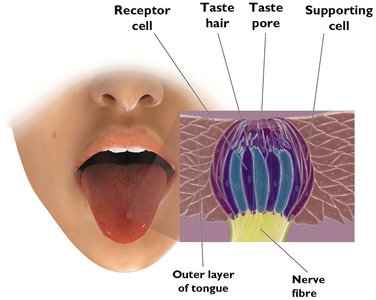
Smell and taste information converge in the orbitofrontal cortex, allowing integration of flavor and odor.
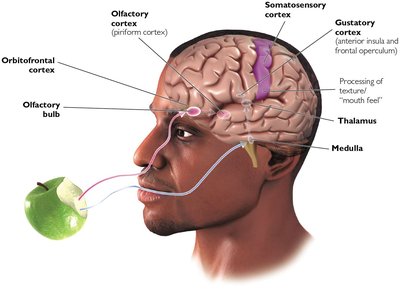
Pheromones: Odorless chemicals that serve as social signals; their role in humans is unclear.
Body Senses
Somatosensory System
Detects touch, temperature, and pain via specialized nerve endings (mechanoreceptors and free nerve endings).
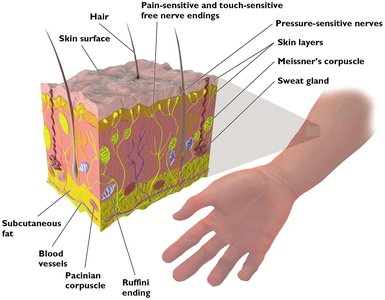
Pain Perception
Gate Control Model: Neural mechanisms in the spinal cord regulate conscious awareness of pain.
Phantom limb pain can occur after limb loss; mirror therapy may help alleviate it.
Proprioception and Vestibular Sense
Proprioception: The sense of body position and movement, involving muscle and tendon receptors.
Vestibular Sense: The sense of balance, relying on fluid-filled semicircular canals in the inner ear.
Human Factors
Field of psychology focused on optimizing technology and environments to fit human sensory and perceptual capabilities (ergonomics).
Perceptual Processes
Parallel Processing
We process multiple sensory inputs simultaneously (parallel processing).
Bottom-Up Processing: Perception is constructed from sensory input.
Top-Down Processing: Perception is influenced by expectations, experiences, and goals.

Perceptual Sets and Context
Perceptual Set: Expectations influence perception.

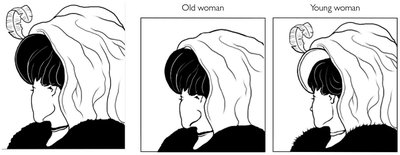
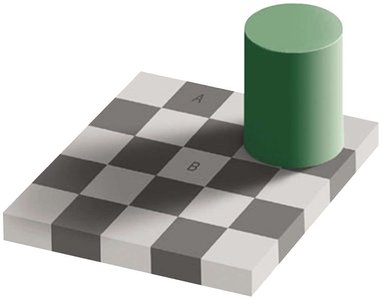
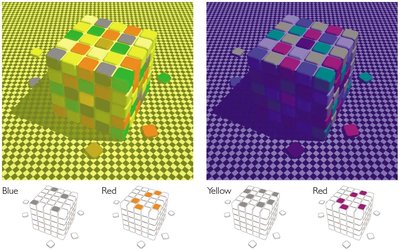
Perceptual Constancy: We perceive objects as having constant size, shape, and color despite changes in sensory input.
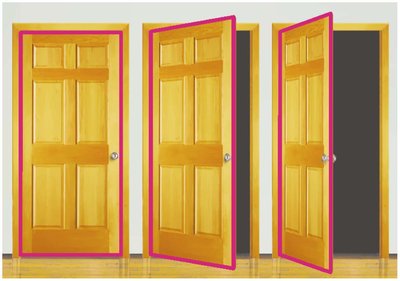
Gestalt Principles
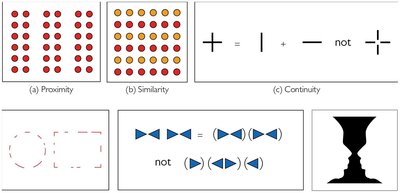
Rules for organizing sensory input into meaningful wholes, including proximity, similarity, continuity, closure, symmetry, and figure-ground relationships.
Motion and Depth Perception
Motion is detected by comparing visual frames over time (phi phenomenon).

Monocular Depth Cues: Require one eye (e.g., relative size, texture gradient, interposition, linear perspective, height in plane, light and shadow).
Binocular Depth Cues: Require both eyes (e.g., binocular disparity, convergence).
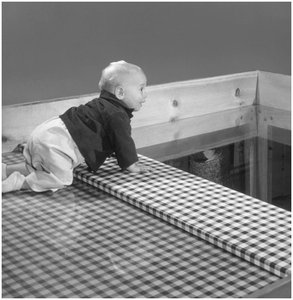
Visual cliff experiments show depth perception is partly innate and partly learned.
Perceptual Illusions and Subliminal Perception
Illusions
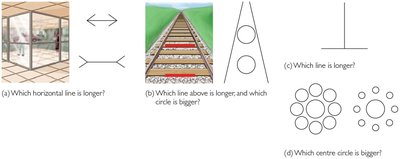
Illusions reveal how perception can be deceived (e.g., moon illusion, Muller-Lyer, Ponzo, horizontal-vertical, Ebbinghaus-Titchner illusions).

Subliminal Perception
Processing of sensory information below conscious awareness can have brief, short-term effects on attitudes and behaviors.
Subliminal self-help tapes and reversed messages are not effective for producing lasting changes.
