 Back
BackSensation and Perception: Study Guide for Psychology Students
Study Guide - Smart Notes
 Tailored notes based on your materials, expanded with key definitions, examples, and context.
Sensation and Perception
Introduction to Sensation and Perception
Sensation and perception are fundamental processes in psychology that allow us to experience and interpret the world around us. Sensation refers to the detection of physical energy by sense organs, which then send information to the brain. Perception is the brain's interpretation of these sensory inputs, enabling us to make sense of our environment.
Sensation: Sense Receptors
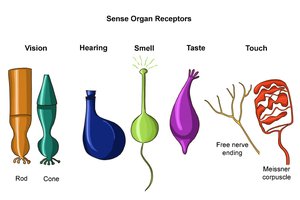
Sensation begins with specialized cells called receptors in our sense organs. Each sense organ contains unique receptors that respond to specific types of stimuli.
Vision: Rods and cones in the retina detect light and color.
Hearing: Hair cells in the cochlea respond to sound vibrations.
Smell: Olfactory receptors detect airborne chemicals.
Taste: Taste buds respond to chemical substances in food.
Touch: Free nerve endings and Meissner corpuscles detect pressure, temperature, and pain.
Perception
Perception is the process by which the brain organizes and interprets sensory information. It allows us to recognize objects, understand spatial relationships, and respond appropriately to our environment.
Interpretation: The brain uses prior knowledge, context, and expectations to interpret sensory data.
Example: Recognizing a familiar face or identifying a song from a few notes.
Bottom-up vs. Top-down Processing
Sensation and perception involve two main types of processing:
Bottom-up Processing: The whole is constructed from individual sensory parts. This is data-driven and begins with the stimulus.
Top-down Processing: Conceptually driven processing influenced by beliefs, expectations, and prior knowledge.
Example: Reading messy handwriting by using context to fill in missing letters (top-down), versus identifying a new object by its features (bottom-up).
Perceptual Constancy
Definition and Types
Perceptual constancy is the process that allows us to perceive stimuli consistently across varied conditions. This means that even when the sensory information changes, our perception of the object remains stable.
Shape Constancy: We perceive objects as having a constant shape, even when their orientation changes.
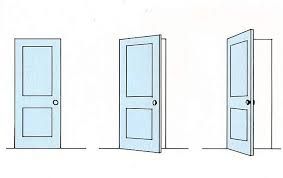
Size Constancy: We perceive objects as having a constant size, even when their distance from us changes.

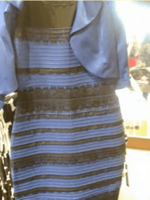
Color Constancy: We perceive colors as stable despite changes in lighting conditions.
Sense Organs and Visual System
The Eye: Structure and Function
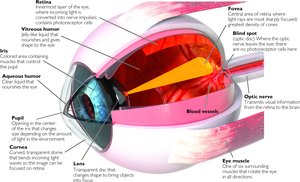
The eye is a complex organ responsible for vision. It contains several structures that focus light and convert it into neural signals.
Sclera: The white, protective outer layer of the eye.
Pupil: The opening in the center of the iris that regulates the amount of light entering the eye.
Iris: The colored part of the eye that controls the size of the pupil.
Cornea: The transparent, curved layer that covers the iris and pupil; focuses light onto the retina.
Lens: Changes curvature to keep images in focus.
The Retina and Visual Receptors
The retina is a thin membrane at the back of the eye and is technically part of the brain. It contains two main types of receptor cells:
Rods: Allow us to see in low levels of light; important for night vision.
Cones: Allow us to see in color and are sensitive to detail; concentrated in the fovea.
The fovea is the central part of the retina responsible for sharp vision (acuity).
The Optic Nerve and Blind Spot
The optic nerve transmits visual information from the retina to the brain. There are no rods or cones where the optic nerve connects to the retina, creating a blind spot in each eye.
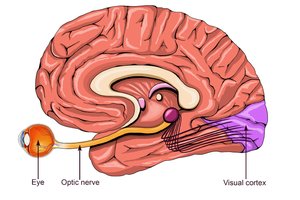
Visual Pathways
Visual information travels from the eye through the optic nerve to the visual cortex in the brain, where it is processed and interpreted.

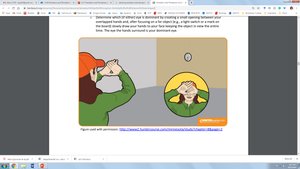
Dominant Eye Activity
To determine your dominant eye, create a small opening between your overlapped hands, focus on a distant object, and bring your hands to your face while keeping the object in view. The eye surrounded by your hands is your dominant eye.
Color Vision
Trichromatic Theory
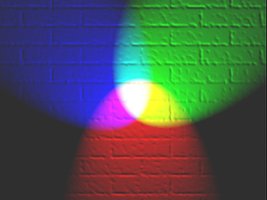
The trichromatic theory of color vision, proposed by Thomas Young and extended by Hermann von Helmholtz, states that color vision is based on our sensitivity to three primary colors: red, green, and blue. The color we perceive depends on the ratio of activity among these three types of cones.
Red-sensitive cones
Green-sensitive cones
Blue-sensitive cones
Color Blindness
Color blindness occurs when one or more cone systems malfunction. Types include:
Trichromats: Normal vision; all three cone systems function.
Dichromats: One cone system malfunctions; can still see some colors.
Monochromats: Two cone systems malfunction; see only black and white (rare).
Color blindness is more common in men than women.
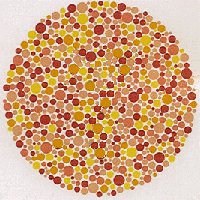
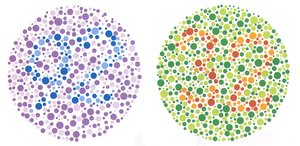
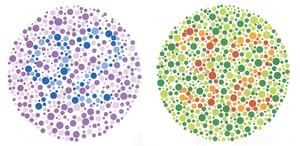
Testing for Dichromatic Colorblindness
Color blindness can be tested using special images called Ishihara plates, which contain numbers or patterns visible only to those with normal color vision.
Opponent Process Theory
The opponent process theory states that we perceive colors in terms of three pairs of opponent cells: red or green, blue or yellow, and black or white. Cells that respond to one color are inhibited by its opponent color.
Red-Green
Blue-Yellow
Black-White
Both trichromatic and opponent process theories are used in color vision; some neurons rely more on one than the other.
Summary Table: Visual Sense Receptors
Receptor Type | Function | Location |
|---|---|---|
Rods | Low-light vision | Retina (periphery) |
Cones | Color vision, detail | Retina (fovea) |
Key Equations
There are no specific equations for sensation and perception, but the following formula is relevant for color mixing:
Additional info: Academic context was added to clarify the structure and function of the eye, the theories of color vision, and the types of color blindness. Examples and applications were provided to reinforce understanding of perceptual constancy and visual processing.
