 Back
BackSkeletal System: Structure, Function, Development, and Disorders
Study Guide - Smart Notes
 Tailored notes based on your materials, expanded with key definitions, examples, and context.
General Functions of Bones
Overview of Bone Functions
Bones are essential for the structural integrity and physiological functioning of the human body. They provide support, protection, facilitate movement, produce blood cells, and store minerals.
Support & Structure: Bones form the framework of the body, maintaining posture and supporting soft tissues.
Protection: Bones shield vital organs such as the brain (skull), heart, and lungs (rib cage).
Movement: Bones act as levers for muscles, enabling motion.
Blood Cell Production (Hematopoiesis): Red bone marrow in spongy bone produces blood cells.
Mineral Storage: Bones store essential minerals, including calcium and phosphorus, which are released as needed.
Skeletal Joints
Classification of Joints
Joints connect bones and are classified structurally by the tissue type and functionally by their movement capacity.
Structural Classification:
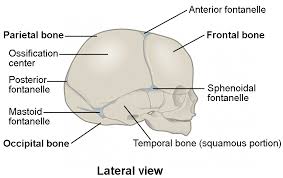
Fibrous Joints: Bones joined by dense fibrous connective tissue; minimal movement. Examples: Sutures (skull), Gomphosis (teeth), Syndesmosis (distal tibiofibular).
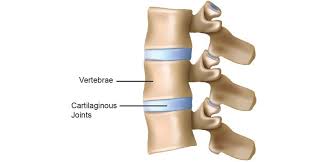
Cartilaginous Joints: Bones connected by cartilage; allow slight movement. Primary: Synchondrosis (hyaline cartilage, e.g., first rib to sternum). Secondary: Symphysis (fibrocartilage, e.g., pubic symphysis, vertebral discs).
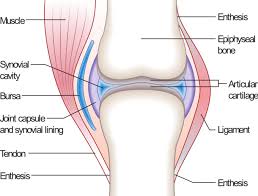
Synovial Joints: Freely movable joints with a fluid-filled cavity; most common type. Examples: Shoulder, knee, elbow, hip.
Functional Classification:
Synarthrosis: Immovable joints (e.g., skull sutures).
Amphiarthrosis: Slightly movable joints (e.g., vertebral discs, syndesmoses).
Diarthrosis: Freely movable joints (all synovial joints).
Synovial Joint Subtypes
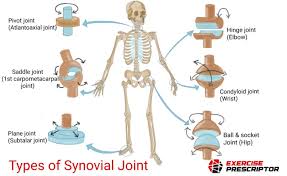
Synovial joints are further classified by their shape and movement.
Plane (Gliding): Flat surfaces slide past each other (carpals).
Hinge: Convex surface fits into concave, like a door (elbow, knee).
Pivot: Rounded end fits into a ring (atlas/axis in neck).
Condyloid (Ellipsoidal): Oval condyle fits into oval depression (knuckles).
Saddle: Both surfaces are saddle-shaped (thumb base).
Ball-and-Socket: Spherical head fits into a socket (shoulder, hip).
Growth and Development of the Skeletal System
Bone Formation Processes
The skeletal system develops from embryonic mesenchyme through two main processes:
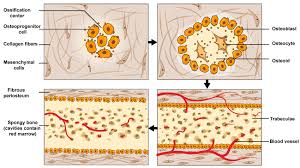
Intramembranous Ossification: Direct formation of bone from membranes, primarily for flat bones (skull, clavicle).
Endochondral Ossification: Cartilage is replaced by bone, forming most long bones (femur, humerus).
Growth in length occurs at the epiphyseal plates, while thickness increases through appositional growth. Bone remodeling continues throughout life.
Ossification (Osteogenesis)
Ossification is the process of bone formation, beginning in the embryo and continuing into adulthood. It involves osteoblasts laying down new bone tissue and is essential for growth, maintenance, and repair.
Intramembranous Ossification: Mesenchymal cells differentiate into osteoblasts, secrete osteoid, which hardens into bone.
Endochondral Ossification: Hyaline cartilage model is replaced by bone tissue, forming diaphysis and epiphyses with growth plates.
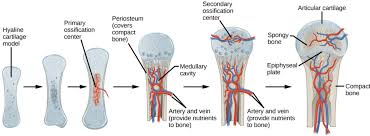
Stages of Bone Formation
Timing: Begins around the 6th-7th week of embryonic development, continues until age 25.
Cells: Osteoblasts secrete osteoid, which mineralizes.
Centers: Ossification starts at primary centers and progresses to secondary centers.
Growth in Length and Diameter
Length: Occurs at the epiphyseal plate via chondrocyte division and ossification.
Diameter: Appositional growth adds new bone to the outer surface.
Regulation: Hormones (growth hormone, estrogen, testosterone) influence growth; remodeling involves osteoclasts and osteoblasts.
Common Bone Diseases and Disorders
Overview of Skeletal Disorders
The skeletal system is susceptible to various diseases and disorders, affecting bone strength, structure, and function.
Osteoporosis: Reduced bone mass, increased fracture risk.
Osteoarthritis: Cartilage degeneration, joint pain and stiffness.
Rickets/Osteomalacia: Soft, malformed bones due to vitamin D deficiency.
Paget’s Disease: Abnormal bone remodeling, enlarged and weak bones.
Rheumatoid Arthritis: Autoimmune joint inflammation and damage.
Infections & Inflammations
Osteomyelitis: Infection causing bone inflammation.
Gout: Arthritis from uric acid crystal buildup.
Genetic & Developmental Disorders
Osteogenesis Imperfecta: Brittle bone disease, frequent fractures.
Fibrous Dysplasia: Bone tissue replaced by fibrous tissue.
Skeletal Dysplasias: Genetic conditions affecting bone/cartilage growth (e.g., Achondroplasia).
Spinal Deformities
Scoliosis
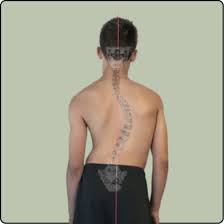
Scoliosis is a lateral curvature of the spine exceeding 10 degrees, often forming an "S" or "C" shape. It is most commonly idiopathic in adolescents but can result from neuromuscular or congenital factors.
Symptoms: Uneven shoulders, hips, or shoulder blades; back pain; reduced lung capacity in severe cases.
Kyphosis
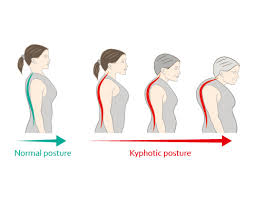
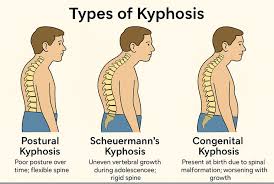
Kyphosis is an excessive outward curve of the thoracic spine, resulting in a "hunchback" appearance. It can be postural, structural, congenital, or degenerative.
Symptoms: Rounded upper back, back pain, stiffness, breathing issues.
Causes: Poor posture, muscle weakness, vertebral abnormalities, osteoporosis.
Types of Kyphosis
Postural Kyphosis: Caused by slouching, flexible.
Scheuermann's Kyphosis: Structural deformity from wedged vertebrae, rigid.
Congenital Kyphosis: Present from birth, due to abnormal spinal development.
Degenerative Kyphosis: Develops in older adults from disc issues, osteoporosis, or fractures.
Lordosis
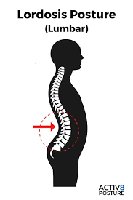
Lordosis is an excessive inward curve of the lumbar spine, resulting in a "swayback" posture. While slight lordosis is normal, hyper lordosis can cause pain and nerve issues.
Causes: Poor posture, weak core muscles, excess weight, injuries.
Treatment: Exercises, posture correction, addressing underlying causes.
Bone Cancers & Tumors
Types of Bone Cancer
Primary: Cancers originating in bone (e.g., Osteosarcoma, Ewing sarcoma).
Secondary (Metastatic): Cancer spreading to bone from other body parts.
Common Symptoms of Skeletal Issues
Symptoms
Pain, swelling, stiffness, warmth, redness
Bruising, loss of movement, popping/grinding sounds
Fatigue, unexplained weight loss (especially with cancer)
Summary Table: Structural and Functional Classification of Joints
Structural Type | Examples | Movement (Functional) |
|---|---|---|
Fibrous | Sutures, Gomphosis, Syndesmosis | Synarthrosis (Immovable) |
Cartilaginous | Synchondrosis, Symphysis | Amphiarthrosis (Slightly Movable) |
Synovial | Shoulder, Knee, Elbow, Hip | Diarthrosis (Freely Movable) |
Summary Table: Types of Spinal Deformities
Deformity | Description | Symptoms |
|---|---|---|
Scoliosis | Lateral curvature of spine | Uneven shoulders/hips, back pain |
Kyphosis | Excessive outward curve (thoracic) | Rounded back, pain, stiffness |
Lordosis | Excessive inward curve (lumbar) | Swayback, pain, nerve issues |
Key Equations and Terms
Bone Remodeling Equation
Bone remodeling is a balance between deposition and resorption:
Key Terms
Osteoblast: Bone-forming cell
Osteoclast: Bone-resorbing cell
Epiphyseal Plate: Growth plate in long bones
Osteoid: Unmineralized bone matrix
