 Back
BackSocial and Personality Development in Infancy: Key Concepts and Theories CH. 6
Study Guide - Smart Notes
 Tailored notes based on your materials, expanded with key definitions, examples, and context.
Social and Personality Development in Infancy
Introduction
Social and personality development during infancy is a foundational period in human development, marked by the formation of emotional bonds, the emergence of self-concept, and the establishment of temperament. This chapter explores major theoretical perspectives, the development of attachment, personality, temperament, self-concept, and the effects of nonparental care.
Theories of Social and Personality Development
Psychoanalytic Perspectives
Psychoanalytic theories emphasize the influence of early experiences and relationships on personality development.
Freud’s Psychosexual Stages: The oral stage (birth to two years) is when infants derive satisfaction through the mouth. Proper management of weaning is crucial; fixation can lead to oral behaviors such as nail-biting or swearing. Freud highlighted the symbiotic relationship between the birth parent and infant.
Erikson’s Psychosocial Stages: The first two years are characterized by the trust versus mistrust stage. Responsive caregiving fosters trust, while inconsistent care can lead to cynicism about the social environment. Harlow’s experiments with monkeys demonstrated the importance of comfort and emotional security over mere provision of food.


Ethological Perspectives
Ethological theories focus on the biological basis of attachment and the evolutionary significance of early relationships.
Attachment: Defined as the emotional tie to a primary caregiver, providing the infant with security.
Attachment Theory (Bowlby): The need to form attachments is considered a genetic characteristic of all humans. Infants develop internal models of relationships, which influence future social interactions.
Internal models include expectations about caregiver availability, likelihood of affection or rejection, and the sense of a safe base.

Attachment
Development of Attachment
Attachment develops through mutual interactions between infants and caregivers. Both the caregiver’s bond to the child and the child’s attachment to the caregiver are important.
Physical closeness, comforting, and affection are essential for building strong emotional bonds.
Synchrony, a mutual pattern of interaction, is crucial for attachment formation with both mothers and fathers.
Fathers and mothers interact differently, but both contribute to the infant’s development.


Bowlby’s Four Phases of Attachment
0–3 months: Nonfocused orienting and signalling – Infants use innate behaviors to signal needs and attract attention.
3–6 months: Focus on one or more figures – Infants begin to show preference for familiar caregivers.
6–24 months: Secure base behavior – True attachment emerges; the caregiver becomes a safe base for exploration.
24 months and beyond: Internal model – Children can anticipate how their actions affect relationships, influencing later social interactions.
Attachment Behaviours
Stranger anxiety: Discomfort in the presence of strangers, often expressed by clinging to the caregiver.
Separation anxiety: Distress when separated from an attachment figure.
Social referencing: Using others’ emotional expressions as a guide for one’s own emotions, aiding in emotional regulation.

Variations in Attachment Quality
Attachment quality is assessed using Ainsworth’s Strange Situation procedure, which observes infants’ reactions to separations and reunions with caregivers.
Secure attachment: Infants use the caregiver as a secure base and are comforted by their return.
Insecure attachments:
Avoidant: Infant avoids contact and shows no preference for the caregiver.
Ambivalent: Infant is upset by separation and not easily comforted upon reunion.
Disorganized/disoriented: Infant displays confused or contradictory behaviors.
Secure attachment is associated with sensitive, consistent caregiving. Inconsistent environments can lead to changes in attachment style.
Caregiver Characteristics and Attachment
Emotional Responsiveness: Willingness and ability to form a bond.
Contingent Responsiveness: Sensitivity to the child’s cues and appropriate responses.
Tactile Responsiveness: Pleasant physical contact provides comfort and buffers stress.
Caregiver Relationship Factors: Interparental conflict can lead to emotional withdrawal in infants.
Mental Health: Caregiver mental health affects responsiveness and synchrony.
Long-Term Consequences of Attachment Quality
Securely attached children are more sociable, positive, empathetic, and emotionally mature.
These characteristics persist into adolescence and adulthood, influencing social skills, leadership, self-esteem, and parenting behaviors.
Personality, Temperament, and Self-Concept
Personality and Temperament
Personality: A pattern of responding to people and objects in the environment.
Temperament: Inborn predispositions, such as activity level, that form the foundation of personality.
Dimensions of Temperament
Thomas and Chess identified three dominant temperament types: easy, difficult, and slow-to-warm-up children. The remaining infants show combinations of these types.

Dimension | Description |
|---|---|
Activity level | A tendency to move often and vigorously, rather than to remain passive or immobile. |
Approach/positive emotionality/sociability | A tendency to move toward rather than away from new people, situations, or objects, usually accompanied by positive emotion. |
Inhibition and anxiety | The flip side of approach is a tendency to respond with fear or to withdraw from new people, situations, or objects. |
Negative emotionality/irritability/anger | A tendency to respond with anger, fussiness, loudness, or irritability; a low threshold of frustration. |
Effortful control/task persistence | An ability to stay focused, to manage attention and effort. |
Origins and Stability of Temperament
Genetic and Epigenetic Factors: Identical twins are more similar in temperament than fraternal twins. Epigenetic mechanisms influence gene expression related to temperament.
Neurological Processes: Physiological patterns, such as arousal thresholds and neurotransmitter function, contribute to temperament.
Environment: Experiences and caregiver responses can modify or reinforce temperamental tendencies. Goodness-of-fit refers to the compatibility between an infant’s temperament and their environment.
Long-term Stability: Temperamental patterns often persist into later childhood and adulthood, shaped by both inborn traits and environmental responses.
Self-Concept
Subjective (Existential) Self: Awareness of being a separate, enduring individual, typically established by 8–12 months.
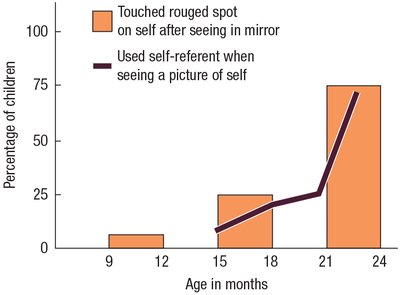
Objective (Categorical) Self: Understanding oneself as defined by categories (e.g., gender, shyness), emerging by about 18–24 months.
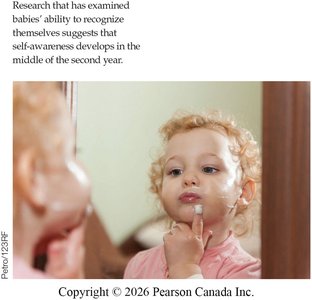
Mirror Recognition and Self-Naming: Self-awareness is demonstrated when infants recognize themselves in a mirror and use self-referent language.
The Emotional Self
Begins with the ability to identify emotions in others’ faces (2–3 months).
Emotional expression and regulation develop alongside self-awareness.
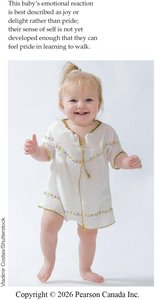
By the end of the first year, infants use caregivers’ emotions to guide their own feelings; self-conscious emotions emerge by the end of the second year.
Awareness of the Intentions of Others
By age 2, infants recognize that others have separate intentions and mental states.
Joint attention (sharing focus on an object with another person) is linked to later language, intellectual, and emotional development.
Effects of Nonparental Care
Overview of Nonparental Care
Nonparental care is common, with many children attending center-based, home-based, or relative-provided care.
Policy changes in Canada have expanded parental leave and increased access to diverse childcare options.
Impact of Nonparental Care
High-quality nonparental care does not harm attachment; the quality of care is more important than whether it is parental or nonparental.
Benefits include improved language, social skills, and self-regulation.
Culturally responsive care supports identity, belonging, and well-being.

Challenges in Studying Nonparental Care
Different types of nonparental care arrangements exist, with varying prevalence.
Maternal employment preferences and decisions affect caregiver well-being and care stability.
Caregiver quality is more influential than the type of daycare in predicting child outcomes.
