 Back
BackSocial and Personality Development in Middle Childhood
Study Guide - Smart Notes
 Tailored notes based on your materials, expanded with key definitions, examples, and context.
Social and Personality Development in Middle Childhood
Overview
This chapter explores the development of social and personality factors in children aged 6 to 12, focusing on theoretical perspectives, self-concept, social cognition, and the influence of family and peers. Understanding these processes is essential for grasping how children form their identities and interact with the world during middle childhood.
Theories of Social and Personality Development in Middle Childhood
Psychoanalytic Perspectives
The psychoanalytic perspective emphasizes the role of unconscious drives and emotions in shaping personality. During middle childhood, interactions with peers and siblings become central to the development of personal competence.
Hidden Emotions and Drives: Children respond differently to social rejection, with some becoming angry and others withdrawing. Parental influence shapes these responses.
Freud's View: The main challenge is forming emotional bonds with peers.
Erikson's View: Middle childhood is marked by the crisis of industry versus inferiority. Success in achieving culturally defined goals (e.g., learning to read and write) leads to a sense of competence, while failure may result in feelings of inferiority.
Alternative Paths to Industry: Children can develop a sense of industry through non-academic pursuits, such as athletics, if they do not succeed in school.
Contemporary Research: Emphasizes the importance of perceived competence and the strong correlation between self-assessment and achievement.
Trait and Social-Cognitive Perspectives
Trait and social-cognitive theories offer alternative explanations for individual differences in personality and competence.
Trait Theories: Focus on stable patterns of behavior (traits) that differ among individuals. The Big Five personality traits emerge during middle childhood and contribute to feelings of competence.
Limitations: Trait theories do not fully explain why certain traits do not always lead to specific outcomes.
Temperamental Components of the Big Five Personality Traits
Big Five Trait | Temperamental Component |
|---|---|
Openness | Curiosity, imagination |
Conscientiousness | Self-discipline, organization |
Extraversion | Activity level, sociability |
Agreeableness | Compliance, cooperativeness |
Neuroticism | Emotional instability, irritability |
Additional info: Table inferred from standard Big Five model and context. | |
The Social-Cognitive Approach
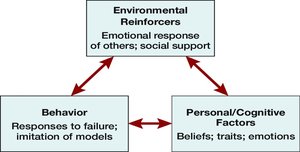
Albert Bandura's social-cognitive theory explains personality development as the result of interactions among personal, behavioral, and environmental factors—a process known as reciprocal determinism.
Personal Component: Beliefs, traits, emotions
Behavioral Component: Responses to failure, imitation of models
Environmental Component: Emotional responses of others, social support
Reciprocal Determinism: Each component influences and is influenced by the others, providing a comprehensive explanation of personality development.
Self-Concept in Middle Childhood
The Psychological Self
The psychological self emerges during the transition from early to middle childhood and becomes more complex as children approach adolescence. It includes a child's unique characteristics and self-judgments of competency.
Personality Traits: Children describe themselves with increasing precision as they age.
Cultural Context: Influences the development of the social self.
Developmental Changes: The psychological self becomes more complex, comparative, less tied to external features, and more focused on feelings and ideas as children progress through the concrete operational stage.
Self-Efficacy
Self-efficacy, as described by Bandura, is the belief in one's ability to cause an intended event or perform a task. It is a key factor in motivation and achievement.
Sources of Self-Efficacy: Peer models, social comparisons, and encouragement from valued sources.
Social Comparisons: Children assess themselves by comparing their abilities to those of others, especially peers.
The Valued Self
The valued self refers to self-esteem, or the degree to which a child values herself as an individual. Self-esteem can be global or domain-specific and develops through middle childhood.
Global Self-Esteem: Overall evaluation of self-worth; stable in the short term but may change over several years.
Domain-Specific Self-Esteem: Evaluation of self-worth in specific areas (e.g., academics, athletics); becomes more refined during middle childhood.
Interaction: High self-esteem in one domain can help balance low global self-esteem.
Self-Esteem and the Ideal Self
Self-esteem is influenced by the gap between a child's ideal self and actual experiences. Social acceptance and the value placed on specific skills also play a role.
Discrepancy: The greater the gap between what a child desires and what he believes he has achieved, the lower the self-esteem.
Social Self-Esteem: Higher in children who are liked by their peers.
Value of Skills: Being good at something only raises self-esteem if the child values that skill.
