 Back
Social Psychology: Key Concepts and Processes
Study Guide - Smart Notes
 Tailored notes based on your materials, expanded with key definitions, examples, and context.
Social Psychology
Overview of Social Psychology
Social psychology is the subfield of psychology that examines how individuals view and influence one another. It explores both the real and imagined presence of others and how these affect our thoughts, feelings, and behaviors.
Real presence: Direct influence from people physically present.
Imagined presence: Influence from people not physically present but mentally considered.
Forming Impressions of Others
Humans naturally seek to understand the psychological world, a drive with evolutionary benefits. Our perceptions of others are shaped by various biases, including those based on facial features.
Attractiveness bias: Tendency to attribute positive traits (intelligence, sociability, competence, morality) to conventionally attractive individuals.
Baby-face bias: Tendency to perceive baby-faced individuals as more honest, naïve, helpless, and warm, but less competent. This may promote caregiving behaviors.
Attribution Theory
Attribution refers to claims about the causes of someone's behavior. We often judge others based on observable actions, not internal thoughts.
Internal attribution: Explaining behavior by personality or internal characteristics.
External attribution: Explaining behavior by environmental or situational factors.
Three factors influence the type of attribution:
Consensus: Do others behave similarly?
Distinctiveness: Does the person behave similarly across situations?
Consistency: Does the person behave the same way in similar situations over time?
Fundamental Attribution Error (FAE)
The fundamental attribution error is the tendency to overemphasize internal factors and underestimate situational influences when explaining others' behavior. This error is especially common in individualistic cultures.
Example: In the Quizmaster Study, participants wrongly attributed the questioner's knowledge to personal ability, ignoring situational factors.
Actor-Observer Bias
The actor-observer bias describes the tendency to attribute others' actions to internal factors, while attributing our own actions to situational factors. This occurs because we have more information about our own circumstances.

Self-Serving Bias
The self-serving bias is the tendency to attribute positive outcomes to internal factors and negative outcomes to external factors, protecting self-esteem.
Example: Taking credit for success but blaming external factors for failure.
Identity and Group Membership
Personal and Social Identity
Identity formation is central to human experience. It includes:
Personal identity: How one sees oneself as unique (the "I").
Social identity: How one identifies with groups (the "We").
Social Identity Theory
Social Identity Theory explains how individuals derive self-esteem from group membership through:
Categorization: Placing oneself and others into groups.
Identification: Adopting the identity and norms of the group.
Social Comparison: Comparing one's group favorably against others to boost self-esteem.
In-Groups and Out-Groups
People participate in various in-groups (groups they belong to) and out-groups (groups seen as different). In-group bias leads to prejudice and discrimination against out-groups.
In-group bias: Favoring one's own group over others.
Out-group homogeneity: Perceiving out-group members as more similar to each other than in-group members.
Reconciliation and Empathy
Reconciliation between groups is promoted by acknowledging past suffering, halting destructive behavior, and expressing empathy. The empathy gap refers to greater neural activation when witnessing pain in in-group members compared to out-group members.
Scapegoating
Scapegoating is blaming an out-group when the in-group experiences frustration or obstacles.
Group Dynamics
Group Polarization
Group polarization is the strengthening of a group's original attitude after discussion. It can be accelerated by groupthink, outgroup homogeneity, and one-upmanship.
Groupthink: Modification of opinions to align with perceived group consensus, often leading to extreme decisions.
One-upmanship: Members take increasingly extreme stances to gain social standing.
Attitudes and Persuasion
Attitude Structure
Attitudes are evaluations of a person, idea, or object, with positive or negative valence. They have three components:
Affective: Feelings
Behavioral: Effect on behavior
Cognitive: Beliefs and knowledge
Cognitive Dissonance
Cognitive dissonance is psychological discomfort from holding inconsistent attitudes, behaviors, or cognitions. To reduce dissonance, individuals may change their behavior, change their beliefs, or add new cognitions.
Example: Smoking despite believing it is unhealthy, then rationalizing the behavior.
Persuasion and the Elaboration Likelihood Model
Persuasion is the process of changing attitudes through communication. The Elaboration Likelihood Model (Petty & Cacioppo, 1986) describes two paths to persuasion:
Central Route: Logic-driven, uses data and facts, leads to lasting attitude change. Works best with motivated, analytical audiences.
Peripheral Route: Emotion-driven, uses cues like positive emotion or celebrity endorsement, leads to temporary attitude change. Works best with less motivated, less analytical audiences.
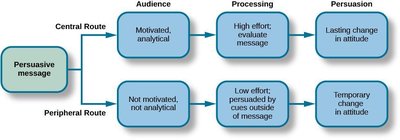
Example: Advertising campaigns may use either route depending on the target audience and desired durability of attitude change.
*Additional info: The Elaboration Likelihood Model is a foundational theory in social psychology, explaining how the depth of processing affects the durability of attitude change.*
