 Back
BackTelepsychology and Integrated Treatment Systems: Study Notes
Study Guide - Smart Notes
 Tailored notes based on your materials, expanded with key definitions, examples, and context.
Telepsychology
Introduction to Telepsychology
Telepsychology refers to the provision of psychological services using telecommunication technologies. It is a subset of telehealth, which encompasses all health disciplines delivered remotely. Telepsychology includes assessment, therapy, consultation, and psychoeducation via video calls, telephone, text messaging, and mobile applications. This approach broadens access to mental health care by removing geographical and mobility barriers.
Telehealth: The use of telecommunications to provide health information and care across distance.
Telepsychology: Psychological services delivered remotely, as defined by the American Psychological Association (APA, 2013).
Can be used as a primary method or adjunct (e.g., appointment reminders, web-based coping skills training).
Historical Development and Recent Surge
Telepsychology was initially used in rural and military settings and grew gradually through the early 2000s. The COVID-19 pandemic accelerated its adoption, leading to relaxed regulations and increased investment in telehealth infrastructure to ensure continuity of care.
Ethical and Legal Considerations
Telepsychology introduces unique ethical and legal challenges that must be addressed to ensure safe and effective practice.
Informed Consent: Must be specific to telepsychology, outlining risks and benefits of remote care.
Confidentiality and Data Protection: Ensuring secure communication and compliance with privacy laws (e.g., HIPAA).
Licensure and Jurisdiction: Practitioners must adhere to laws regarding practice across state or national borders.
Emergency Protocols: Procedures for managing crises or emergencies remotely.
Guidelines: Adherence to standards set by APA, RCI, or local regulatory bodies.
Competency and Training Requirements
Practitioners must develop competencies specific to telepsychology, including:
Proficiency with technology platforms
Online risk assessment and crisis intervention skills
Ability to establish therapeutic alliance virtually
Understanding legal standards in telepractice
Populations Best Served by Telepsychology
Individuals in remote or underserved areas
People with mobility limitations or chronic illness
Clients with anxiety or agoraphobia
Youth comfortable with digital platforms
Busy professionals or caregivers
Platforms and Tools
Video conferencing software (e.g., Zoom, Skype)
Email, online chat, text messaging, phone calls
Secure communication platforms
Electronic Health Records (EHR) integration
Digital assessment tools and therapy apps
Data protection and HIPAA compliance
Guidelines and Standards
Professional guidelines ensure effective and ethical telepsychology practice. For example, ACPRO provides a model for interjurisdictional telepsychology service delivery.
Evidence for Effectiveness
Research demonstrates that telepsychology is as effective as in-person therapy for many populations and disorders. Meta-analyses show high user satisfaction, feasibility, and similar clinical outcomes to traditional psychotherapy. Telehealth also reduces disparities in cost and access.
Studies (e.g., Backhaus et al., 2012; Hilty et al., 2013) support the effectiveness of videoconferencing psychotherapy (VCP).
No patient subgroup has been identified as not benefiting from telemental health.
Emerging technologies (e.g., virtual reality, mobile devices) are likely to shape the future of mental health care.
Telehealth Practice Domains
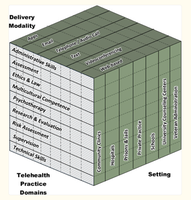
The practice of telepsychology spans multiple domains, delivery modalities, and settings. The following table summarizes these dimensions:
Telehealth Practice Domains | Delivery Modality | Setting |
|---|---|---|
Administrative Skills | App, Email, Telephone/Audio Call, Text, Videoconferencing, Web-based | Community Clinic, Hospital, Prison & Jail, Private Practice, Schools, University Counseling Center, Urban/Suburban/Rural |
Assessment | App, Email, Telephone/Audio Call, Text, Videoconferencing, Web-based | Community Clinic, Hospital, Prison & Jail, Private Practice, Schools, University Counseling Center, Urban/Suburban/Rural |
Ethics & Law | App, Email, Telephone/Audio Call, Text, Videoconferencing, Web-based | Community Clinic, Hospital, Prison & Jail, Private Practice, Schools, University Counseling Center, Urban/Suburban/Rural |
Multicultural Competence | App, Email, Telephone/Audio Call, Text, Videoconferencing, Web-based | Community Clinic, Hospital, Prison & Jail, Private Practice, Schools, University Counseling Center, Urban/Suburban/Rural |
Psychotherapy | App, Email, Telephone/Audio Call, Text, Videoconferencing, Web-based | Community Clinic, Hospital, Prison & Jail, Private Practice, Schools, University Counseling Center, Urban/Suburban/Rural |
Research & Evaluation | App, Email, Telephone/Audio Call, Text, Videoconferencing, Web-based | Community Clinic, Hospital, Prison & Jail, Private Practice, Schools, University Counseling Center, Urban/Suburban/Rural |
Risk Assessment | App, Email, Telephone/Audio Call, Text, Videoconferencing, Web-based | Community Clinic, Hospital, Prison & Jail, Private Practice, Schools, University Counseling Center, Urban/Suburban/Rural |
Supervision | App, Email, Telephone/Audio Call, Text, Videoconferencing, Web-based | Community Clinic, Hospital, Prison & Jail, Private Practice, Schools, University Counseling Center, Urban/Suburban/Rural |
Technical Skills | App, Email, Telephone/Audio Call, Text, Videoconferencing, Web-based | Community Clinic, Hospital, Prison & Jail, Private Practice, Schools, University Counseling Center, Urban/Suburban/Rural |
Current Issues and Future Directions
Telepsychology addresses issues of availability, accessibility, acceptability, anonymity, and affordability in mental health services. However, establishing telepsychology practice can be daunting for practitioners due to the need for new competencies and adaptation to various settings and modalities.
Integrated and Eclectic Treatment Systems
Definitions
Integrated and eclectic treatment systems in psychotherapy involve combining or selecting interventions from multiple theoretical models to best address client needs.
Integration: Blending concepts from multiple theories into a unified model.
Eclecticism: Pragmatically selecting interventions from various theories without necessarily combining their philosophies.
Historical Background and Key Proponents
Arnold Lazarus: Developed Multimodal Therapy (technical eclecticism), using techniques from various therapies based on client needs.
John Norcross: Advocate for integration in psychotherapy, promoting theoretical integration, technical eclecticism, and the common factors approach.
Arnold Lazarus – Multimodal Therapy
Multimodal Therapy is based on the idea that human functioning can be understood through seven interactive modalities, summarized by the acronym BASIC I.D.:
Behaviour
Affect
Sensation
Imagery
Cognition
Interpersonal Relationships
Drugs/Biology
Lazarus’s approach is technically eclectic, drawing from cognitive-behavioral, behavioral, and psychodynamic therapies as appropriate.
John Norcross – Integration in Psychotherapy
Theoretical Integration: Blending concepts from different schools of thought.
Technical Eclecticism: Choosing methods proven effective, regardless of theoretical origin.
Common Factors Approach: Focusing on elements effective across therapies, such as the therapeutic alliance.
Types of Integration and Eclecticism
Theoretical Integration: Merging two or more theories (e.g., CBT + psychodynamic).
Technical Eclecticism: Using techniques from different approaches based on client needs.
Assimilative Integration: Grounded in one theory but includes others as needed.
Common Factors Approach: Focuses on shared elements across therapies (e.g., alliance, empathy).
Benefits and Challenges of Integrated Approaches
Benefits:
Flexibility to tailor treatment to diverse client needs
Client-centered adaptability for complex or comorbid conditions
Broader efficacy; research shows integrated approaches can outperform single-school therapies in some contexts
Challenges:
Theoretical inconsistency or contradiction
Training gaps among clinicians
Risk of superficial or “patchwork” therapy if not applied critically
Characteristics of Sound Eclectic Approaches
Theoretical coherence: Consistent guiding philosophy
Evidence-based practice: Use of empirically supported methods
Client-centered and culturally responsive planning
Continuous evaluation and flexibility
Supervision and reflective practice
Formulating an Eclectic/Integrated Treatment System
Assess client needs and context (comprehensive intake, cultural assessment, life history)
Select theoretical models based on client goals and presenting problems
Incorporate techniques coherently, aligning with core conceptualizations
Track outcomes and use feedback-informed treatment (e.g., ORS/SRS, session check-ins)
Use structured formulations (e.g., 5Ps model: Predisposing, Precipitating, etc.)
Addressing Diversity in Integrated Approaches
Consider cultural, linguistic, and socioeconomic factors
Include indigenous and community practices where applicable
Apply intersectionality and trauma-informed care
Use culturally adapted interventions (e.g., culturally translated CBT, narrative therapy for collectivist cultures)
