 Back
Back1. The Science of Studying and Learning: Evidence-Based Strategies in Psychology
Study Guide - Smart Notes
 Tailored notes based on your materials, expanded with key definitions, examples, and context.
The Science of Studying and Learning
Neural Plasticity and Systematic Empiricism
Understanding how we learn is a central topic in psychology, drawing on neuroscience and empirical research. Neural plasticity refers to the brain's ability to change and adapt as a result of experience and learning. This adaptability underlies our capacity to acquire new skills and knowledge throughout life. Systematic empiricism, the foundation of psychological science, emphasizes the importance of evidence-based methods over intuition or subjective feelings.
Neural plasticity: The brain's ability to reorganize itself by forming new neural connections.
Hemispherectomy: A surgical procedure where one cerebral hemisphere is removed, demonstrating the brain's remarkable capacity to adapt functions to the remaining hemisphere.
Systematic empiricism: The practice of relying on structured observation and experimentation to draw conclusions.
Example: After a hemispherectomy, the remaining hemisphere can take over many functions, illustrating neural plasticity.
Additional info: Systematic empiricism is a core principle in psychological research methods (see Ch. 2 Research Methods).
Principles of Effective Learning
Learning as a Skill and Life-Long Endeavor
Learning is not a passive process but an active skill that can be developed and refined. Research shows that the most effective learning strategies are often more challenging and less intuitive than common, easier methods.
Learning is a skill: It can be improved with practice and the use of effective strategies.
Effortful learning: Strategies that require more cognitive effort often lead to better retention and understanding.
Life-long endeavor: Learning continues throughout life, supported by neural plasticity.
Amount and Quality of Studying
Consistent and high-quality study habits are crucial for academic success. Effective studying involves regular review, active engagement with material, and seeking help when needed.
Attend class regularly and review notes before and after lectures.
Spend at least two hours studying per class session, including reading, reviewing, and reflecting.
Seek help through office hours, study groups, or tutoring.
Space out studying over several days for better retention.
Evidence-Based Study Strategies
The Testing Effect
Research by Roediger & Karpicke demonstrates that actively retrieving information from memory (testing) significantly enhances long-term retention compared to simply restudying material. This phenomenon is known as the testing effect.
Retrieval practice: Actively recalling information without cues, then checking accuracy.
Testing effect: The finding that repeated testing improves long-term memory more than repeated studying.
Daily quizzes and frequent self-testing are effective for strengthening memory.
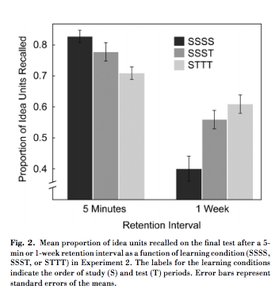
Additional info: The graph shows that repeated testing (STTT) leads to better long-term retention after one week compared to repeated studying (SSSS).
Self-Explanation and Integration
Explaining concepts aloud and integrating ideas across lectures and chapters enhances understanding and transfer of knowledge. Self-explanation helps clarify and solidify learning, especially when applied during problem-solving.
Self-explanation: Articulating reasoning and understanding while learning or solving problems.
Integrating material across sources (lectures, textbooks, study guides) deepens comprehension.
Covering slides and recalling information from memory is a useful technique.
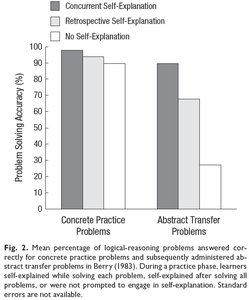
Additional info: Concurrent self-explanation leads to higher accuracy in both concrete and abstract problems compared to no self-explanation.
Note-Taking Methods
The method of note-taking can impact learning outcomes. Research by Mueller & Oppenheimer (2014) found that taking notes by hand (longhand) leads to better conceptual understanding than typing notes on a laptop, likely due to deeper processing and reduced distractions.
Longhand note-taking: Writing notes by hand encourages processing and summarizing information.
Laptop note-taking: Often leads to verbatim transcription and increased distractions.
Handwritten notes are associated with better performance on conceptual questions.
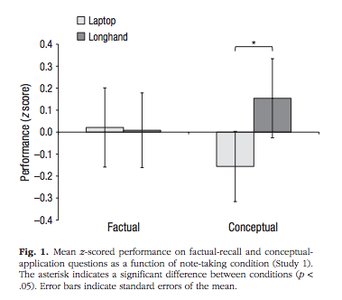
Additional info: The graph shows a significant advantage for longhand note-taking on conceptual questions.
Effective vs. Ineffective Study Strategies
Supported by Data as Effective
Retrieval practice: Regular self-testing and recall from memory.
Spaced practice: Distributing study sessions over time rather than cramming.
Elaboration: Connecting new information to existing knowledge and expressing it in your own words.
Interleaving: Mixing different subjects or types of problems within a single study session.
Supported by Data as Ineffective
Rereading text multiple times beyond the second reading.
Highlighting only, without further engagement.
Typing notes instead of writing by hand.
"Massed" practice (cramming all at once).
Relying on "learning styles" (no evidence supports matching study methods to learning preferences).
Summary Table: Effective vs. Ineffective Study Strategies
Effective Strategies | Ineffective Strategies |
|---|---|
Retrieval practice (self-testing) | Rereading text repeatedly |
Spaced practice | Highlighting only |
Elaboration and integration | Typing notes |
Interleaving subjects | Massed practice (cramming) |
Handwritten notes | Relying on learning styles |
Conclusion
Psychological science provides clear guidance on how to study effectively. Strategies that require more effort, such as retrieval practice, spaced learning, elaboration, and handwritten notes, are consistently supported by empirical evidence. Students are encouraged to adopt these methods for deeper learning and long-term retention.
