 Back
BackThe Self: Development, Knowledge, Control, and Evaluation
Study Guide - Smart Notes
 Tailored notes based on your materials, expanded with key definitions, examples, and context.
The Origins and Nature of the Self-Concept
Self-Concept and Its Development
The self-concept refers to the collection of beliefs, attitudes, and knowledge that individuals have about themselves. It develops early in life, with evidence of self-recognition appearing around 18–24 months in humans.
Self-Recognition: The 'rouge test' demonstrates that both humans and some great apes possess a rudimentary self-concept, as they recognize themselves in a mirror.
Self-Schemas: Organized bodies of knowledge about oneself, including attitudes, likes, dislikes, and personality traits. Self-schemas influence memory and perception.
Self-Concept Clarity: The degree to which self-knowledge is stable and clearly defined. Low self-concept clarity is associated with low self-esteem, depression, and rumination.
Cultural and Gender Differences in Self-Concept
Independent vs. Interdependent Self: Western cultures emphasize independence and uniqueness, while Asian cultures value connectedness and interdependence.
Gender Differences: Women tend to focus on relational interdependence (close relationships), while men emphasize collective interdependence (group memberships).
Self-Knowledge: How We Come to Know Ourselves
Introspection and Self-Awareness Theory
Introspection involves looking inward to examine one's own thoughts and feelings, but people often spend little time doing this and may not accurately understand the causes of their feelings.
Self-Awareness Theory: When people focus on themselves, they compare their behavior to internal standards and values. This can lead to positive or negative feelings, depending on whether behavior matches standards.
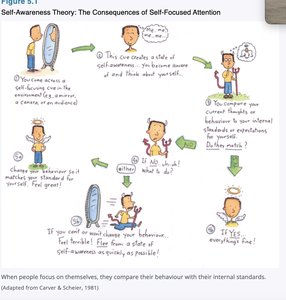
Escaping Self-Awareness: Negative self-awareness can lead to attempts to escape, sometimes through unhealthy behaviors, but also through positive means like spirituality or flow experiences.
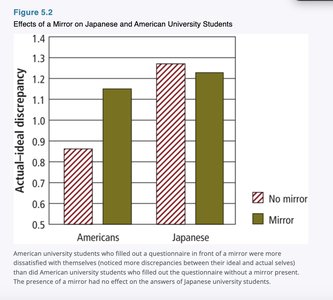
Cultural Differences: East Asians are more likely to have an outsider perspective, viewing themselves through others' eyes, and are less influenced by cues like mirrors.
Telling More Than We Can Know
Causal Theories: People use cultural and personal theories to explain their feelings, but these are not always accurate.
Self-Perception Theory
Behavior Observation: When attitudes are uncertain, individuals infer their feelings by observing their own behavior and the context.
Intrinsic vs. Extrinsic Motivation:
Intrinsic Motivation: Engaging in activities for enjoyment or interest.
Extrinsic Motivation: Engaging in activities for external rewards or pressures.
Overjustification Effect: Extrinsic rewards can undermine intrinsic motivation, especially if initial interest was high.
Task-Contingent vs. Performance-Contingent Rewards: Performance-contingent rewards are less likely to decrease intrinsic motivation.
Social Sources of Self-Knowledge
Looking-Glass Self: Our self-concept is shaped by how we believe others perceive us.
Social Comparison Theory: We compare ourselves to others when objective standards are unavailable, usually choosing similar others for comparison.
Self-Control: The Executive Function of the Self
Success and Failure in Self-Control
Self-control is the ability to regulate immediate desires to achieve long-term goals.
Self-Regulatory Resource Model: Self-control requires energy, which can be depleted by prior acts of self-control.
Strategies for Success:
Forming specific implementation intentions
Arranging environments to avoid temptations
Ensuring adequate rest
Thought Suppression: Attempting to suppress thoughts often leads to increased focus on them.
Self-Esteem: How We Evaluate Ourselves
Social Comparison and Self-Esteem
Self-esteem is the evaluation of one's self-knowledge, influenced by social comparison and acceptance.
Downward Social Comparison: Comparing oneself to those worse off can boost self-esteem, provided one feels secure from their negative outcomes.
Upward Social Comparison: Comparing oneself to those better off can be threatening, but may inspire self-improvement if the superior outcome seems attainable.
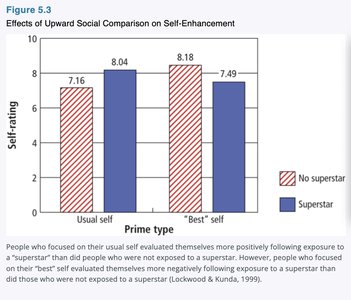
Relationship Comparisons: Upward comparisons in romantic relationships can be positive due to empathy and shared fate.
Cultural Differences: Collectivist cultures are more likely to seek self-improvement through upward comparison, while individualist cultures seek self-enhancement.
Sociometer Theory
Sociometer: Self-esteem acts as a gauge of social acceptance or rejection, motivating individuals to restore relationships when self-esteem drops.
Chronic vs. State Self-Esteem: Chronic self-esteem reflects general acceptance, while state self-esteem fluctuates with current social situations.
Self-Evaluation: Biased or Accurate?
Self-Enhancement vs. Self-Verification
Self-Enhancement: The tendency to hold unrealistically positive views of oneself, more common in individualist cultures.
Self-Effacement: The tendency to be self-critical, more common in collectivist cultures.
Self-Verification Theory: The desire for accurate feedback about oneself, even if it is negative, to maintain a coherent self-concept.
Conditions for Seeking Accuracy: People seek self-verification when feedback is about qualities other than physical attractiveness or when the evaluator is not a romantic partner.
Summary Table: Key Concepts
Concept | Definition | Example/Application |
|---|---|---|
Self-Concept | Knowledge about one's own thoughts, beliefs, traits | Recognizing oneself in a mirror |
Self-Schema | Organized knowledge about the self | Remembering events relevant to one's interests |
Introspection | Looking inward to examine thoughts/feelings | Reflecting on why one feels happy |
Self-Awareness Theory | Comparing behavior to internal standards | Feeling guilty after breaking a personal rule |
Self-Perception Theory | Inferring attitudes from behavior | Concluding one likes classical music after listening often |
Intrinsic Motivation | Doing something for enjoyment | Playing piano for fun |
Extrinsic Motivation | Doing something for external reward | Playing piano for money |
Overjustification Effect | Extrinsic rewards undermine intrinsic motivation | Losing interest in piano after being paid to play |
Looking-Glass Self | Self-concept shaped by others' perceptions | Feeling smart when praised by teachers |
Social Comparison Theory | Learning about self by comparing to others | Comparing grades with classmates |
Self-Control | Regulating behavior to achieve goals | Resisting snacks to maintain a diet |
Sociometer Theory | Self-esteem as a gauge of social acceptance | Feeling valued when included in a group |
Self-Enhancement | Unrealistically positive self-view | Believing one is above average in intelligence |
Self-Verification | Seeking accurate feedback about self | Preferring honest criticism over false praise |
Additional info: Academic context was added to clarify definitions, examples, and cultural/gender differences. Tables were inferred for clarity and completeness. Images were included only where directly relevant to the explanation of self-awareness, cultural differences, and social comparison effects.
