 Back
BackThinking, Reasoning, and Decision-Making: Psychology Study Notes
Study Guide - Smart Notes
 Tailored notes based on your materials, expanded with key definitions, examples, and context.
Thinking, Language, and Intelligence
Introduction to Thinking
Thinking is defined as any mental activity or processing of information. It encompasses a wide range of cognitive processes, including perceiving, learning, remembering, and communicating. These processes are fundamental to human cognition and are interconnected with other psychological concepts.
Perceiving: Attaching meaning to sensory stimuli.
Learning: Acquiring new information through classical conditioning, operant conditioning, and observational learning.
Remembering: Encoding, storing, and retrieving information.
Communicating: Processing and producing speech, which involves thinking.
Relationship Between Thinking-Related Concepts
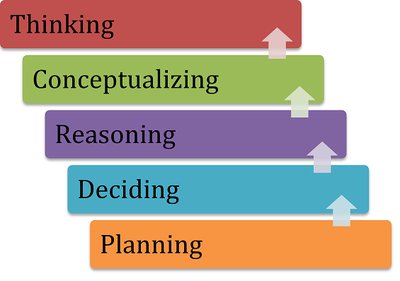
Thinking is a broad concept that includes several subordinate processes. Research by Rips and Conrad (1989) revealed a hierarchical relationship among these concepts: Planning is a kind of Deciding, which is a kind of Reasoning, which is a kind of Conceptualizing, which is a kind of Thinking. This hierarchy illustrates the nested nature of cognitive processes.
Cognitive Economy
Cognitive economy refers to the tendency to minimize cognitive effort and resources. This allows individuals to maximize efficiency in their mental processes. While cognitive economy frees up resources for additional tasks, it can also lead to oversimplification and faulty conclusions.
Advantage: Frees up cognitive resources, effort, and time.
Disadvantage: May result in errors due to oversimplification and reliance on assumptions.
Heuristics
Heuristics are mental shortcuts that increase thinking efficiency. Two common types are the representativeness heuristic and the availability heuristic.
Representativeness Heuristic: Assuming all members of a category share similar characteristics. Example: Believing all dogs are vicious after being bitten by one.
Availability Heuristic: Judging the frequency or likelihood of an event based on how easily examples come to mind. Example: Overestimating the rate of missing children due to frequent news reports.
Decision Making
Types of Decision Making
Decision making involves choosing between options using perception, memory, emotion, and reasoning. It can be categorized by levels of rationality:
Rational: Careful analysis of alternatives to achieve a goal. Example: Choosing a university based on logical evaluation.
Nonrational: Intuitive and impulsive judgments made quickly, often without explanation. Example: Athletes making split-second decisions during a game.
Irrational: Decisions based on emotions, urges, or prejudices, often ignoring logic. Example: Choosing food based on cravings rather than health goals.

Decision Fatigue
Decision fatigue is the decline in decision quality after making many decisions. Mental energy is limited, and repeated choices deplete cognitive resources, leading to avoidance or simplistic decisions.
Example: Opting for familiar TV shows instead of choosing a new movie after a long day of decision-making.
Reasoning
Deductive Reasoning
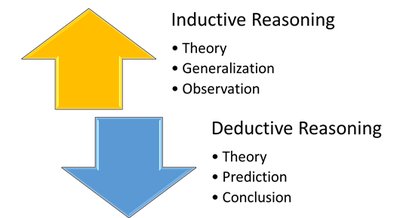
Deductive reasoning is a top-down process, starting with a theory or hypothesis and leading to a conclusion. It is most commonly demonstrated through syllogisms, which use two premises to reach a logical conclusion.
Example: Premise 1: All cats are animals. Premise 2: Garfield is a cat. Conclusion: Garfield is an animal.
Inductive Reasoning
Inductive reasoning is a bottom-up process, starting with repeated observations and generalizing to form a theory. It relies on probability and cannot guarantee absolute certainty.
Example: Observing that all tigers seen at the zoo have stripes and generalizing that all tigers have stripes.
Problem Solving
Algorithms and Strategies
Problem solving involves generating cognitive strategies to achieve a goal. Algorithms are step-by-step procedures learned through experience and reused for similar problems. Complex problems may require breaking them into subproblems, each solved with its own algorithm.
Obstacles to Problem Solving
Salience of Surface Similarities: Focusing on surface-level characteristics and applying ineffective algorithms.
Mental Sets: Reusing the same algorithms repeatedly, leading to rigid thinking and lack of innovation.
Functional Fixedness: Fixating on conventional uses for objects, missing alternative solutions.
Thinking and Language
Linguistic Determinism vs. Linguistic Relativism
Language and thinking are highly interrelated. Two main theories explain their relationship:
Linguistic Determinism: The extreme view that all thinking is represented linguistically and cannot exist without language.
Linguistic Relativism: The view that language influences, but does not determine, thinking. Language facilitates recall and categorization but is not necessary for all aspects of thinking.
Summary and Key Takeaways
Heuristics speed up thinking but can lead to errors.
Decision making varies in rationality and is affected by cognitive resources.
Reasoning can be deductive (top-down) or inductive (bottom-up).
Problem solving uses algorithms and faces obstacles like mental sets and functional fixedness.
Language shapes but does not fully determine thinking.
