 Back
BackThinking, Reasoning, and Language: Study Notes
Study Guide - Smart Notes
 Tailored notes based on your materials, expanded with key definitions, examples, and context.
Thinking, Reasoning, and Language
Introduction
This chapter explores the cognitive processes underlying human thought, reasoning, and language. It covers how we process information, make decisions, solve problems, and acquire and use language. Understanding these processes is fundamental to cognitive psychology and provides insight into human intelligence and communication.
Thinking and Cognitive Economy
Definition of Thinking
Thinking refers to any mental activity or processing of information, including learning, remembering, perceiving, communicating, believing, and deciding.
Humans are described as cognitive misers, meaning we tend to invest as little energy as possible in cognitive processing, a principle known as cognitive economy.
Quick judgments, such as those based on limited observation (thin slicing), are common due to cognitive economy.
Heuristics and Biases
Heuristics
Heuristics are mental shortcuts or rules of thumb that increase thinking efficiency but can lead to systematic errors, known as cognitive biases.
Representativeness heuristic: Judging the probability of an event by its similarity to a prototype, often ignoring base rates.
Availability heuristic: Estimating the likelihood of an event based on how easily examples come to mind.
Hindsight bias: The tendency to overestimate how well we could have predicted an outcome after it has occurred.
Top-Down Processing
Concepts and Schemas
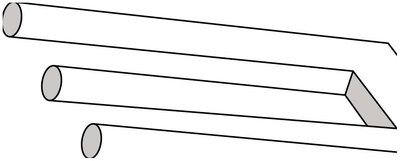
Top-down processing streamlines cognitive functioning by using pre-existing knowledge to fill in gaps in information.
Concepts are our knowledge and ideas about a set of objects, actions, or characteristics that share core properties.
Schemas are organized knowledge structures or mental models that we've stored in memory.
Decision Making and Problem Solving
Decision Making
Decision making is the process of selecting among a set of possible alternatives.
It involves two systems: System 1 (fast, intuitive) and System 2 (slow, analytical).
Most daily decisions are made implicitly, relying on cognitive economy.
Framing effect: The way information is presented can influence decisions, even if the underlying facts are identical (e.g., "5% chance of winning" vs. "95% chance of losing").
Problem Solving
Problem solving involves generating a cognitive strategy to accomplish a specific goal.
Algorithms are step-by-step procedures that guarantee a solution.
Other strategies include breaking problems into subgoals and using analogical reasoning.
Obstacles to Problem Solving
Salience of surface similarities: Focusing on irrelevant details rather than underlying principles.
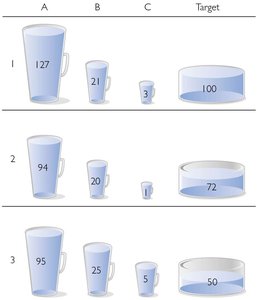
Mental sets: Becoming stuck in a specific problem-solving strategy, inhibiting alternative solutions.
Functional fixedness: Difficulty in seeing objects as having functions other than their usual use.


Models of the Mind
Early models likened the mind to a computer, but newer embodied cognition perspectives emphasize that our thinking is grounded in bodily interactions with the world.
Knowledge is organized to simulate actual experiences, not just abstract computations.
Language
Definition and Features
Language is an arbitrary system of communication that combines symbols (words or signs) in rule-based ways to create meaning.
It serves both informational and social/emotional functions and is highly practiced and automatic.
Levels of Language Analysis
Phonemes: The basic units of sound in a language (about 100 worldwide; English uses 40-45).
Morphemes: The smallest units of meaning (e.g., "dog," "re-").
Syntax: The rules for constructing sentences (word order, markers, structure).
Extralinguistic information: Non-content elements like facial expressions, tone, and context that aid interpretation.

Language Dialects
Dialects are variations of a language used by specific groups, with consistent syntax rules that may differ from the mainstream.
Evolution and Function of Language
Language requires significant learning and brain power, suggesting its advantages are substantial (e.g., communication of complex ideas, social coordination).
Most language elements are arbitrary, except for onomatopoeia and sound symbolism.

Language Acquisition
Developmental Milestones
Children recognize their native language before birth.
Babbling (intentional vocalization without meaning) emerges before age 1 and helps develop vocal control.
Comprehension precedes production; children recognize words before they can say them.
First words appear around 1 year, with rapid vocabulary growth and common over- and under-extension of meanings.
Syntactic development progresses from one-word to two-word phrases by age 2.
Sign Language
Sign language is a full language with its own phonemes, morphemes, and syntax, not merely gesturing.
Developmental stages and brain areas involved are similar to spoken language.
Bilingualism
Early exposure leads to greater proficiency; most bilinguals have a dominant language but are proficient in both.
Bilinguals show heightened metalinguistic insight and may use different brain areas depending on age of acquisition.

Language Deprivation
Cases like "Genie" suggest a sensitive period for language learning, not a strict critical period.
The younger the learner, the better the outcome ("less is more" theory).

Theories of Language Acquisition
Imitation theory: Children learn language by mimicking adults, but this does not explain generativity.
Nativist theory: Children are born with innate knowledge of language structure (Chomsky's language acquisition device).
Social pragmatics theory: Social context and interactions drive language learning.
General cognitive processing theory: Language learning is a result of general cognitive skills, but children outperform adults in language learning despite adults' overall cognitive superiority.
Language Processing in the Brain
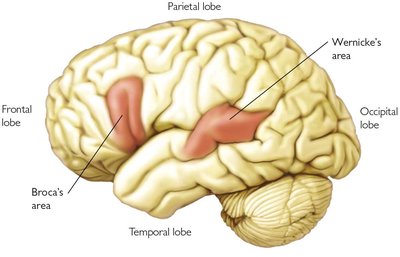
Specific brain areas, such as Broca's area and Wernicke's area, are involved in language production and comprehension.
Nonhuman Animal Communication
Animals communicate using scent, visual, and vocal signals, mainly for mating and aggression.
Attempts to teach animals human language have had limited success; humans appear unique in language sophistication.
Reading
Learning to Read
Reading, like language, becomes automatic with practice.
Key prerequisites for reading include understanding that writing is meaningful, recognizing directionality, identifying letters, and linking letters to sounds.
Expert readers master whole word recognition and phonetic decomposition (sounding out words).
The Stroop Effect
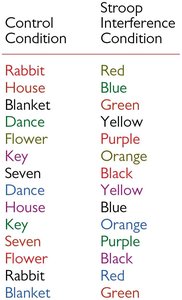
The Stroop effect demonstrates the automaticity of reading: naming the ink color of a word is harder when the word itself is a different color name.
Speed Reading
The average reading speed is 200-300 words per minute (WPM).
Comprehension drops significantly above 400 WPM, so speed reading often sacrifices understanding for speed.
