Back
BackTolerance and Empathy: Psychological Perspectives from Gandhi's Writings
Study Guide - Smart Notes
 Tailored notes based on your materials, expanded with key definitions, examples, and context.
Unit II: Tolerance and Empathy
Tolerance (Based on 'Truth is God' - Chapter 20 by M.K. Gandhi)
This section explores the psychological concepts of tolerance and empathy through the philosophical and ethical reflections of Mahatma Gandhi. These concepts are foundational in social psychology and personality studies, as they relate to how individuals perceive, judge, and interact with others in diverse societies.
Definition and Nature of Tolerance
Tolerance is the acceptance of differences in beliefs, behaviors, and practices among individuals or groups. It involves refraining from negative judgment or discrimination against those who are different.
Gandhi critiques the word 'tolerance' for its implication of superiority, suggesting that true tolerance is rooted in humility and the recognition of one's own limitations.
He emphasizes that all humans are fallible and that no one possesses absolute truth, which necessitates tolerance as a virtue.
Psychological Foundations of Tolerance
Tolerance is not merely passive acceptance but an active process of understanding and respecting differences.
It is closely linked to empathy, which is the ability to understand and share the feelings of others.
Gandhi connects tolerance to the pursuit of truth, suggesting that recognizing our own limitations leads to greater acceptance of others.
Examples and Applications
In social psychology, tolerance is essential for reducing prejudice and promoting harmonious intergroup relations.
Gandhi's approach advocates for nonviolence and respect for all religions and viewpoints, which can be applied in multicultural societies to foster peace and cooperation.
Judgment and Moral Relativism
Gandhi warns against judging others harshly, as all individuals are subject to error.
He distinguishes between right and wrong but acknowledges that knowledge of truth is limited and subjective.
This aligns with psychological theories of moral development, which recognize the complexity and context-dependence of moral judgments.
Empathy and Social Harmony
Empathy is the psychological capacity to place oneself in another's position, which underpins genuine tolerance.
Gandhi's teachings encourage individuals to seek understanding and compassion, rather than conflict or superiority.
Empathy is crucial for conflict resolution, social cohesion, and ethical behavior.
Table: Comparison of Tolerance and Empathy
Concept | Definition | Psychological Role | Example |
|---|---|---|---|
Tolerance | Acceptance of differences without negative judgment | Reduces prejudice, promotes social harmony | Respecting different religious practices |
Empathy | Understanding and sharing another's feelings | Facilitates compassion, conflict resolution | Comforting a friend in distress |
Gandhi's Ethical Perspective
Gandhi advocates for humility, self-reflection, and nonviolence as essential components of tolerance.
He warns that intolerance leads to social fragmentation and conflict.
His philosophy aligns with psychological principles of prosocial behavior and ethical decision-making.
About the Writer
Mahatma Gandhi (1869-1948) was an Indian lawyer, social reformer, and leader of the Indian independence movement.
He is renowned for his philosophy of nonviolence (ahimsa) and his advocacy for tolerance, empathy, and ethical living.
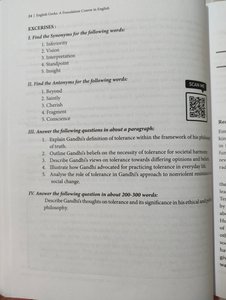
Exercises and Application Questions
Define tolerance and empathy within the framework of psychological theories.
Discuss Gandhi's beliefs on the necessity of tolerance for social harmony.
Analyze the role of empathy in reducing prejudice and promoting ethical behavior.
Reflect on the significance of tolerance in contemporary multicultural societies.