 Back
BackPsychology chapter 16
Study Guide - Smart Notes
 Tailored notes based on your materials, expanded with key definitions, examples, and context.
Treatment of Psychological Disorders
Insight Therapies
Insight therapies are a class of psychological treatments that focus on verbal interactions to enhance clients' self-knowledge, leading to positive changes in personality and behavior. These therapies aim to uncover underlying psychological processes and promote self-understanding.
Psychoanalysis
Person (Client) Centered Therapy
Group Therapy
Family Therapy
Psychoanalysis
Psychoanalysis, developed by Sigmund Freud, emphasizes the recovery of unconscious conflicts, motives, and defenses through specialized techniques. The goal is to bring unconscious material into conscious awareness, facilitating resolution and personal growth.
Unconscious Motivation: The part of the mind containing thoughts and memories outside of conscious awareness.
Free Association: Clients express thoughts and feelings with minimal censorship, allowing the analyst to detect unconscious material.
Dream Analysis: Clients recall dreams, which therapists interpret for symbolic meaning.
Interpretation: Therapists explain the significance of clients' thoughts, feelings, and behaviors, focusing on patterns rather than dramatic revelations.
Resistance: Clients may unconsciously avoid confronting distressing material, employing strategies to keep it out of awareness.
Transference: Clients redirect emotional experiences from significant relationships onto the therapist, facilitating insight into unresolved issues.
Working Through: The final stage, where the therapist helps the client resolve issues uncovered during therapy.
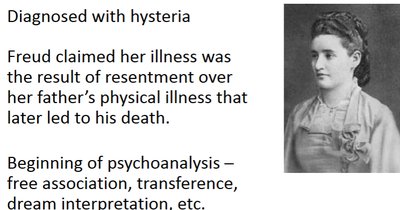
Example: The case of Anna O, diagnosed with hysteria, was foundational in the development of psychoanalysis. Freud attributed her symptoms to unconscious emotional conflicts related to her father's illness and death, leading to the use of techniques such as free association and dream interpretation.
Modern Psychodynamic Approaches
While traditional Freudian psychoanalysis is less common today, modern psychodynamic therapies retain several core features:
Focus on emotional experiences
Efforts to avoid distressing thoughts and feelings
Identification of recurring life experiences
Discussion of past, especially childhood, events
Analysis of interpersonal relationships
Exploration of dreams and fantasies
Emphasis on the therapeutic relationship
Person-Centered Therapy
Person-centered therapy, developed by Carl Rogers, emphasizes creating a supportive emotional climate where clients direct the pace and focus of therapy. The approach aims to foster self-acceptance and personal growth by helping clients align their self-concept with reality.
Clients learn they do not always need to please others or seek external acceptance.
They are encouraged to respect their own feelings and values.
Therapy helps restructure self-concept for greater authenticity.
The therapeutic alliance—emotional bond and agreement on goals—is central to success.
Three core conditions for a safe emotional climate:
Genuine Acceptance: Therapist is honest and spontaneous.
Unconditional Positive Regard: Therapist offers non-judgmental acceptance.
Empathy: Therapist demonstrates accurate understanding of the client's experience.
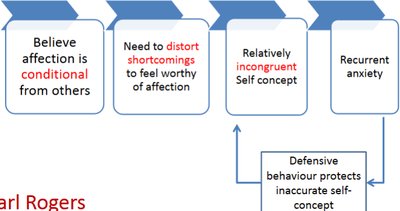
Example: According to Rogers, when individuals believe affection is conditional, they may distort their shortcomings to feel worthy, leading to an incongruent self-concept and recurrent anxiety. Defensive behaviors then protect this inaccurate self-concept.
Family Therapy
Family therapy adopts a systems approach, focusing on family dynamics and communication patterns. It is often used to address issues related to dysfunctional family members, such as those with addictions, poor emotional control, or severe mental illnesses (e.g., schizophrenia, bipolar disorder).
Emphasizes the interconnectedness of family members
Targets communication and relational patterns
Seeks to improve overall family functioning
Group Therapy
Group therapy involves multiple participants (typically 4–15, with 8 being ideal) who share similar psychological issues. The group setting provides support, acceptance, and opportunities for members to learn from each other.
Therapist selects participants, sets goals, and maintains safety
Clients act as therapists for each other, sharing experiences and coping strategies
Promotes emotional support and cohesiveness
Cognitive Behavioral Therapy (CBT)
CBT combines cognitive and behavioral techniques to help clients change maladaptive thought and behavior patterns. It is widely used for various psychological disorders, including depression and anxiety.
Cognitive Component: Clients learn to identify and challenge negative thought patterns, question self-defeating beliefs, and reframe situations.
Behavioral Component: Clients practice new skills, monitor behaviors, and engage in behavioral rehearsal and modeling.
Example: A client with depression may learn to track negative thoughts, challenge beliefs like "I can't do anything right," and practice new coping behaviors.
Treating Major Depression
Treatment for major depression often involves a combination of non-pharmacological and pharmacological approaches. The choice of treatment depends on the severity of symptoms and individual needs.
Non-Pharmacological Treatments
Cognitive-Behavioral Therapy (CBT): Effective for mild to moderate depression; may be combined with medication for severe cases. Some meta-analyses suggest limited efficacy for remission and quality of life.
Sleep Deprivation: Can produce brief improvement, especially REM-sleep deprivation; often combined with other treatments.
Electroconvulsive Therapy (ECT): Induces brief seizures to alter brain chemistry; reserved for severe or treatment-resistant depression.
Repetitive Transcranial Magnetic Stimulation (rTMS): Uses electromagnetic stimulation of brain regions involved in mood regulation; generally well-tolerated.
Exercise: High-intensity aerobic or anaerobic exercise can be as effective as medication or psychotherapy, with potentially longer-lasting effects.
Pharmacological Treatments
Pharmacological treatments for mood disorders primarily target monoamine neurotransmitters (e.g., serotonin, norepinephrine, dopamine). Most drugs affect neurotransmission by altering receptor binding or neurotransmitter concentration in the synaptic cleft.
Monoamine Oxidase Inhibitors (MAOIs): Inhibit the enzyme monoamine oxidase, increasing monoamine levels. Risk of dangerous interactions with tyramine-rich foods ("cheese effect").
Tricyclic Antidepressants: Block reuptake of serotonin and norepinephrine; safer than MAOIs but still have side effects.
Selective Serotonin Reuptake Inhibitors (SSRIs): Most commonly prescribed; include drugs like Prozac and Zoloft. Used for various conditions but can cause weight gain and sexual dysfunction.
Atypical Antidepressants: Diverse group with unique mechanisms; bupropion is notable for fewer side effects and inhibition of dopamine and norepinephrine reuptake.
Effectiveness: Antidepressants are generally more effective for severe depression than for mild to moderate cases. The debate continues regarding their overall efficacy, with factors such as severity, researcher bias, and social context influencing outcomes.
Why Some Ineffective Strategies Seem Effective
Spontaneous Remission: Some disorders improve without treatment; control groups are necessary for accurate assessment.
Placebo Effect: Improvement due to expectation rather than the treatment itself.
Regression to the Mean: Extreme symptoms tend to become less severe over time.
Self-Serving Biases: Clients may overestimate treatment effectiveness due to investment of time and resources.
Retrospective Rewriting: Clients may misremember past symptoms as worse, exaggerating perceived improvement.
Additional Info:
Omega-3 fatty acids may also help alleviate depressive symptoms.
Pharmacological treatments act on neurotransmitter systems, with synaptic concentration regulated by autoreceptors, reuptake, and enzymatic breakdown.
