 Back
BackWorking Memory: Structure, Function, and Cognitive Implications
Study Guide - Smart Notes
 Tailored notes based on your materials, expanded with key definitions, examples, and context.
Memory
Working Memory
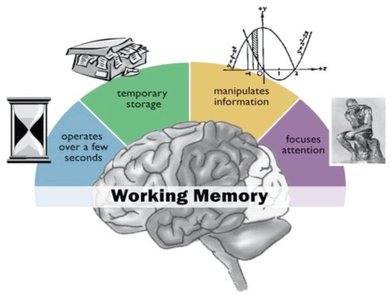
Working memory is a core cognitive system that temporarily holds and manipulates information necessary for complex tasks such as reasoning, learning, and comprehension. While often used interchangeably with short-term memory, working memory is distinct in that it not only stores information briefly but also allows for active processing and manipulation of that information.
Definition: Working memory refers to the mental workspace where information is temporarily stored and cognitively manipulated.
Key Functions: Temporary storage, manipulation of information, and focusing of attention.
Model: The most widely accepted model is Baddeley and Hitch's (1974) multi-component model, which describes working memory as comprising several subsystems responsible for different types of information processing.
Individual Differences: Working memory capacity varies among individuals, influencing their ability to handle complex or multitasking situations.
Clinical Relevance: Deficits in working memory are common in conditions such as ADHD, where individuals may struggle to encode and retain information due to attentional lapses.
Example: Remembering a phone number while searching for a pen, or mentally calculating the total cost of items while shopping.
Working Memory and Cognitive Load
The concept of cognitive load refers to the total amount of mental effort being used in the working memory at any given time. When the cognitive load exceeds the capacity of working memory, cognitive overload occurs, impairing learning and information processing.
Cognitive Load: The amount of information and mental operations that working memory is processing simultaneously (Sweller, 1988).
Cognitive Overload: When working memory is overwhelmed, new information cannot be effectively encoded into long-term memory.
Factors Affecting Cognitive Load: Age, expertise, and emotional state can influence how much cognitive load an individual can handle.
Example: Trying to learn a new concept while distracted or stressed can lead to cognitive overload and poor retention.
Multitasking and Working Memory Limitations
Despite popular belief, true multitasking is not possible for most people due to the limitations of working memory. Instead, the brain rapidly switches attention between tasks, a process known as task-switching, which often results in decreased efficiency and increased errors.
Monotasking: The human brain is optimized for focusing on one task at a time.
Task-Switching: Attempting to multitask leads to frequent switching between tasks, which slows performance and increases mistakes for over 98% of people.
Research Findings: Only about 2.5% of people can multitask effectively; for most, divided attention impairs performance and learning.
Impact on Learning: Students who frequently multitask take longer to complete assignments and tend to have lower grades.
Mindfulness: Focusing on one task at a time enhances learning and mental well-being. Mindfulness-based therapies can improve attention and reduce symptoms of depression, anxiety, and chronic pain.
Example: Listening to music while studying or checking social media while watching a lecture can reduce focus and retention of information.
Summary Table: Key Features of Working Memory
Feature | Description |
|---|---|
Temporary Storage | Holds information for a few seconds to minutes |
Manipulation of Information | Allows for mental operations such as calculation, reasoning, and transformation |
Focuses Attention | Directs cognitive resources to relevant information |
Limited Capacity | Can only process a small amount of information at once |
Susceptible to Overload | Excessive information leads to cognitive overload and impaired learning |
Additional info: Working memory is a central concept in cognitive psychology and is foundational for understanding higher-order thinking, problem-solving, and academic performance. Strategies to improve working memory include chunking information, minimizing distractions, and practicing mindfulness.
