 Back
BackNative Americans: The First Americans – Sociology Study Notes
Study Guide - Smart Notes
 Tailored notes based on your materials, expanded with key definitions, examples, and context.
Native Americans: The First Americans
Introduction
This chapter explores the historical and contemporary experiences of Native Americans in the United States, focusing on their interactions with European settlers, the impact of federal policies, collective action, identity, and ongoing challenges related to economic development, education, healthcare, religion, and the environment.
European Contacts and Early Treaties
European colonization profoundly affected Native Americans through disease, warfare, and cultural misunderstanding. Early treaties and acts of Congress shaped the fate of Indigenous peoples, often to their detriment.
Columbus and Misnaming: Christopher Columbus mistakenly called Indigenous peoples "Indians," a term that oversimplifies the diversity among Native groups.
Impact of European Arrival: Superior weaponry and diseases brought by Europeans decimated Indigenous populations.
Cultural Diversity: Native Americans comprised hundreds of distinct cultures, languages, and societies, including the Maya, Inca, and Aztec.
Key Legislation:
The Indian Removal Act (1830): Forced relocation of tribes, most notably the Trail of Tears.
The Allotment Act (1887): Divided tribal lands into individual plots, undermining communal landholding.
The Indian Reorganization Act (1934): Sought to restore tribal self-government and communal landholding.
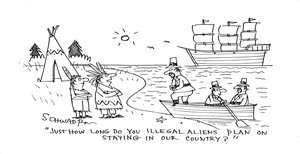
Example: The cartoon highlights the irony of labeling newcomers as "illegal aliens," referencing the displacement of Native Americans by European settlers.
Reservation Life and Federal Policies
Federal policies continue to shape the lives of Native Americans, especially those living on reservations. While some autonomy has been granted, ultimate authority remains with the federal government.
Bureau of Indian Affairs (BIA): Manages many aspects of reservation life, including economic development and healthcare.
Contemporary Policies: Since World War II, policies have aimed to increase tribal autonomy but often fall short in practice.
Key Federal Actions:
Legal Claims: Efforts to address historical injustices and land claims.
The Termination Act (1953): Attempted to assimilate Native Americans by ending federal recognition of certain tribes.
Employment Assistance Program: Sought to improve economic opportunities for Native Americans.
Economic Challenges: High unemployment and economic stagnation have led some tribes to open casinos, raising concerns about social impacts.
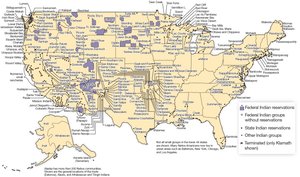
Example: The map shows the distribution of Native American lands and communities across the United States.
Collective Action and Pan-Indianism
Native Americans have engaged in collective action to assert their rights and preserve their cultures. Pan-Indianism refers to intertribal movements that unite different tribes for common political and cultural goals.
Historical Resistance: Tribes have historically united to resist military incursions and government policies.
Modern Activism: Includes protests, legal actions, and cultural movements such as replacing Columbus Day with Indigenous People’s Day and campaigns against stereotypical sports mascots.
Powwows: Intertribal gatherings that celebrate Native culture through dance, music, and socializing.
American Indian Identity: Macro and Micro Levels
Native American identity is shaped by both collective (macro) and individual (micro) factors, including tribal sovereignty, legal definitions, and personal heritage.
Sovereignty: The right of tribes to self-governance and self-determination.
Indian Child Welfare Act (ICWA): Aims to preserve Native families and culture by regulating the adoption of Native children, though compliance is uneven.
Blood Quantum: A measure of Native ancestry used to determine eligibility for tribal membership and federal benefits; typically, one-quarter ancestry is required.
Contemporary Challenges: Economic Development, Education, and Healthcare
Native Americans face systemic discrimination and significant challenges in economic development, education, and healthcare.
Economic Development: High unemployment rates persist; some tribes rely on tourism and casino gambling, which can conflict with cultural values.
Education: Historically, federal boarding schools aimed to assimilate Native children. Today, tribally controlled colleges offer culturally relevant education.
Healthcare: Native Americans experience poorer health outcomes and greater barriers to healthcare access compared to other groups.
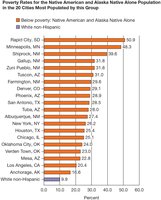
Example: The chart illustrates high poverty rates among Native Americans in various U.S. cities compared to the national average for White non-Hispanics.
Religious and Spiritual Expression
Native American spirituality is diverse and deeply connected to nature and tradition. The American Indian Religious Freedom Act protects the right to practice traditional religions.
Spiritual Practices: Include ceremonies, rituals, and the use of sacred objects such as peyote (a hallucinogen used in some religious ceremonies).
Religious Freedom: The government recognizes the right of Native Americans to practice their religions, though conflicts over sacred sites and artifacts persist.
Pluralism vs. Assimilation: Native Americans advocate for recognition of their traditions within a pluralistic society rather than forced assimilation.
Environmental Issues
Environmental concerns are central to Native American activism, intersecting with issues of land rights, economic development, and cultural survival.
Land Disputes: Many environmental issues stem from historical treaties and ongoing land claims.
Environmental Justice: Native Americans often face environmental hazards and advocate for sustainable stewardship of their lands.
Balancing Needs: Economic development and spiritual needs must be balanced with environmental protection.
Contemporary Land: Reservations now comprise only 2.6% of historic Native American lands, often in less desirable locations.
Example: Some Native nations, such as the Haudenosaunee, encourage rethinking humanity’s relationship with the earth to address environmental crises.

Additional info: The referenced book, Ishmael, explores humanity’s relationship with the environment, a theme relevant to Native American perspectives on stewardship.
