 Back
BackSocial Interaction and Social Structure: Study Notes
Study Guide - Smart Notes
 Tailored notes based on your materials, expanded with key definitions, examples, and context.
Social Interaction and Social Structure
Introduction to Social Interaction
Social interaction is the process of acting toward and reacting to others, forming the foundation of social structure. Social structure refers to the organized relationships and interactions that make life orderly and predictable. Understanding these concepts is essential for analyzing how individuals relate to one another within society.
Social Structure: The framework of relationships and interactions that guide behavior and maintain order.
Social Interaction: The dynamic process of individuals acting and reacting in relation to others.
Example: A classroom setting where students and teachers interact according to established roles and expectations.
Statuses and Roles
Statuses and roles are fundamental concepts in sociology that describe a person's position and expected behavior within society. Status signifies prestige and social identity, while roles are the behaviors, rights, and obligations associated with a status.
Status: A socially defined position in society (e.g., executive, nurse, student).
Role: The expected behavior for a person occupying a particular status.
Status Set: The collection of statuses a person occupies at a given time (e.g., student, daughter, employee).
Example: A person may simultaneously be a student, daughter, and employee.
Ascribed and Achieved Status
Status sets include both ascribed and achieved statuses. Ascribed statuses are assigned at birth and cannot be changed, while achieved statuses are attained through personal effort or voluntary action.
Ascribed Status: Social position assigned at birth (e.g., sex, age, ethnicity).
Achieved Status: Social position attained through effort (e.g., college graduate, employee).
Master Status: A status that overrides others and shapes a person's identity (e.g., doctor, student).
Status Inconsistency: Conflict from occupying positions ranked differently (e.g., a teacher working as a bartender).
Roles, Role Sets, Role Conflict, and Role Strain
Each status is associated with one or more roles. Role performance refers to how individuals fulfill their roles, which can vary. Role conflict occurs when demands of different roles clash, while role strain arises from conflicting demands within the same role.
Role Set: The array of roles attached to a particular status (e.g., teacher, mother, student).
Role Conflict: Difficulties in managing multiple contradictory roles (e.g., student and employee).
Role Strain: Stress from conflicting demands within a single role (e.g., student balancing assignments and exams).
Coping Strategies: Compromise, prioritization, compartmentalization, limiting roles, and exiting roles.
Explaining Social Interaction
Symbolic Interaction and Social Construction of Reality
Symbolic interaction emphasizes that people construct reality through their interactions, taking context and others into account. The social construction of reality is the process by which people produce, interpret, and share everyday life meanings.
Symbolic Interaction: People actively construct reality through communication and interpretation.
Social Construction of Reality: Reality is shaped by shared definitions and interactions.
Doublespeak: Language that obscures or distorts meaning, often used to make negative realities appear positive.

Self-Fulfilling Prophecies
Definitions of reality can lead to self-fulfilling prophecies, where beliefs and actions make outcomes real. Perceptions shape behavior, reinforcing expectations.
Self-Fulfilling Prophecy: When a belief or expectation leads to actions that cause the belief to become reality.
Example: Believing one cannot succeed in a subject may result in poor performance.
Ethnomethodology and Dramaturgical Analysis
Ethnomethodology studies how people construct shared definitions of reality, often by observing or breaking interaction rules. Dramaturgical analysis views social interaction as a theatrical performance, with individuals managing impressions for their audience.
Ethnomethodology: The study of everyday methods people use to make sense of interactions.
Dramaturgical Analysis: Social life as a stage, with front-stage (public) and back-stage (private) behaviors.
Impression Management: Efforts to present favorable images to others.
Social Exchange Theory
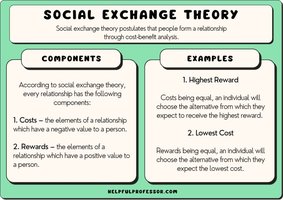
Social exchange theory proposes that individuals seek to maximize rewards and minimize costs in their interactions. Relationships are evaluated based on the balance of positive and negative elements.
Costs: Negative elements in a relationship (e.g., effort, money).
Rewards: Positive elements (e.g., companionship, affection).
Decision Making: Individuals choose alternatives with the highest reward or lowest cost.
Formula:
Example: Choosing to spend time with a friend for companionship versus going alone to an event.
Feminist Theories of Social Interaction
Feminist theories highlight how cultural norms and gender role expectations shape interaction patterns. Women are often socialized to be supportive and expressive, while men are socialized to be dominant and assertive, especially in professional contexts.
Gendered Interaction: Women tend to engage in conversational maintenance and express support; men often dominate conversations and provide unsolicited advice.
Contextual Variation: Interaction differences are shaped by social context, not innate sex differences.
Nonverbal Communication
Forms and Importance of Nonverbal Communication
Nonverbal communication includes messages sent without words, such as gestures, facial expressions, eye contact, touch, and personal space. It often conveys true feelings more powerfully than spoken language.
Silence: Can express agreement, disagreement, respect, or other emotions.
Visual Cues: Gestures, facial expressions, and eye contact provide information about emotions and intentions.
Touch: Communicates support, affection, power, or control; interpretation varies by gender and culture.
Personal Space: The distance people maintain reflects power, status, and cultural norms.
Cross-Cultural Variations in Nonverbal Communication
Nonverbal cues such as gestures, facial expressions, eye contact, and touch differ across cultures. Misunderstandings can occur when cultural rules are not recognized.
Gestures: The same gesture may have different meanings in different countries.
Facial Expressions: Women smile more than men across cultures; men may misinterpret smiles as flirtation.
Eye Contact: In some cultures, direct eye contact is considered rude or aggressive.
Touch: Cultural norms dictate acceptable forms of touch; some cultures avoid certain types of contact.
Personal Space: Varies by culture, status, and relationship type.
Space and Power
Space usage signifies privilege, status, and power. Higher socioeconomic status often correlates with greater consumption of space and entitlement to invade others' personal space.
Example: Reserved parking spaces, private offices, and first-class airline seats.
Cross-Cultural Differences: Americans have strict queuing rules, while some European cultures are less queue-conscious.
