Surveys and experiments conducted by the researcher.
What is the sample space of a coin toss?
The sample space is {heads, tails}.
What percent is 19 out of 95?
19/95 × 100 = 20%.
What are two essential features of statistically designed experiments?
Randomization and control.
How do you interpret the probability of a detasseler making less than \$13/hr given p(z < 0.5)?
It is the probability that the standardized variable z is less than 0.5.
True or false: The population proportion and sample proportion always have the same value.
False.
What is 11 out of 20 as a percentage?
11/20 × 100 = 55%.
What ratios are equivalent to 5:4?
Any ratio where the first number is 1.25 times the second, such as 10:8.
What is 18 out of 30 as a percentage?
18/30 × 100 = 60%.
What describes the likelihood that a given event will occur?
Probability.
If Myron receives 10 votes from a class of 25 students, what percentage does he receive?
10/25 × 100 = 40%.
When should you use a sample versus a population for data collection?
Use a sample when the population is too large or inaccessible.
How do you calculate the probability of picking an orange marble and flipping tails?
Multiply the probability of picking an orange marble by the probability of flipping tails.
How do you determine the measurement level (nominal, ordinal, interval, ratio) of a variable?
By assessing the nature of the data: categories (nominal), order (ordinal), equal intervals (interval), and true zero (ratio).
Which values can represent the probability of an event?
Any value between 0 and 1, inclusive.
What is the probability of flipping heads on a fair coin?
1/2, or 0.5, or 50%.
What best defines a binary variable?
A variable with only two possible values.
What is the probability of the complement of rolling a number less than 5 on a six-sided die?
Probability of rolling 5 or 6: 2/6 = 1/3.
How do you determine if a distribution is a discrete probability distribution?
Check that all probabilities are between 0 and 1 and their sum is 1.
What is the area under the entire probability density curve?
The area is 1.
If the chosen significance level is α = 0.05, what does this mean?
There is a 5% chance of rejecting the null hypothesis when it is true.
For mutually exclusive events a and b, what is the joint probability?
The joint probability is 0.
How do you find the probability of z occurring in a region?
Calculate the area under the probability curve for that region.
How do you verify that a function is a probability mass function?
Check that all probabilities are between 0 and 1 and their sum is 1.
How do you use the empirical rule to find the probability corresponding to a region?
Use the rule that about 68%, 95%, and 99.7% of data fall within 1, 2, and 3 standard deviations of the mean, respectively.
If the probability of picking a blue marble is 3/25, how likely is this event?
It is somewhat unlikely, with a probability of 0.12 or 12%.
How likely is an event with a probability of 3/4?
It is very likely, with a probability of 0.75 or 75%.
What is stratified random sampling?
It is sampling where a random sample is taken from each group or stratum.
What is nonresponse bias?
Nonresponse bias occurs when certain individuals do not respond, potentially skewing results.
What is a probability distribution?
A probability distribution assigns probabilities to all possible outcomes.
What is the probability of an event with probability 0?
It is impossible.
What is the probability of an event with probability 1?
It is certain.
What values are possible for a probability?
A probability must be a number between 0 and 1, inclusive. Values less than 0 or greater than 1 cannot be probabilities.
What does the notation p(B|A) represent in probability?
The notation p(B|A) represents the probability of event B occurring given that event A has occurred. This is called conditional probability.
Which values cannot be probabilities?
Any value less than 0 or greater than 1 cannot be a probability.
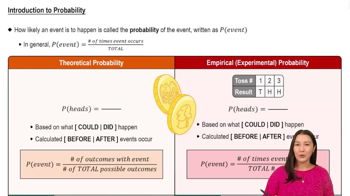
What is the difference between theoretical and experimental (empirical) probability?
Theoretical probability is calculated based on possible outcomes before any events occur, while experimental (empirical) probability is calculated from actual data after events have occurred.
How does experimental probability differ from theoretical probability?
Experimental probability is based on observed results from actual trials, whereas theoretical probability is based on the possible outcomes determined before any trials are conducted.
In probability, what does the upside-down 'U' symbol (∩) mean?
The upside-down 'U' symbol (∩) in probability represents the intersection of two events, meaning the outcomes that are common to both events.
How likely is an event with a probability of 3/4?
An event with a probability of 3/4 is very likely to occur, as 3/4 equals 0.75, which is closer to 1 than to 0.
If the probability of picking a blue marble is 3/25, what does this mean?
It means that out of all possible outcomes, the chance of picking a blue marble is 3 out of 25, or 0.12.
 Back
Back

 5:37
5:37