Binomial Distribution quiz #1 Flashcards

Binomial Distribution quiz #1
Control buttons has been changed to "navigation" mode.
1/25
  • What are the criteria that define a binomial probability experiment?
    A binomial probability experiment must have: (1) a fixed number of trials, (2) only two possible outcomes per trial (success or failure), (3) independent trials, and (4) a constant probability of success for each trial.
  • How many possible outcomes are there for a single trial in a binomial experiment?
    There are two possible outcomes for each trial in a binomial experiment: success or failure.
  • What are the key properties of a binomial distribution?
    A binomial distribution describes the probability of a fixed number of successes in a fixed number of independent trials, each with the same probability of success.
  • What is the formula for the probability of getting exactly x successes in n independent binomial trials with probability p of success?
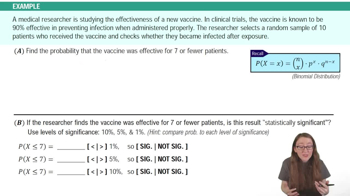
    The probability is given by: P(X = x) = C(n, x) × p^x × (1−p)^(n−x), where C(n, x) is the number of combinations of n items taken x at a time.
  • What is the expected value (mean) of a binomial distribution with n trials and probability p of success?
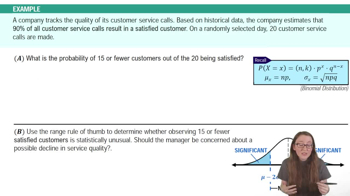
    The mean (expected value) is μ = n × p.
  • What is the standard deviation of a binomial distribution with n trials and probability p of success?
    The standard deviation is σ = √(n × p × (1−p)).
  • What is the relationship between the probability of success (p) and the probability of failure (q) in a binomial experiment?
    The probability of failure q is equal to 1 minus the probability of success: q = 1 − p.
  • Which of the following is not a requirement for a binomial probability distribution: fixed number of trials, only two outcomes per trial, independent trials, or variable probability of success?
    A variable probability of success is not a requirement; the probability of success must remain constant for all trials.
  • How do you determine if a scenario is a binomial experiment?
    Check if the scenario has a fixed number of independent trials, each with only two possible outcomes and a constant probability of success.
  • Give an example of a binomial experiment.
    Flipping a coin 10 times and counting the number of heads is a binomial experiment.
  • If a basketball player makes 70% of free throws and shoots 30 times, how would you model the number of successful free throws using a binomial distribution?
    Let n = 30 (number of trials) and p = 0.70 (probability of success). The number of successful free throws follows a binomial distribution with these parameters.
  • How do you calculate the probability of getting exactly 3 successes in 4 binomial trials with probability of success p = 0.4?
    Use the formula: P(X = 3) = C(4, 3) × (0.4)^3 × (0.6)^1.
  • What are the conditions for using the binomial distribution?
    The conditions are: fixed number of trials, only two possible outcomes per trial, independent trials, and constant probability of success.
  • What is a similarity between the binomial and Poisson distributions?
    Both distributions are used to model the probability of a certain number of events occurring in a fixed context (number of trials for binomial, interval for Poisson), and both deal with discrete random variables.
  • What is not a requirement of the binomial probability distribution?
    The trials do not need to have more than two possible outcomes; in fact, only two outcomes per trial are required.
  • How do you calculate the mean of a binomial distribution?
    The mean is calculated as μ = n × p, where n is the number of trials and p is the probability of success.
  • How do you calculate the variance of a binomial distribution?
    The variance is σ² = n × p × (1−p).
  • How do you find the probability of getting between k1 and k2 successes (inclusive) in a binomial experiment?
    Add the probabilities for each value from k1 to k2: P(k1 ≤ X ≤ k2) = Σ [C(n, x) × p^x × (1−p)^(n−x)] for x = k1 to k2.
  • How can you use the complement rule to find the probability of at least k successes in a binomial experiment?
    Calculate 1 minus the probability of fewer than k successes: P(X ≥ k) = 1 − P(X ≤ k−1).
  • What is the general formula for the probability of exactly x successes in n binomial trials with probability p?
    P(X = x) = C(n, x) × p^x × (1−p)^(n−x).
  • If a binomial experiment has n trials and probability p of success, what is the probability of exactly x successes?
    The probability is P(X = x) = C(n, x) × p^x × (1−p)^(n−x).
  • How do you determine the number of ways to arrange x successes in n binomial trials?
    Use the combination formula: C(n, x) = n! / [x! × (n−x)!].
  • What is the role of independence in a binomial experiment?
    Independence ensures that the outcome of one trial does not affect the outcome of any other trial.
  • How do you interpret the mean of a binomial distribution in context?
    The mean represents the expected number of successes in n trials, each with probability p of success.
  • What is the formula for the standard deviation of a binomial distribution?
    The standard deviation is σ = √(n × p × (1−p)).