What does a large value for the chi-square statistic indicate in a test for independence between two categorical variables?
A large value for the chi-square statistic indicates that the observed frequencies differ significantly from the expected frequencies under the assumption of independence, suggesting evidence against the null hypothesis and that the variables may be dependent.
How is the chi-square test for independence used to assess the relationship between two categorical variables?
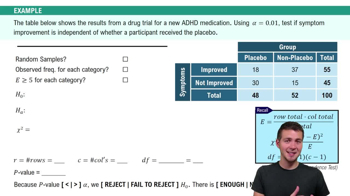
The chi-square test for independence compares observed and expected frequencies in a contingency table to determine if two categorical variables are related. The null hypothesis assumes the variables are independent, while the alternative suggests dependence. The test statistic is calculated, and a p-value is used to decide whether to reject the null hypothesis.
What does the chi-square test allow us to conclude about experimental observations involving two categorical variables?
The chi-square test allows us to determine whether the observed relationship between two categorical variables is statistically significant or if any association is likely due to chance, thereby helping us decide if the variables are independent or dependent.
How are expected frequencies calculated in a chi-square test for independence?
Expected frequencies are calculated by multiplying the row total by the column total and dividing by the grand total for each cell. This assumes the variables are independent.
What is the formula for degrees of freedom in a chi-square test for independence?
The degrees of freedom are calculated as (number of rows minus one) times (number of columns minus one). This determines the reference distribution for the test statistic.
What does it mean to 'fail to reject' the null hypothesis in an independence test?
Failing to reject the null hypothesis means there is not enough evidence to conclude the variables are dependent. The observed data are not sufficiently unusual under the assumption of independence.
Why is it important to check that expected frequencies are at least five in each category for a chi-square test?
Expected frequencies of at least five in each category ensure the validity of the chi-square approximation. This helps maintain the accuracy of the test results.
What conditions must be met before running a chi-square test for independence?
You must have random samples, observed frequencies for all categories, and expected frequencies of at least five per cell. These conditions help ensure the test's reliability.
How is the p-value used in the context of a chi-square test for independence?
The p-value is compared to the significance level (alpha) to decide whether to reject the null hypothesis. If the p-value is greater than alpha, the null hypothesis is not rejected.
In what way is the independence test similar to the goodness of fit test?
Both tests use the chi-square statistic and compare observed to expected frequencies. The main difference is how expected frequencies are calculated for each test.
 Back
Back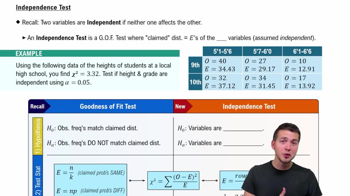
 06:28
06:28