What type of variable is required to construct a confidence interval for a population proportion?
A categorical variable with two possible outcomes (success or failure) is required to construct a confidence interval for a population proportion.
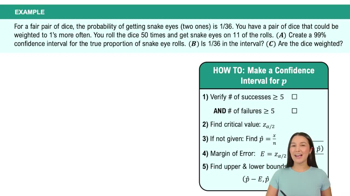
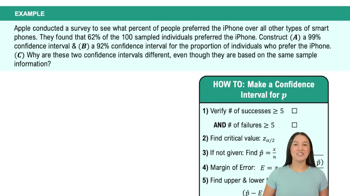
What is the formula for the point estimate p̂ when constructing a confidence interval for a population proportion?
The point estimate p̂ is calculated by dividing the number of successes x by the sample size n. This gives p̂ = x/n.
How do you determine if the sampling distribution of p̂ is approximately normal?
Check that both np and nq are greater than or equal to 5, where n is the sample size and p and q are the proportions of success and failure. This ensures at least 5 successes and 5 failures.
What does the critical z-value zα/2 depend on when constructing a confidence interval for a proportion?
The critical z-value zα/2 depends on the chosen confidence level for the interval. It can be found using a z-table or calculator.
How do you calculate the margin of error for a confidence interval for a population proportion?
The margin of error E is calculated as zα/2 times the square root of p̂(1-p̂)/n. This quantifies the uncertainty around the point estimate.
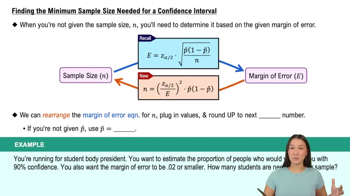
What should you do if the calculated sample size n is a decimal when determining the minimum sample size for a desired margin of error?
You should round up to the next whole number because you cannot sample a fraction of a subject. This ensures the margin of error requirement is met.
What value of p̂ should you use when calculating minimum sample size if p̂ is not provided?
Use p̂ = 0.5 when it is not given, as this yields the largest required sample size for a given margin of error. This is a conservative approach.
Which function on the TI-84 calculator is used to construct a confidence interval for a population proportion?
The '1-PropZInterval' function is used on the TI-84 calculator. It quickly calculates the confidence interval after entering sample data.
How do you interpret the bounds of a confidence interval for a population proportion?
The bounds indicate the range in which you are confident the true population proportion lies. For example, a 90% interval means you are 90% confident the true proportion is between the lower and upper bounds.
What steps are involved in using a TI-84 calculator to find a confidence interval for a population proportion?
First, access the test menu and select the 1-PropZInterval function, then enter the sample data and confidence level. Finally, calculate to view the interval bounds.
 Back
Back
 06:38
06:38